Logistical Challenges and State Procurement of Paddy in Kerala
Source:The Hindu ↗
Why It Matters
This article provides a practical case study for GS3 Agriculture, highlighting the real-world bottlenecks in the procurement supply chain. It illustrates how unseasonal weather affects crop quality, leading to disputes between farmers and millers, and demonstrates the dual pricing mechanism involving Central MSP and State bonuses.
Summary
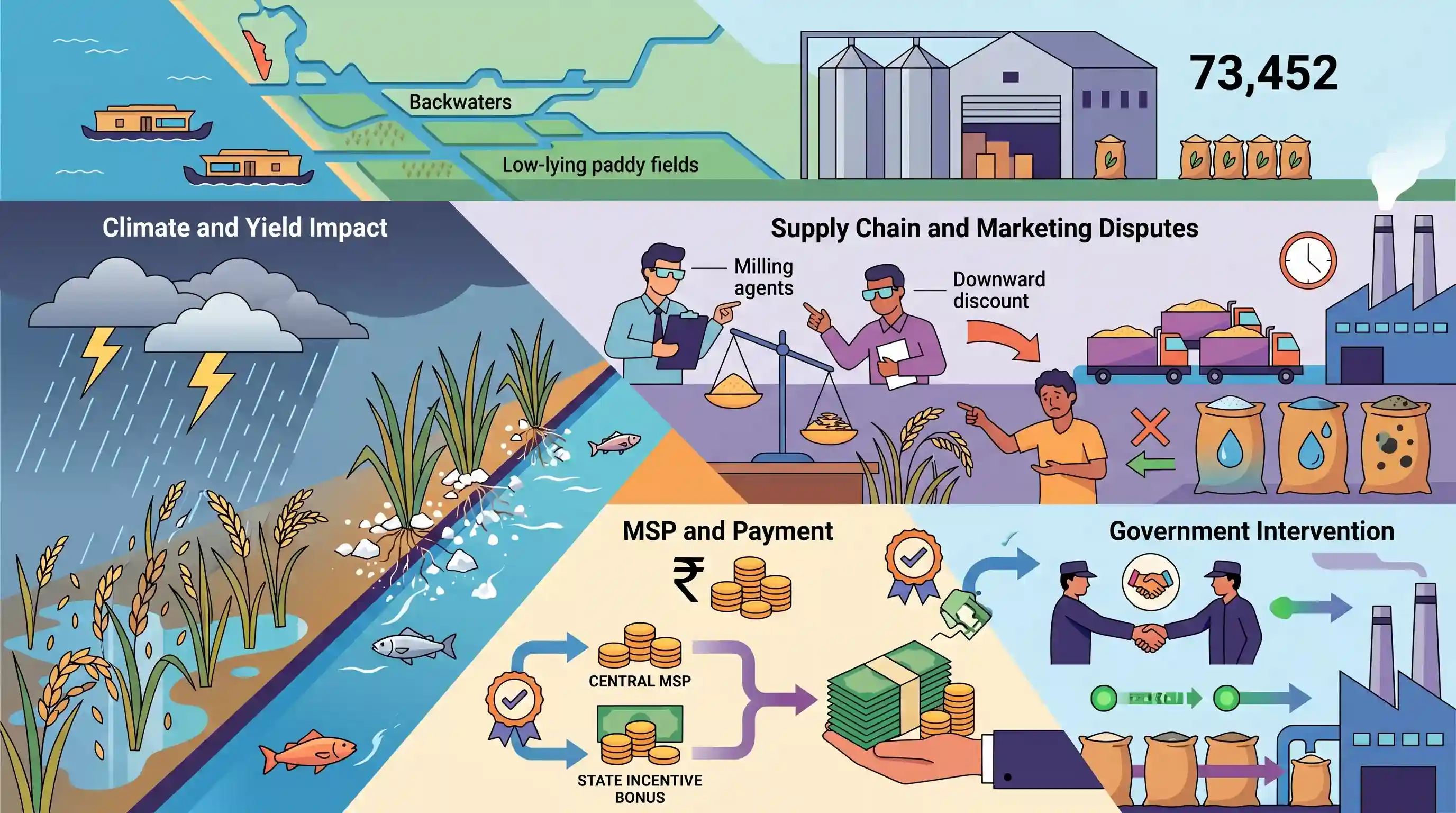
The Kerala State Civil Supplies Corporation (Supplyco) has procured 73,452 tonnes of paddy from farmers in Alappuzha during the puncha season. Despite the procurement, farmers faced severe logistical and financial challenges due to delays by milling agents who demanded steep quantity discounts citing poor grain quality (moisture, chaff, and discoloration) caused by unseasonal summer rains. Furthermore, high salinity in local waterbodies negatively impacted overall paddy yields. The state government intervened by deploying Rapid Response Teams to mediate disputes and facilitated procurement at ₹28.20 per kg, which combines the Central MSP and a State incentive bonus.
Key Points
- Supplyco procured over 73,452 tonnes of paddy in Alappuzha, Kerala, during the puncha crop season.
- Farmers faced significant distress as mill agents delayed procurement, demanding steep discounts (up to 7 kg per quintal) citing high moisture content, chaff, and grain discoloration.
- Unseasonal summer rains exacerbated grain quality issues, while high soil/water salinity in certain areas directly reduced crop yields.
- The procurement price was fixed at ₹28.20 per kg, comprising the Union government's Minimum Support Price (MSP) of ₹23 and the Kerala State government's incentive bonus of ₹5.20.
Important Terms
Minimum Support Price (MSP)

The guaranteed price at which the government purchases crops from farmers to prevent distress sales. It is recommended by the CACP and fixed at 1.5 times the production cost (A2+FL).
UPSC context
GS Paper III (Agriculture). Tests knowledge of price interventions, food security, and agricultural marketing reforms.
Supplyco (Kerala State Civil Supplies Corporation)
The nodal state agency in Kerala responsible for paddy procurement, retail of essential commodities, and implementing the Public Distribution System (PDS) to ensure market stability and food security.
UPSC context
GS Paper III (Supply Chain Management). Relevant for state-level institutional frameworks in food procurement and distribution.
State Incentive Bonus (SIB)
An additional financial supplement provided by the Kerala government over the Central MSP to ensure remunerative prices for paddy farmers, currently making the total procurement price ₹28.20 per kg.
UPSC context
GS Paper III (Subsidies). Covers state-specific fiscal interventions and their impact on farm income and federal agricultural relations.
Decentralized Procurement (DCP)
A system where state agencies (like Supplyco) directly procure, store, and distribute food grains instead of the Food Corporation of India (FCI), with the Centre reimbursing the costs.
UPSC context
GS Paper III (Food Security). Tests understanding of administrative shifts from centralized to localized procurement and logistics.
Rapid Response Teams (RRTs)
Specialized administrative units deployed to mediate disputes between farmers and millers, conducting quality inspections to prevent unfair quantity discounts or procurement delays.
UPSC context
GS Paper II (Governance). Evaluates local administrative mechanisms for grievance redressal and effective public service delivery in agriculture.
Puncha Season
A specific summer paddy cultivation season in Kerala (usually January to May), predominantly in the Kuttanad region, which is highly sensitive to unseasonal rains and salinity.
UPSC context
GS Paper I (Geography/Agriculture). Tests understanding of regional cropping patterns and climatic vulnerabilities of Indian agriculture.
Prelims Trap
"State governments are prohibited from procuring foodgrains at a price higher than the centrally declared Minimum Support Price."
States can and frequently do announce a State Incentive Bonus (SIB) over and above the central MSP to boost local farmer incomes.
Static Concepts Connected
What is the Decentralised Procurement (DCP) Scheme?
- Origin: Introduced in 1997-98 to enhance local procurement, reduce transit costs, and expand MSP reach to non-traditional states.
- Mechanism: State agencies directly procure, scientifically store, and distribute foodgrains for the Targeted Public Distribution System (TPDS).
- Surplus transfer: Only the excess surplus grain, beyond the state's own PDS requirements, is transferred to the FCI's central pool.
Why is Kuttanad's farming system globally significant?
- Below Sea Level: It is one of the few places in the world where farming is practiced 1.2 to 3 meters below sea level.
- GIAHS Status: Recognized by the UN FAO as a Globally Important Agricultural Heritage System (GIAHS) for its unique traditional methods.
- Salinity Management: Relying on structures like the Thanneermukkom Bund to prevent tidal saltwater intrusion from the Arabian Sea into paddy fields.
Cross-Topic Patterns
Climate anomalies vs. FCI procurement norms
Extreme weather pushes grain moisture beyond FCI's 17% limit, triggering distress sales and shifting the burden onto State governments to mediate quality disputes with private millers.
Wetland agriculture and salinity stress
Sea-level rise and unseasonal rains increase water salinity in Kerala's below-sea-level puncha cultivation, threatening crop yields in a GIAHS-designated wetland ecosystem.

Expect a multi-statement prelims question in 2026 combining the Decentralised Procurement Scheme (DCP) and FCI moisture norms.
Linked PYQs · 5
Linked PYQs · 5
- 2018MainsGS3
What do you mean by Minimum Support Price (MSP)? How will MSP rescue the farmers from the low income trap?
- 2020PrelimsGS1
Consider the following statements: 1. In the case of all cereals, pulses and oil-seeds, the procurement at Minimum Support Price (MSP) is unlimited in any State/UT of India. 2. In the case of cereals and pulses, the MSP is fixed in any State/UT at a level to which the market price will never rise. Which of the statements given above is/are correct?
- 2020PrelimsGS1
Which of the following factors/policies were affecting the price of rice in India in the recent past? 1. Minimum Support Price 2. Government's trading 3. Government's stockpiling 4. Consumer subsidies Select the correct answer using the code given below:
- 2025MainsGS3
Elaborate the scope and significance of supply chain management of agricultural commodities in India.
- 2022MainsGS3
What are the main bottlenecks in upstream and downstream process of marketing of agricultural products in India?
