Rajasthan High Court Suo Motu Action on Dome Collapse Risk
Source:scc-online ↗
Why It Matters
The case exemplifies judicial activism through suo motu cognizance to enforce administrative accountability in public infrastructure projects. It highlights critical governance issues regarding the quality, monitoring, and maintenance of state-funded construction by agencies like RSRDC and PWD in Rajasthan, making it highly relevant for RAS exams focusing on state polity and administration.
Summary
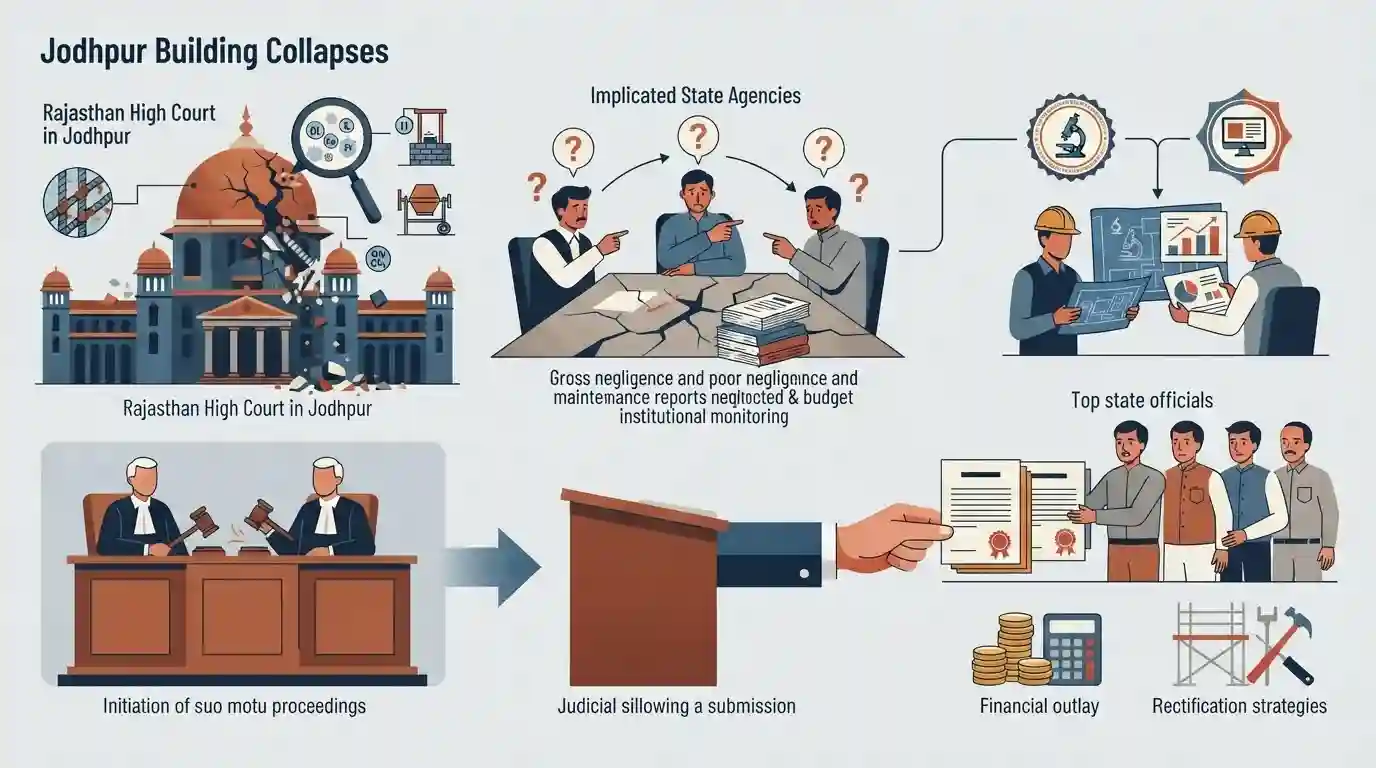
The Rajasthan High Court has taken suo motu cognizance of the imminent structural collapse risk at its Principal Seat building in Jodhpur, specifically concerning the Central Dome. Despite being constructed less than 15 years ago, the building exhibits severe deterioration. Independent structural audits conducted by IIT Bombay and IIT Jodhpur exposed profound systemic failures, including the use of substandard construction practices like high-chloride borewell water, which accelerated reinforcement corrosion and carbonation. A Division Bench strongly criticized the State Government, the Public Works Department (PWD), and the Rajasthan State Road Development and Construction Corporation (RSRDC) for gross negligence, poor institutional monitoring, and inadequate maintenance. The Court has directed top state officials to submit comprehensive affidavits detailing accountability measures, financial outlays, and urgent rectification strategies, underscoring the critical need for quality assurance in public infrastructure projects.
Key Points
- The Rajasthan High Court took suo motu cognizance of the severe structural deterioration of its Principal Seat building in Jodhpur, constructed less than 15 years ago.
- Structural audits by IIT Bombay and IIT Jodhpur identified deep-rooted systemic failures, including the use of high-chloride borewell water during construction, leading to rapid carbonation and reinforcement corrosion.
- The High Court Division Bench strongly criticized the RSRDC and PWD for gross negligence in project execution, quality monitoring, and ongoing maintenance.
- The Court mandated the filing of comprehensive affidavits by top State and RSRDC officials to detail accountability mechanisms, financial liabilities, and immediate structural remediation strategies.
Important Terms
Rajasthan High Court

The supreme judicial authority in Rajasthan, with its Principal Seat located in Jodhpur. It recently exercised suo motu cognizance over severe structural defects and collapse risks in its own building to enforce state accountability.
UPSC context
RPSC RAS GS Paper 2 (Polity): Tests knowledge of the state judiciary, judicial activism, and judicial oversight of executive negligence.
Rajasthan State Road Development and Construction Corporation (RSRDC)
A wholly state-owned enterprise formed in 1979. It serves as the nodal agency responsible for executing and managing major infrastructure projects across Rajasthan, including state highways, bridges, and public buildings.
UPSC context
RPSC RAS GS Paper 2 (Governance): Focuses on public sector enterprises, state agency accountability, and quality control in infrastructure development.
Public Works Department (PWD)
The Rajasthan government's oldest engineering department. It is primarily entrusted with the design, construction, repair, and ongoing maintenance of state roads, bridges, and official government buildings.
UPSC context
RPSC RAS GS Paper 2 (Public Administration): Highlights issues of institutional monitoring, governance transparency, and quality assurance in public works.
Prelims Trap
The Principal Seat of the Rajasthan High Court is located in the state capital, Jaipur.
While Jaipur is the capital, it only hosts a permanent bench. The Principal Seat of the Rajasthan High Court is in Jodhpur.
Static Concepts Connected
What is the historical timeline of the Rajasthan High Court seats?
- Principal Seat: Established in Jodhpur in 1949 under the Rajasthan High Court Ordinance.
- Jaipur Bench Abolition: Abolished in 1958 based on the Satyanarayan Rao Committee recommendations.
- Jaipur Bench Revival: Re-established in 1977 under Section 51(2) of the States Reorganisation Act, 1956.
How does high-chloride water cause structural damage to reinforced concrete?
- Depassivation: Chlorides destroy the protective alkaline passive film that naturally surrounds embedded steel rebars in concrete.
- Volume Expansion: Once exposed, steel rusts. Rust occupies more volume than steel, causing internal pressure.
- Spalling: This pressure causes the surrounding concrete to crack and break away, compromising structural integrity.
Cross-Topic Patterns
Judicial Activism in Infrastructure
Courts increasingly use suo motu powers (Article 226) to enforce executive accountability for infrastructure failures, bridging constitutional polity with public administration.
Applied Science of Concrete Degradation
The article links administrative negligence directly to everyday science. The chemistry of chloride-induced corrosion is a highly testable applied science topic.

Expect a mixed-statement question combining the history of Rajasthan HC seats, RSRDC facts, and the chemistry of chloride corrosion.
Linked PYQs · 3
Linked PYQs · 3
- 2024RPSC_PRELIMSGS1
The size of citizen's character is not –
- 2025RPSC_PRELIMSGS1
What is the main objective of the “Rajasthan Urban Area Development Program (Phase-III)”?
- 2018RPSC_PRELIMSGS1
Which of the following are the important mineral-based industries in Rajasthan? (a) Zinc Smelting Industry (b) Cement Industry (c) Electronic Industry (d) Marble Industry Code:
