Rajasthan High Court Suo Motu Order On Udaipur Lakes
Source:verdictum ↗
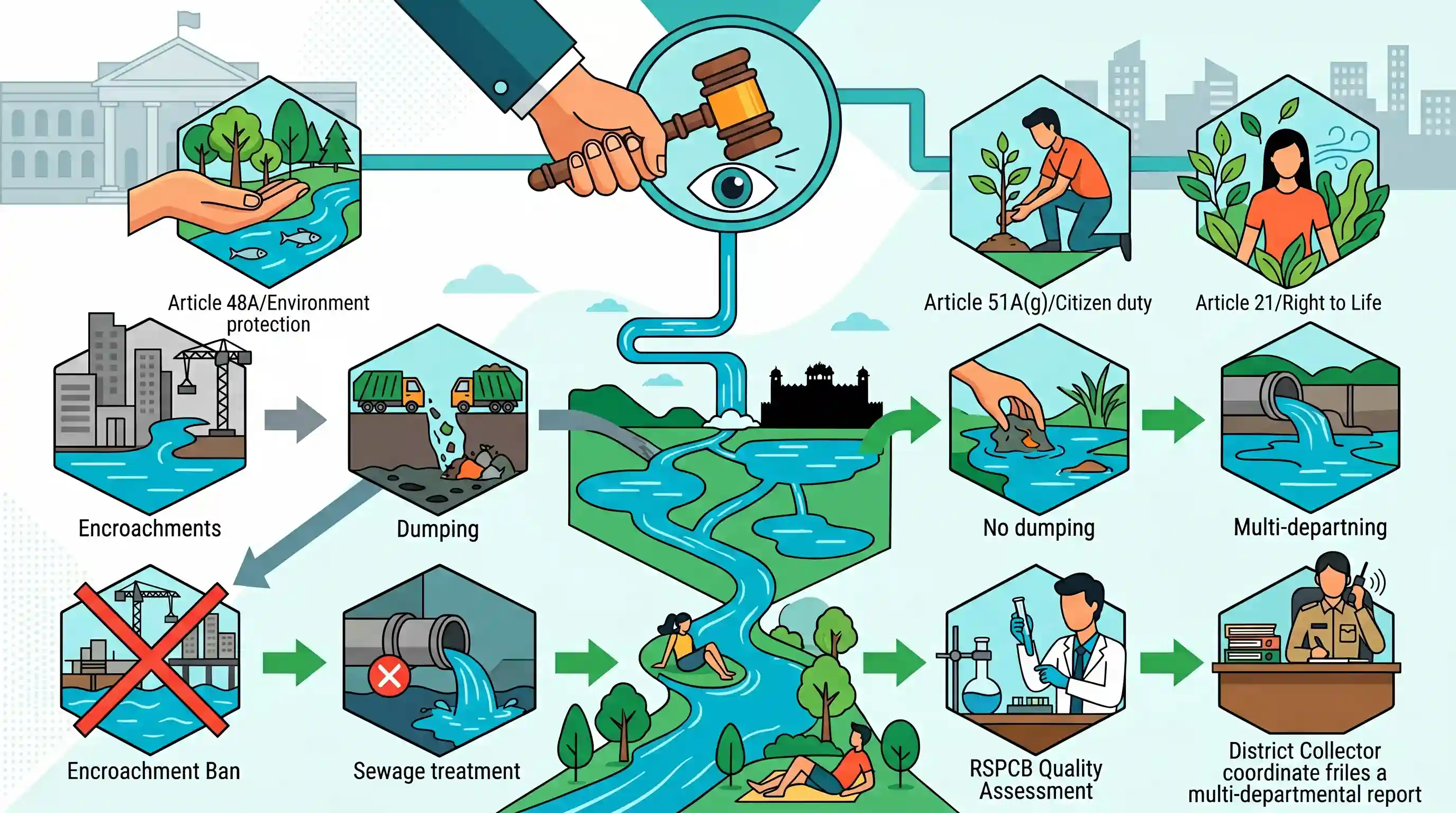
Why It Matters
This judicial intervention highlights the crucial role of Article 226 and constitutional duties in regional environmental governance. It addresses the conservation of Udaipur's vital hydrological ecosystem, emphasizing the balance between tourism development and ecological carrying capacity, which is a repeated theme in Rajasthan's state exams.
Summary
The Rajasthan High Court took suo motu PIL cognizance (CW/12630/2026) regarding the severe environmental degradation, boundary encroachments, and infrastructure failures affecting Udaipur's interconnected lake and canal network. Invoking Article 226, the Division Bench of Justice Pushpendra Singh Bhati and Justice Rekha Borana issued a series of sweeping interim directives to protect these ecological assets. The court grounded its order in Constitutional principles, citing Article 21, Article 48A, Article 51A(g), and the Public Trust Doctrine. Immediate measures include a total ban on further encroachments, dumping, or construction in catchment areas, a prohibition on untreated sewage discharge, and directed water quality assessments by the RSPCB, with the Udaipur District Collector coordinating a comprehensive multi-departmental status report.
Key Points
- The Jodhpur Bench of the Rajasthan High Court took suo motu public interest litigation cognizance (under Article 226) of the ecological degradation, boundary encroachments, and municipal negligence in the interconnected lake ecosystem of Udaipur.
- The division bench of Justice Pushpendra Singh Bhati and Justice Rekha Borana linked lake preservation to India's Constitutional framework: citing Article 21 (Right to a clean environment under Right to Life), Article 48A (DPSP duty of the State to protect environment and lakes), Article 51A(g) (Fundamental Duty of citizens to protect natural environment), and the Public Trust Doctrine.
- Specific water bodies and structural facilities identified in the order include Pichola, Fateh Sagar, Swaroop Sagar, Rang Sagar, Roop Sagar (Rupsagar) Talab, Doodh Talai, Goverdhan Sagar, Badi Lake (Jiyan Sagar), Udai Sagar, Madar Lakes (Bada & Chhota), Kumharia Talab, and the Madar Canal.
- Key issues highlighted were the lack of boundary demarcation at Roop Sagar Talab leading to illegal constructions, structural vulnerabilities in the Madar Canal walls causing flood risks, and over-commercialization/tourism pressure around Fateh Sagar Lake.
- Interim directions prohibit further encroachment, reclamation, dumping, land-filling, or construction in the catchment areas/boundaries of lakes and canals. Status quo must be maintained on lake boundaries, and untreated sewage discharge is banned.
- The Rajasthan State Pollution Control Board (RSPCB) is directed to assess lake water quality, while the Udaipur District Collector is tasked with coordinating across departments to submit a comprehensive consolidated status report.
Important Terms
Public Trust Doctrine

A legal principle establishing that certain natural and cultural resources (like lakes, rivers, and forests) are preserved for public use, making the government the custodian rather than the owner, preventing private ownership or degradation.
UPSC context
GS II (Judiciary) and GS III (Environment); tests understanding of environmental jurisprudence, judicial activism, and resource management.
National Lake Conservation Plan
A centrally sponsored program launched in 2001 to restore and conserve degraded urban and semi-urban lakes through an integrated ecosystem approach, now merged into the National Plan for Conservation of Aquatic Ecosystems (NPCA).
UPSC context
GS III (Environment & Biodiversity); tests knowledge of central schemes for water body restoration and wetland conservation.
Rajasthan State Pollution Control Board
A statutory body corporate constituted under Section 4 of the Water (Prevention and Control of Pollution) Act, 1974, responsible for preventing, controlling, and abating air and water pollution across Rajasthan.
UPSC context
GS III (Environmental Governance); tests understanding of statutory bodies implementing environmental regulations and standards.
Rajasthan High Court
The highest judicial authority in the state of Rajasthan, established on August 29, 1949, under the Rajasthan High Court Ordinance, with its principal seat in Jodhpur and a permanent bench in Jaipur.
UPSC context
GS II (Polity - State Judiciary); tests understanding of the jurisdiction, powers, and landmark rulings of state High Courts.
Constitution of India
The supreme law of India that establishes the country's political framework, fundamental rights, directive principles, and duties of citizens, enabling the judiciary to safeguard public interest and the environment.
UPSC context
GS II (Indian Polity); tests deep understanding of constitutional architecture, fundamental provisions, and judicial review.
State of Rajasthan
The largest state in India by geographical area, located in the northwestern region, characterized by critical ecological challenges such as water scarcity, desertification, and the conservation of fragile lake ecosystems.
UPSC context
GS III (Geography/Environment); tests state-specific awareness of resource scarcity, environmental degradation, and regional development.
Prelims Trap
Udaipur's lake system and its primary outlet, the Ahar River, drain westward into the Arabian Sea drainage basin.
Udaipur's lakes lie in the Berach Basin. The Berach drains into the Banas (Chambal tributary), feeding the Yamuna/Ganga, making it part of the east-flowing Bay of Bengal drainage system.
Static Concepts Connected
What is the Public Trust Doctrine in Indian environmental law?
- Core Premise: Posits that certain natural resources like water bodies are preserved for public use and cannot be subjected to private ownership.
- State's Role: The State acts as a trustee, legally bound to manage and protect these resources for the common public benefit.
- Judicial Landmark: Formally imported into Indian jurisprudence by the Supreme Court in the landmark M.C. Mehta v. Kamal Nath (1997) case.
What is the National Plan for Conservation of Aquatic Ecosystems?
- Origin: Created in 2013 by merging the National Lake Conservation Plan and the National Wetlands Conservation Programme.
- Administrative Authority: Implemented by the Ministry of Environment, Forest and Climate Change on a cost-sharing basis with state governments.
- Conservation Scope: Targets holistic conservation of both lakes and wetlands through water quality monitoring, catchment management, and biodiversity protection.
Cross-Topic Patterns
Judicial Activism vs Municipal Governance
High Court suo motu interventions under Article 226 showcase the judiciary filling the environmental enforcement vacuum left by negligent municipal bodies and state pollution control boards.
Ramsar Sites + Community Conservation
Menar Wetland's Ramsar designation highlights how community-led models (like voluntary local bans on hunting and fishing) succeed where top-down state conservation machinery struggles.

Expect a 2026 question mapping Rajasthan's new Ramsar sites (Menar, Siliserh) to their river basins and community conservation models.
Linked PYQs · 2
Linked PYQs · 2
- 2018RPSC_PRELIMSGS1
Which of the following lakes in Rajasthan does not fall under the ‘National Lake Conservation Program’ (NLCP)?
- 2023RPSC_PRELIMSGS1
Match the following list – P (Directive Principles) with list – R (Article): List – P List – R A. Equal justice and free legal aid I. Article 48 A B. Protection of the environment II. Article 39 A C. Right to work III. Article 41 D. Preservation of monuments IV. Article 49 Choose the correct option: . A B C D
