Ground level ozone and summer air pollution threat in Delhi
स्रोत:इंडियन एक्सप्रेस ↗
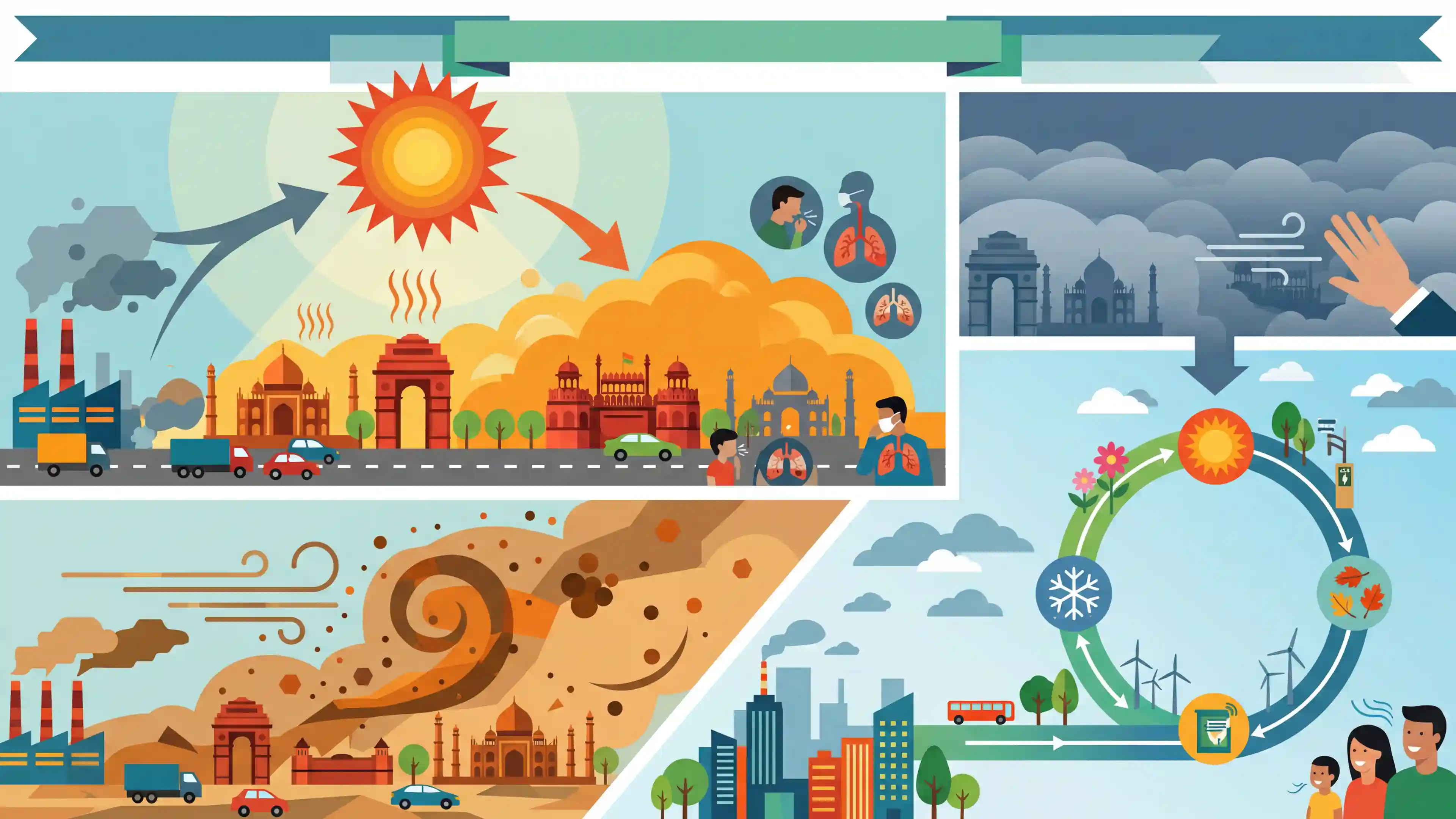
क्यों मायने रखता है
Brings attention to the neglected issue of summer air pollution (specifically ground-level ozone and dust), which is highly relevant for both Prelims (pollutant chemistry/WHO guidelines) and Mains GS-3 (limitations of current environmental policies like NCAP and GRAP).
सारांश
The article highlights the severity of summer air pollution in Delhi, emphasizing that it poses as significant a threat to public health as the more widely recognized winter smog. During summers, high temperatures and intense sunlight facilitate the formation of ground-level ozone—a harmful secondary pollutant—from vehicular and industrial emissions. Additionally, dry weather and regional dust storms sharply increase particulate matter (PM10) levels. The author argues that India's air quality discourse and policy interventions must evolve from episodic, winter-focused reactions to continuous, year-round mitigation strategies.
मुख्य बिंदु
- Summer air pollution in Delhi is critically severe, challenging the popular misconception that hazardous air quality is primarily a winter phenomenon.
- Ground-level ozone emerges as a major summer pollutant; it is a secondary pollutant formed when Nitrogen Oxides (NOx) and Volatile Organic Compounds (VOCs) react in the presence of intense sunlight.
- High temperatures, dry conditions, and regional dust storms significantly elevate the levels of coarse particulate matter (PM10), adding to continuous vehicular and industrial PM2.5 emissions.
- The piece underscores the necessity for a paradigm shift from seasonal, reactionary measures (like winter-centric GRAP enforcement) to year-round, comprehensive air quality management frameworks.
महत्वपूर्ण शब्द
National Clean Air Programme (NCAP)

A 2019 national strategy aiming for a 40% reduction in particulate matter (PM2.5 and PM10) by 2026 across 131 non-attainment cities through city-specific action plans.
UPSC context
GS Paper III: Environmental Pollution. Tests knowledge of national environmental targets and city-level governance.
Graded Response Action Plan (GRAP)
An emergency response framework for Delhi-NCR that triggers specific anti-pollution measures (like construction bans) in stages based on the severity of the Air Quality Index (AQI).
UPSC context
GS Paper III: Environment and Disaster Management. Important for understanding episodic pollution mitigation in urban areas.
Central Pollution Control Board (CPCB)
A statutory organization established in 1974 that serves as India's apex body for monitoring air and water quality and advising the government on pollution control.
UPSC context
GS Paper II: Statutory Bodies. Tests understanding of environmental governance and regulatory frameworks.
Ground-level Ozone
A secondary pollutant formed when nitrogen oxides (NOx) and volatile organic compounds (VOCs) react in the presence of sunlight; it is a major component of summer smog.
UPSC context
GS Paper III: Environment. Tests scientific understanding of secondary pollutants and their seasonal health impacts.
Particulate Matter (PM10)
Inhalable particles with diameters of 10 micrometers or less, often originating from dust, construction sites, and waste burning, which can penetrate the respiratory system.
UPSC context
GS Paper III: Environment. Tests knowledge of specific pollutants and their primary sources in urban India.
प्रारंभिक ट्रैप
Ground-level ozone is a primary pollutant directly emitted by vehicular and industrial exhausts during summer.
Ground-level ozone is a secondary pollutant. It is not emitted directly but formed when NOx and VOCs react in sunlight. Aspirants often confuse it with primary emissions.
संबंधित अवधारणाएँ
What is the difference between classical and photochemical smog?
- Classical Smog: Occurs in cool, humid climates. It is a mixture of smoke, fog, and sulphur dioxide, acting chemically as a reducing mixture.
- Photochemical Smog: Occurs in warm, dry, sunny climates. Formed by the action of sunlight on nitrogen oxides and volatile organic compounds (oxidizing smog).
- Key Components: Major components of photochemical smog include ground-level ozone, nitric oxide, formaldehyde, and Peroxyacetyl Nitrate (PAN).
What are the key targets and mechanisms under the National Clean Air Programme (NCAP)?
- Revised Target: Aims for a 40% reduction in PM2.5 and PM10 concentrations by 2026, using 2017 as the base year for comparison.
- Coverage: Implemented in 131 non-attainment cities that consistently failed to meet National Ambient Air Quality Standards (NAAQS) for five consecutive years.
- Legal Status: It is a collaborative, cross-sectoral scheme, not legally binding, relying on city-specific action plans rather than punitive legal measures.
अंतर-विषय पैटर्न
Aravalli degradation and summer PM10
The destruction of the Aravalli range removes the natural barrier against Thar desert winds, directly exacerbating summer dust storms and PM10 spikes in the NCR region.
UHI effect accelerates ozone formation
Urban Heat Islands (UHI) increase local temperatures, acting as a catalyst for the photochemical reactions between NOx and VOCs, thereby worsening summer ground-level ozone pollution.

Expect a multi-statement question in 2026 comparing the formation conditions and chemical compositions of summer (photochemical) vs winter smog.
संबद्ध PYQ · 2
संबद्ध PYQ · 2
- 2022PrelimsGS1
In the context of WHO Air Quality Guidelines, consider the following statements: 1. The 24-hour mean of PM2.5 should not exceed 15 µg/m³ and annual mean of PM2.5 should not exceed 5 µg/m³. 2. In a year, the highest levels of ozone pollution occur during the periods of inclement weather. 3. PM10 can penetrate the lung barrier and enter the bloodstream. 4. Excessive ozone in the air can trigger asthma. Which of the statements given above are correct?
- 2021MainsGS3
Describe the key points of the revised Global Air Quality Guidelines (AQGs) recently released by the World Health Organisation (WHO). How are these different from its last update in 2005? What changes in India's National Clean Air Programme are required to achieve these revised standards?
