Coalition Politics and Regional Parties Dynamics in Punjab
Source:Indian Express ↗
આ શા માટે મહત્વનું છે
This development is an excellent case study of the friction between national centralization and regional autonomy. It demonstrates how policy decisions taken by the Centre (like the 2020 farm laws) can disrupt long-standing regional-national coalitions and fundamentally alter electoral geography and state-level representation.
સારાંશ
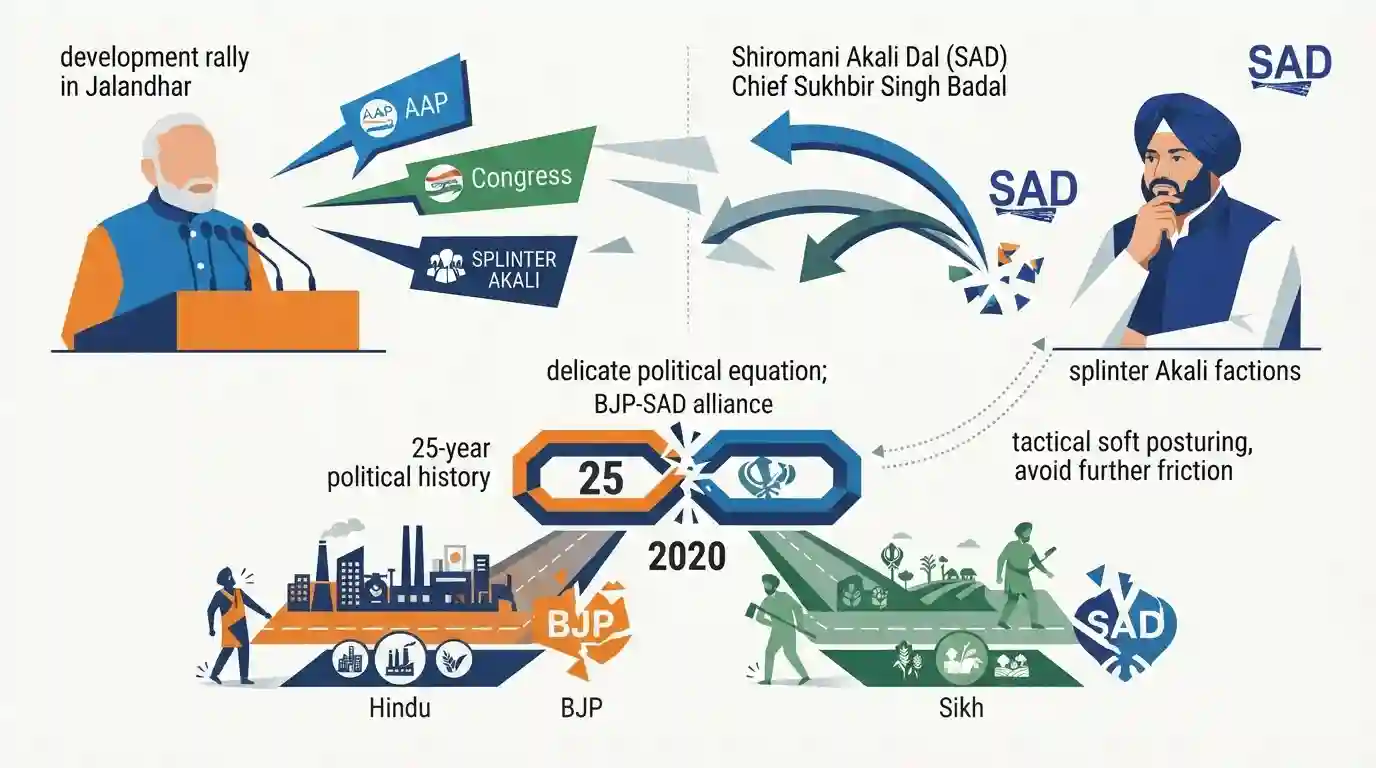
During a development rally in Jalandhar, PM Narendra Modi criticized the 'Akali Dal' alongside the AAP and Congress. In response, Shiromani Akali Dal (SAD) Chief Sukhbir Singh Badal claimed the PM's attack was aimed at smaller splinter Akali factions, rather than the mainstream SAD. This soft posturing highlights the delicate political equation in Punjab. The 25-year BJP-SAD alliance broke down in 2020 over the central farm laws. Since then, both parties have struggled electorally due to the loss of their complementary voter bases (urban Hindu and rural Sikh). While there are no active plans to reunite, Badal's tactical reading of the remark shows a desire to keep communication channels open and avoid further political friction.
મુખ્ય મુદ્દા
- During a development rally in Jalandhar, PM Narendra Modi criticized Punjab's major opposition forces: the ruling AAP as 'kattar beimaan', Congress for endless internal leadership struggles ('kissa kursi ka'), and the 'Akali Dal' for acting out of selfish internal interests rather than serving Punjab.
- In a surprise reaction, Shiromani Akali Dal (SAD) President Sukhbir Singh Badal publicly downplayed the criticism, claiming PM Modi's remarks targeted splinter factions like 'Akali Dal Punar Surjit' rather than the mainstream SAD.
- Political analysts interpret Badal's defensive posture as a deliberate attempt to avoid escalating tensions and to prevent creating permanent political adversaries out of former long-term allies.
- The BJP-SAD alliance, which lasted nearly 25 years and governed Punjab three times, represented a highly successful socio-political coalition combining the SAD's rural Sikh voter base with the BJP's urban Hindu middle-class and trader support.
- The alliance collapsed in 2020 when the SAD walked out of the NDA over the controversial central farm laws. Since the split, both parties have faced significant electoral setbacks, highlighting the critical nature of their previous electoral complementarity.
- While the BJP currently maintains it intends to expand independently in Punjab and there are no active talks of a reunion, public exchanges between the two former allies are closely scrutinized for signs of future political realignments.
મહત્વપૂર્ણ શબ્દો
Central Farm Laws (2020)

A set of three agricultural marketing legislations enacted in 2020 to reform and deregulate farm trade, contract farming, and food stocking, later repealed in 2021 following sustained farmer protests.
UPSC context
GS Paper III (Agriculture) and GS Paper II (Federalism); tests policies on agricultural marketing and Centre-State legislative dynamics.
Shiromani Akali Dal (SAD)
Founded in 1920, it is a prominent regional political party in Punjab that originated from the Gurdwara Reform Movement, primarily championing regional interests, federal autonomy, and the rural Sikh electorate.
UPSC context
GS Paper II (Regional Parties & Federalism) and GS Paper I (Modern History); tests socio-religious movements and regional electoral dynamics.
National Democratic Alliance (NDA)
A right-leaning, BJP-led national political coalition in India formed in 1998, which became a landmark model for stable, multi-party pre-poll alliance governance at the federal level.
UPSC context
GS Paper II (Coalition Politics & Federalism); tests characteristics, challenges, and constitutional dynamics of multi-party coalition governance.
Bharatiya Janata Party (BJP)
Formed in 1980, it is a major national political party in India with a right-wing nationalist ideology, currently leading the central government under the National Democratic Alliance.
UPSC context
GS Paper II (Electoral Dynamics & Governance); tests national party systems, ideology, and political executive structures.
Aam Aadmi Party (AAP)
A national political party in India founded in 2012 following an anti-corruption movement, known for its populist welfare policies and currently governing Delhi and Punjab.
UPSC context
GS Paper II (Electoral Dynamics & Federalism); tests national party criteria, state welfare models, and changing political landscapes.
પ્રિલિમ્સ ટ્રેપ
The 1973 Anandpur Sahib Resolution formally demanded secession from India and the immediate establishment of a sovereign independent Khalistan state.
The resolution demanded radical federal restructuring—limiting the Union to four subjects (Defence, Foreign Affairs, Communications, Currency) and vesting residuary powers in states—not secession.
સંલગ્ન સ્થિર ખ્યાલો
What is the significance of the 1973 Anandpur Sahib Resolution in federalism?
- Radical autonomy: Demanded limiting the Union government's jurisdiction strictly to four areas: Defence, Foreign Affairs, Communications, and Currency.
- Residuary powers: Insisted that all residuary powers should be vested entirely in the individual states, rather than the Centre.
- Commission reference: Served as a critical historical submission during the formulation of the Sarkaria Commission on Centre-State relations.
How did the Punjabi Suba Movement reshape regional geography in 1966?
- Linguistic division: Campaigned for a Punjabi-speaking state, leading to the enactment of the Punjab Reorganisation Act of 1966.
- Trifurcation process: Divided the erstwhile East Punjab into modern Punjab, Hindi-speaking Haryana, and transferred hilly territories to Himachal Pradesh.
- Joint capital: Established Chandigarh as a Union Territory serving as a shared capital for both Punjab and Haryana.
આંતર-વિષય પેટર્ન
Consociationalism & Social Harmony
Coalitions like BJP-SAD bridge demographic divides (urban Hindu/rural Sikh). Their collapse often triggers polarization, showing how electoral politics directly impacts grassroots social cohesion and communal stability.
Regionalism vs. National Integration
Linguistic state reorganizations (like Punjab Suba) show how addressing regional identity demands within the constitutional framework can strengthen national integration rather than weaken it.

The historical trajectory of federalism, from the Anandpur Sahib Resolution to modern farm-law friction, is a high-probability 2026 Mains theme.
સંલગ્ન PYQ · 4
સંલગ્ન PYQ · 4
- 2022MainsGS2
“While the national political parties in India favour centralisation, the regional parties are in favour of State autonomy.” Comment.
- 2024MainsGS2
What changes has the Union Government recently introduced in the domain of Centre-State relations ? Suggest measures to be adopted to build the trust between the Centre and the States and for strengthening federalism.
- 2013MainsGS1
Growing feeling of regionalism is an important factor in generation of demand for a separate State. Discuss.
- 2001PrelimsGS1
Consider the following statements regarding the political parties in India: I. The Representation of the People Act, 1951 provides for the registration of political parties. II. Registration of political parties is carried out by the Election Commission. III. A national level political party is one which is recognised in four or more States. IV. During the 1999 general elections, there were six National and 48 State level parties recognised by the Election Commission. Which of these statements are correct?
