Constitutional Democracy Confronts Exclusionary Nationalist Narratives
Source:Indian Express ↗
Why It Matters
The changing nature of nationalism is a critical theme for UPSC aspirants, bridging GS1 (ideological evolution of the freedom movement and society) and GS2 (constitutionalism, secularism, and democratic governance). It provides essential analytical perspectives for Essay papers on topics related to democracy, citizenship, and the idea of India.
Summary
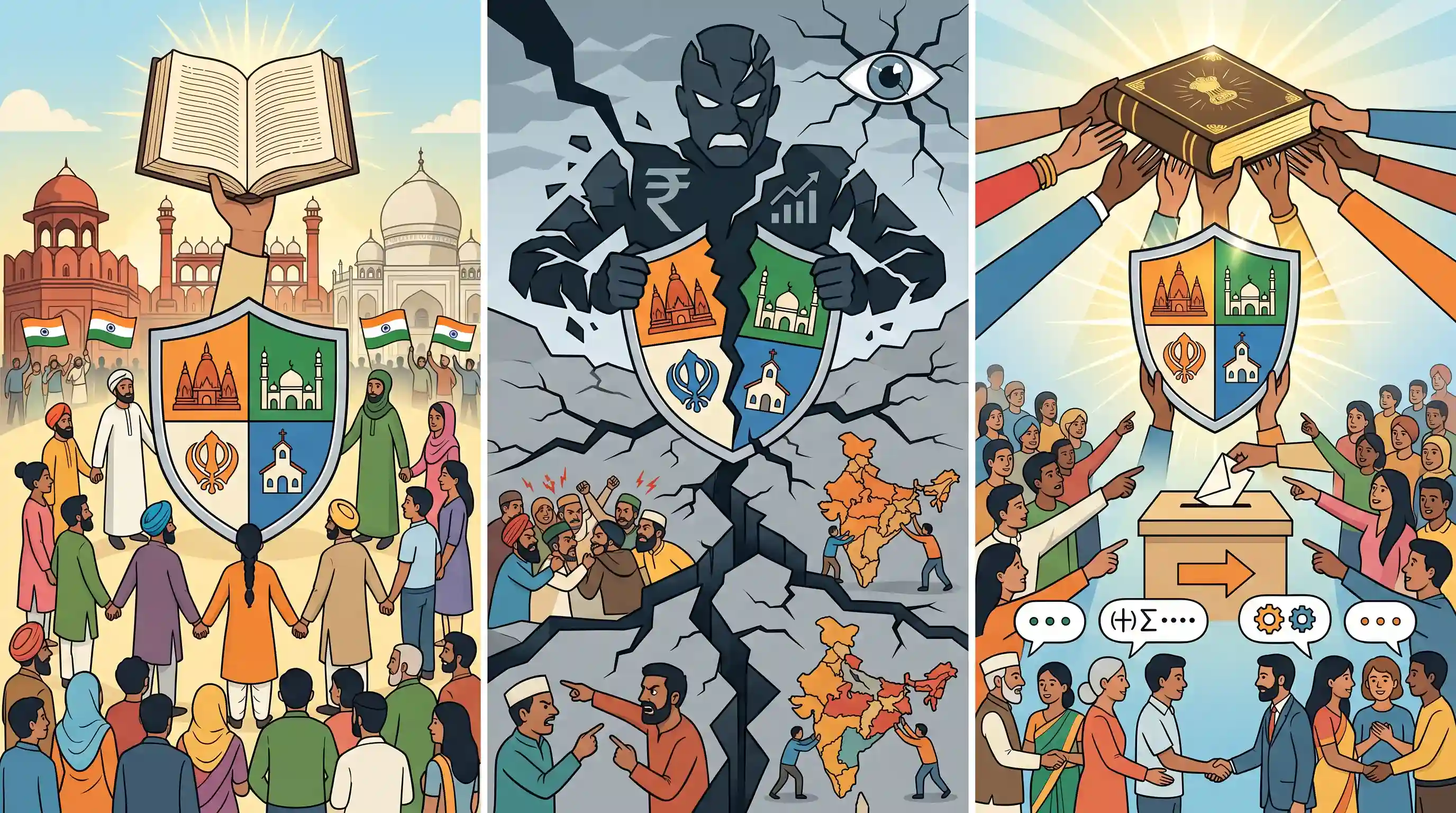
In this opinion piece, Suhas Palshikar discusses the shifting contours of Indian nationalism, highlighting how contemporary political discourse has appropriated the concept through majoritarian and exclusionary ideologies. The article contrasts the inclusive, civic, and anti-colonial nationalism born out of India's freedom struggle with the currently dominant cultural nationalism. This ideological shift undermines constitutional values, pluralism, and secularism, altering the relationship between the state and the citizen. The author makes a case for reclaiming a constitutional nationalism rooted in democratic ideals rather than majoritarian dominance.
Key Points
- The article analyzes the transformation of Indian nationalism from its inclusive, anti-colonial origins during the freedom struggle to a contemporary, exclusionary model.
- It highlights how the concept of nationalism has been appropriated by majoritarian ideologies, often equating national identity with specific cultural or religious markers.
- This ideological shift poses challenges to India's constitutional democracy, pluralism, and the secular fabric of the nation.
- The author emphasizes the need to reclaim a civic, constitutional nationalism based on democratic values and equal citizenship, pushing back against hyper-nationalism.
Important Terms
Constitutional Nationalism

A form of nationalism where national identity is defined by adherence to constitutional principles, democratic values, and civic rights rather than shared ethnicity or religion.
UPSC context
GS Paper II: Constitution/Evolution. Tests understanding of India’s foundational identity vs. contemporary exclusionary ideologies.
Cultural Nationalism
National identity rooted in shared cultural traditions, language, or religion. It often seeks a monolithic national narrative, contrasting with civic or inclusive models.
UPSC context
GS Paper I: Indian Society. Evaluates the impact of cultural homogenisation on pluralism and minority rights.
Majoritarianism
A political framework where the majority community (religious or ethnic) asserts dominance, often leading to policies that marginalize minority groups and undermine pluralism.
UPSC context
GS Paper I & II: Communalism/Governance. Analyzes challenges to the social fabric and democratic accountability.
Secularism (Indian Model)
The Indian model (Sarva Dharma Sama Bhava) emphasizing equal respect for all religions and state neutrality, rather than a strict Western separation of church and state.
UPSC context
GS Paper II: Basic Structure. A core constitutional value frequently tested regarding its unique practice in India.
Pluralism
A social system where diverse religious, linguistic, and ethnic groups coexist, maintaining their unique identities while participating in a unified national life.
UPSC context
GS Paper I: Salient features of Indian Society. Tests knowledge on managing diversity and social harmony.
Constitutionalism
The principle that government authority is derived from and limited by a fundamental law (the Constitution), ensuring rule of law and individual liberties.
UPSC context
GS Paper II: Polity. Focuses on the limitation of state power and the protection of citizen rights.
Prelims Trap
"Indian secularism strictly separates religion and state to prevent majoritarian dominance."
India follows 'principled distance' and 'Sarva Dharma Samabhava', intervening in religious matters when necessary, unlike the strict separation in the Western model.
Static Concepts Connected
What distinguishes civic nationalism from cultural nationalism?
- Civic Nationalism: Anchored in shared citizenship, constitutional values, and equal political rights regardless of ethnic, racial, or religious background.
- Cultural Nationalism: Defines the nation through shared heritage, language, religion, or ethnicity, which often demands assimilation and can lead to exclusionary policies.
What is the core principle of Constitutionalism?
- Limited Government: Dictates that government power is legally limited by a constitution, preventing the arbitrary or majoritarian abuse of power.
- Rights Protection: Ensures that fundamental individual and minority rights are permanently shielded from the shifting preferences of the electoral majority.
Cross-Topic Patterns
Preamble values + Basic Structure Doctrine
Secularism is a basic structure of the Constitution (S.R. Bommai case). The rise of exclusionary cultural nationalism directly tests these non-amendable tenets of Indian democracy.
UCC + Cultural Assimilation vs Integration
The cultural nationalism debate overlaps heavily with the Uniform Civil Code discourse, exposing the deep tension between national integration (Article 44) and minority cultural rights (Article 29).

Expect a GS1 Mains question asking to contrast India's anti-colonial civic nationalism with contemporary majoritarian cultural nationalism.
Linked PYQs · 5
Linked PYQs · 5
- 2012MainsGS1
The Indian independence movement was a mass-based movement that encompassed various sections of society. It also underwent the process of constant ideological evolution." Critically examine.
- 2020MainsGS1
Since the decade of the 1920s, the national movement acquired various ideological strands and thereby expanded its social base. Discuss.
- 2018MainsGS1
How the Indian concept of secularism is different from the western model of secularism? Discuss.
- 2018MainsGS1
Communalism arises either due to power struggle or relative deprivation.' Argue by giving suitable illustrations.
- 2024MainsGS2
Discuss India as a secular state and compare with the secular principles of the US constitution.
