Sugam Parivahan Seva: Electric Buses Launched in Madhya Pradesh
Source:ummid ↗
Why It Matters
The revival of a state-backed public transportation system after a 21-year gap is a major public policy shift in Madhya Pradesh. This is highly relevant for MPPSC Prelims given the specific focus on state-level welfare schemes, urban infrastructure, and environmental initiatives.
Summary
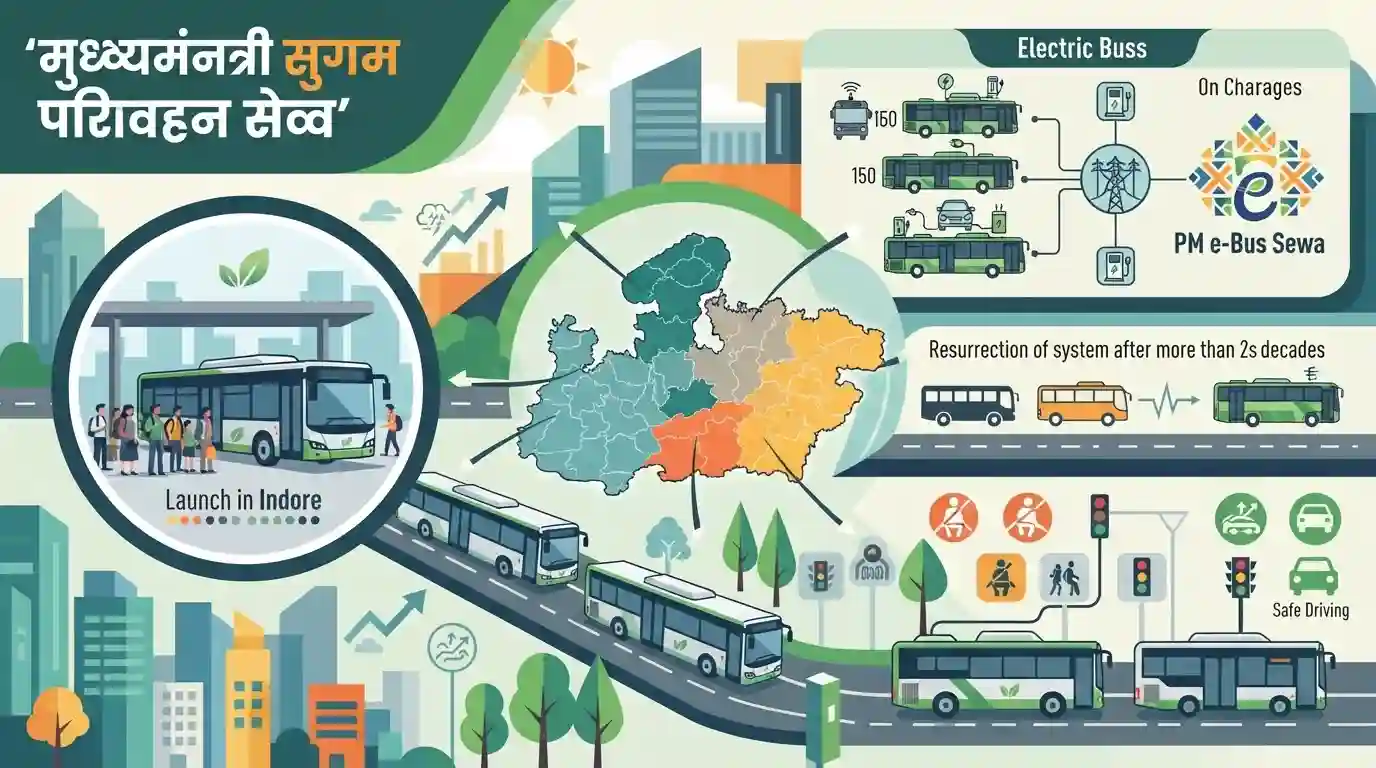
Madhya Pradesh will resurrect its state-run public transport system after more than two decades with the launch of the 'Mukhyamantri Sugam Parivahan Seva'. Scheduled to deploy over 5,200 buses statewide across seven zones, the scheme will debut its first phase in Indore. It prominently features the roll-out of 150 electric buses supported by the Central government's PM e-Bus Sewa, integrating eco-friendly transit and robust road safety measures.
Key Points
- The Madhya Pradesh government is re-establishing state-run public transportation with the 'Mukhyamantri Sugam Parivahan Seva', effectively replacing the MPSRTC which shut down 21 years ago.
- The initiative involves rolling out over 5,200 buses across seven designated transport zones in the state (Indore, Ujjain, Bhopal, Jabalpur, Sagar, Gwalior, Rewa).
- Phase 1 launches in July 2026 in the Indore region, operated by AICTSL, and features 150 electric buses allocated under the Central government's PM e-Bus Sewa scheme.
- The deployment prioritizes road and women's safety, aligning with the Motor Vehicles Act, 1988, and adheres to IRDAI guidelines for electric vehicle insurance.
Important Terms
Mukhyamantri Sugam Parivahan Seva

A Madhya Pradesh state initiative to reintroduce government-operated public transport after 21 years. It deploys over 5,200 buses across seven transport zones via a PPP model, including electric buses, ensuring modern and efficient statewide connectivity.
UPSC context
GS-2/GS-3; Tests knowledge of state-level welfare schemes, public-private partnerships (PPP), and urban-rural infrastructure development.
PM e-Bus Sewa
A Union Cabinet-approved scheme deploying 10,000 electric buses across Indian cities on a Public-Private Partnership model. It promotes sustainable urban mobility by integrating accessible bus stops, last-mile connectivity, and dedicated charging infrastructure.
UPSC context
GS-3; Focuses on electric vehicle adoption, greenhouse gas emission reduction, and green urban mobility initiatives.
Motor Vehicles Act, 1988
The principal central legislation regulating road transport vehicles in India. It governs the issuance of route permits and operational guidelines for both private operators and state initiatives like the Sugam Parivahan Seva.
UPSC context
GS-2; Evaluates understanding of statutory and regulatory frameworks concerning road safety, public administration, and transport compliance.
Madhya Pradesh State Road Transport Corporation (MPSRTC)
The former state-owned public transport entity of Madhya Pradesh. It was shut down in 2005 due to financial losses, leaving a 21-year gap in large-scale government-run bus services before the new scheme's launch.
UPSC context
GS-3; Relevant for studying public sector enterprise reforms, fiscal management, and the evolution of public service delivery.
Atal Indore City Transport Service Limited (AICTSL)
A specialized transport agency managing Indore's city bus services. It will oversee the first phase of the Sugam Parivahan Seva rollout, managing the deployment of 150 new electric buses across identified urban routes.
UPSC context
GS-2; Highlights localized institutional mechanisms and Special Purpose Vehicle (SPV) models for efficient urban transport governance.
Prelims Trap
"PM e-Bus Sewa provides fully-funded electric buses to all urban centers and smart cities."
It operates on a PPP model (not direct state ownership) and strictly targets cities with a 3 lakh+ population, prioritizing those without existing organized bus networks.
Static Concepts Connected
What are the core components of the PM e-Bus Sewa scheme?
- PPP Model: Deploys 10,000 electric buses on a Public-Private Partnership (PPP) basis, providing central assistance for operational costs.
- City eligibility: Targets cities with a population of 3 lakh and above (2011 Census), prioritizing those currently lacking organized bus services.
- Infrastructure support: Funds the development of green urban mobility initiatives, bus depots, and behind-the-meter power infrastructure for EV charging.
How is public road transport governed constitutionally and legally in India?
- Concurrent List: "Mechanically propelled vehicles" fall under the Concurrent List (List III) of the Seventh Schedule.
- RTC Act 1950: A central legislation that provides the statutory framework for establishing State Road Transport Corporations (SRTCs).
- MVA 1988: The central Motor Vehicles Act (1988) regulates vehicle permits, traffic safety rules, and mandates third-party insurance.
Cross-Topic Patterns
EV subsidies & Urban Governance
Transitioning to electric transit relies on PPPs as urban local bodies lack upfront capital. PM e-Bus Sewa subsidizes per-kilometer operations, shifting acquisition and maintenance risks to private operators.
State capacity via PPP models
MP reviving its state transport after two decades using an aggregator PPP model highlights a broader governance shift from state-as-operator to state-as-regulator in public utilities.

Expect a multi-statement prelims question combining PM e-Bus Sewa's PPP model, city-population criteria, and broader EV mobility targets.
Linked PYQs · 2
Linked PYQs · 2
- 2023MPPSC_PRELIMSGS1
Which of the following statements is not correct regarding the roadways of Madhya Pradesh according to Basic Road Statistics 2018-19?
- 2024MPPSC_PRELIMSGS1
UNNATI (Agri-GISl project of Madhya Pradesh Government is for :
