Suez Canal Offers Toll Discounts to Revive Red Sea Shipping Route
Source:Indian Express ↗
Why It Matters
The Red Sea crisis illustrates how localized geopolitical conflicts can paralyze critical global maritime chokepoints like the Suez Canal and Bab-el-Mandeb. This directly impacts India's strategic interests, energy security, and international trade costs, underscoring the necessity of robust maritime security frameworks.
Summary
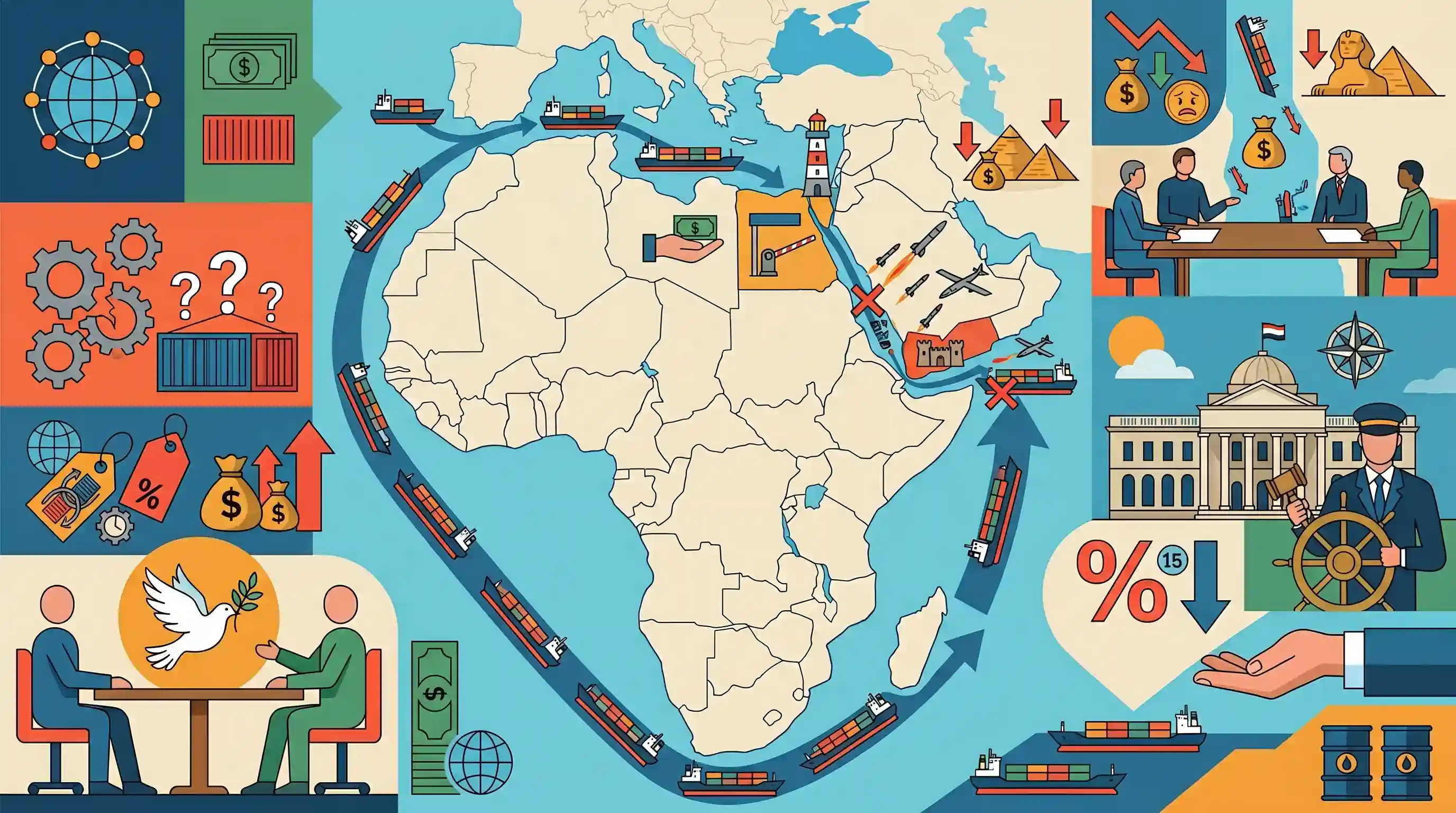
The Suez Canal Authority is offering a 15% toll discount to lure cargo ships back to the Red Sea route amid reports of a potential US-Houthi ceasefire. The vital maritime corridor had seen a massive drop in traffic as shipping companies diverted vessels around the Cape of Good Hope to avoid attacks by Houthi rebels. This geopolitical crisis has caused significant disruptions to global supply chains, sharply increased international shipping costs, and severely dented Egypt's economy by slashing its canal revenues.
Key Points
- The Suez Canal Authority has announced a 15% toll discount to incentivize cargo ships to return to the Red Sea route.
- Maritime traffic had plummeted as major shipping lines diverted vessels around the Cape of Good Hope to avoid persistent attacks by Yemen-based Houthi rebels.
- The discount aligns with reports of a potential US-Houthi ceasefire, which could restore security to the critical Bab-el-Mandeb maritime chokepoint.
- The prolonged crisis has severely impacted global supply chains by inflating freight costs and elongating transit times, while drastically reducing Egypt's crucial foreign exchange earnings from canal tolls.
Important Terms
Bab-el-Mandeb Strait

A strategic strait connecting the Red Sea to the Gulf of Aden; it is the southern gateway for ships entering the Suez Canal.
UPSC context
GS Paper-I (Geography) and Paper-II (IR). Tests knowledge of maritime navigation, mapping, and geopolitical significance of West Asian waterways.
Houthi Movement (Ansar Allah)
A Shia militant and political organization from Yemen that attacks international shipping in the Red Sea to influence regional conflicts.
UPSC context
GS Paper-II (International Relations). Relevant for discussing non-state actors, West Asia's power dynamics, and India’s maritime security interests.
Suez Canal Authority (SCA)
The Egyptian state-owned agency responsible for operating the Suez Canal, managing transit tolls, maintenance, and international competitiveness of the waterway.
UPSC context
GS Paper-III (Economy). Critical for understanding economic impacts of trade disruptions and transit revenue in regional national budgets.
Maritime Chokepoint
Strategic, narrow geographic passages (like canals or straits) where large volumes of global trade pass, making them vulnerable to disruption.
UPSC context
GS Paper-I (Geography) and GS Paper-III (Security). Tests understanding of supply chain vulnerabilities and protecting International Shipping Lanes.
Cape of Good Hope Route
A maritime route around the southern tip of Africa used as the primary, albeit longer and costlier, alternative to the Suez Canal.
UPSC context
GS Paper-I (Geography) and Paper-III (Economy). Relates to global trade logistics shifts and freight inflation during maritime crises.
Prelims Trap
The Bab-el-Mandeb Strait connects the Red Sea directly to the Persian Gulf.
Bab-el-Mandeb connects the Red Sea to the Gulf of Aden. The Strait of Hormuz connects the Persian Gulf to the Gulf of Oman. UPSC often swaps these in map-based questions.
Static Concepts Connected
What are the critical maritime chokepoints around the Arabian Peninsula?
- Bab-el-Mandeb: Connects the Red Sea to the Gulf of Aden. It is flanked by Yemen on the Asian side and Djibouti/Eritrea on the African side.
- Strait of Hormuz: Connects the Persian Gulf to the Gulf of Oman. It is bounded by Iran to the north and Oman/UAE to the south; vital for global oil transit.
- Suez Canal: An artificial sea-level waterway in Egypt linking the Red Sea to the Mediterranean Sea, separating the African continent from Asia.
What are India's proposed alternative trade corridors to Europe bypassing the Suez?
- IMEC: India-Middle East-Europe Economic Corridor, combining ship-to-rail networks from India through UAE, Saudi Arabia, Jordan, and Israel to European ports.
- INSTC: International North-South Transport Corridor, a multi-modal transit network moving freight from India via Iran and Russia to Europe, completely bypassing the Red Sea.
Cross-Topic Patterns
Supply chains and India's export inflation
The shift to the Cape of Good Hope raises freight rates, directly hurting the price competitiveness of Indian engineering goods, textiles, and agricultural exports in key European markets.
Indian Navy's expanding maritime footprint
Houthi drone attacks and parallel Somali piracy have prompted the Indian Navy to aggressively deploy guided-missile destroyers, cementing its role as a net security provider in the Western Indian Ocean.

Expect a multi-statement map question in 2026 pairing Middle East chokepoints (Bab-el-Mandeb, Hormuz) with their exact bordering nations.
Linked PYQs · 4
Linked PYQs · 4
- 2025MainsGS3
Why is maritime security vital to protect India's sea trade? Discuss maritime and coastal security challenges and the way forward.
- 2025MainsGS2
"Energy security constitutes the dominant kingpin of India's foreign policy, and is linked with India's overarching influence in Middle Eastern countries.” How would you integrate energy security with India's foreign policy trajectories in the coming years?
- 2024PrelimsGS1
Consider the following statements : Statement-I : Sumed pipeline is a strategic route for Persian Gulf oil and natural gas shipments to Europe. Statement-II : Sumed pipeline connects the Red Sea with the Mediterranean Sea. Which one of the following is correct in respect of the above statements?
- 2024MainsGS2
Discuss the geopolitical and geostrategic importance of Maldives for India with a focus on global trade and energy flows. Further also discuss how this relationship affects India's maritime security and regional stability amidst international competition ?
