Sudan Paramilitary Attack in Darfur Highlights Ongoing Conflict Crisis
Source:Indian Express ↗
Why It Matters
The conflict in Sudan holds strategic significance due to the country's location near the Red Sea and the Horn of Africa. The mention of specific conflict zones like Darfur and el-Fasher is highly relevant for UPSC Prelims 'Places in News' geography mapping questions. Furthermore, the humanitarian crisis and allegations of war crimes tie into GS2 topics concerning international institutions (UN, ICC) and human rights.
Summary
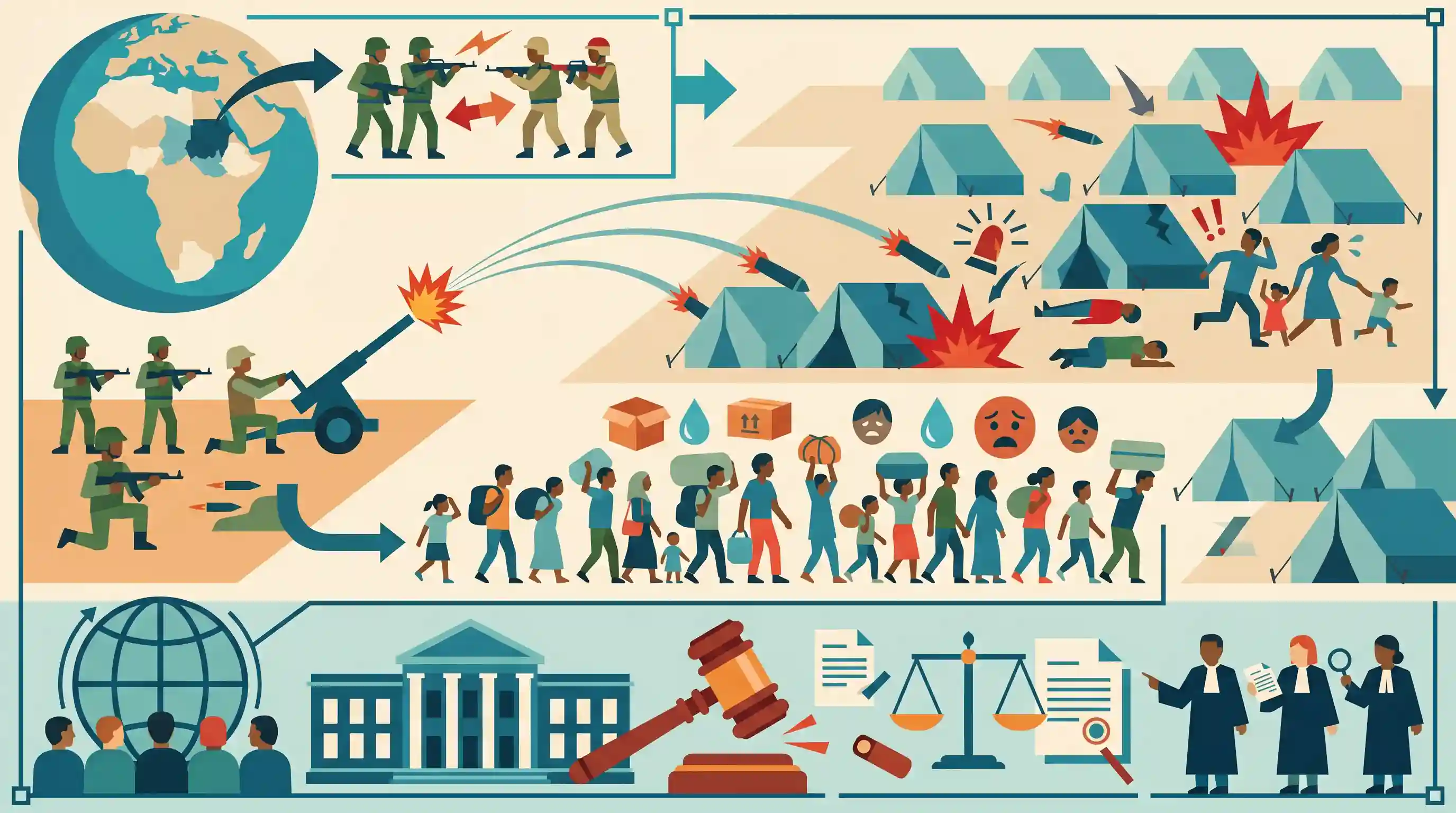
Sudan's paramilitary Rapid Support Forces (RSF) launched an artillery attack on a camp for displaced persons in North Darfur, killing 13 people, including women and children. This attack is part of the broader civil war in Sudan that erupted between the national military and the RSF, resulting in a severe humanitarian crisis with thousands dead and millions displaced. The ongoing atrocities in the Darfur region have drawn international condemnation, with the International Criminal Court investigating potential war crimes and crimes against humanity committed by both factions.
Key Points
- Sudan's paramilitary Rapid Support Forces (RSF) attacked the Abu Shouk camp in North Darfur, killing at least 13 civilians, mostly women and children.
- The incident is part of an ongoing civil war between the Sudanese military, led by Gen. Abdel Fattah Burhan, and the RSF, commanded by Gen. Mohammed Hamdan Dagalo.
- The conflict has devastated Sudan, leading to over 14,000 deaths and displacing more than 8 million people globally.
- The International Criminal Court prosecutor stated there are credible grounds to believe both sides have committed war crimes and crimes against humanity in Darfur.
Important Terms
Rapid Support Forces (RSF)

A Sudanese paramilitary group formed in 2013 from the Janjaweed militias. Led by Mohamed Hamdan Dagalo, it is currently engaged in a civil war against the national military for control of Sudan.
UPSC context
GS Paper 2: International Relations; important for understanding global conflict dynamics and 'Places in News' like Darfur.
Sudanese Armed Forces (SAF)
Sudan's official national military, led by General Abdel Fattah al-Burhan. It has been the primary state actor in the country's governance and conflicts since the 2019 and 2021 coups.
UPSC context
GS Paper 2: International Relations; tests knowledge of state vs. non-state actors in geopolitical crises.
International Criminal Court (ICC)
The world's first permanent international criminal court, based in The Hague. It prosecutes individuals for genocide, war crimes, crimes against humanity, and the crime of aggression when national courts fail.
UPSC context
GS Paper 2: Important International institutions; focuses on jurisdiction, the Rome Statute, and India’s non-party status.
Rome Statute
The 1998 treaty that established the International Criminal Court. It defines the court's functions, structure, and jurisdiction over the four core international crimes. Sudan is a signatory but has not ratified it.
UPSC context
GS Paper 2: International Treaties; relevant for understanding the legal basis of international justice and sovereignty issues.
Darfur
A region in western Sudan that has faced decades of ethnic violence and humanitarian crises. It is currently a major flashpoint in the conflict between the RSF and SAF.
UPSC context
GS Paper 1: World Geography; frequently appears in 'Places in News' due to ongoing humanitarian and security issues.
Janjaweed
Arab-dominated militias active in Darfur since the early 2000s, notorious for atrocities against non-Arab groups. They served as the predecessor and primary recruitment base for the modern-day RSF.
UPSC context
GS Paper 1/2: History and IR; provides essential background for understanding the roots of the Sudanese civil war.
Prelims Trap
"The International Criminal Court (ICC) is an organ of the United Nations."
Aspirants often confuse the ICC with the ICJ. The ICJ is the UN's principal judicial organ; the ICC is an independent treaty-based entity (Rome Statute).
Static Concepts Connected
How does the International Criminal Court differ from the ICJ?
- Jurisdiction: The ICC prosecutes individuals for war crimes and genocide, while the ICJ settles legal disputes submitted by recognized member states.
- UN Affiliation: ICJ is the primary judicial organ of the UN. The ICC is an independent body established by the 1998 Rome Statute.
- India's Status: India is a member of the ICJ (via UN membership) but has not signed the Rome Statute and is therefore not an ICC member.
What is the geographical significance of Sudan and the Darfur region?
- Strategic Borders: Sudan borders seven nations (Egypt, Libya, Chad, CAR, South Sudan, Ethiopia, Eritrea), acting as a critical geopolitical bridge between North and Sub-Saharan Africa.
- Red Sea Coast: Sudan's eastern coastline along the Red Sea gives it outsized importance for global maritime trade and chokepoint security.
- Darfur Region: Located in western Sudan bordering Chad, Darfur is a vast, semi-desert region characterized by long-standing ethnic conflicts and severe resource scarcity.
Cross-Topic Patterns
Proxy militias evolving into state threats
The RSF's evolution from Janjaweed border militias into a force rivaling the national army mirrors global trends where state-backed paramilitaries eventually challenge sovereign state control.
Red Sea maritime security complex
Sudan's internal collapse adds a western-flank vulnerability to the Red Sea, compounding regional maritime risks alongside Yemen's Houthi rebels and piracy off the Horn of Africa.

Expect a 2026 Prelims map question pairing Darfur, el-Fasher, or the broader Sahel region with their respective countries or conflicts.
Linked PYQs · 3
Linked PYQs · 3
- 2023PrelimsGS1
Consider the following pairs: Area of conflict mentioned in news Country where it is located 1. Donbas : Syria 2. Kachin : Ethiopia 3. Tigray : North Yemen How many of the above pairs are correctly matched?
- 2015PrelimsGS1
Amnesty International is
- 2022PrelimsGS1
The term "Levant" often heard in the news roughly corresponds to which of the following regions?
