Tribal Women Succession Rights and Legal Frameworks
Source:Indian Express ↗
Why It Matters
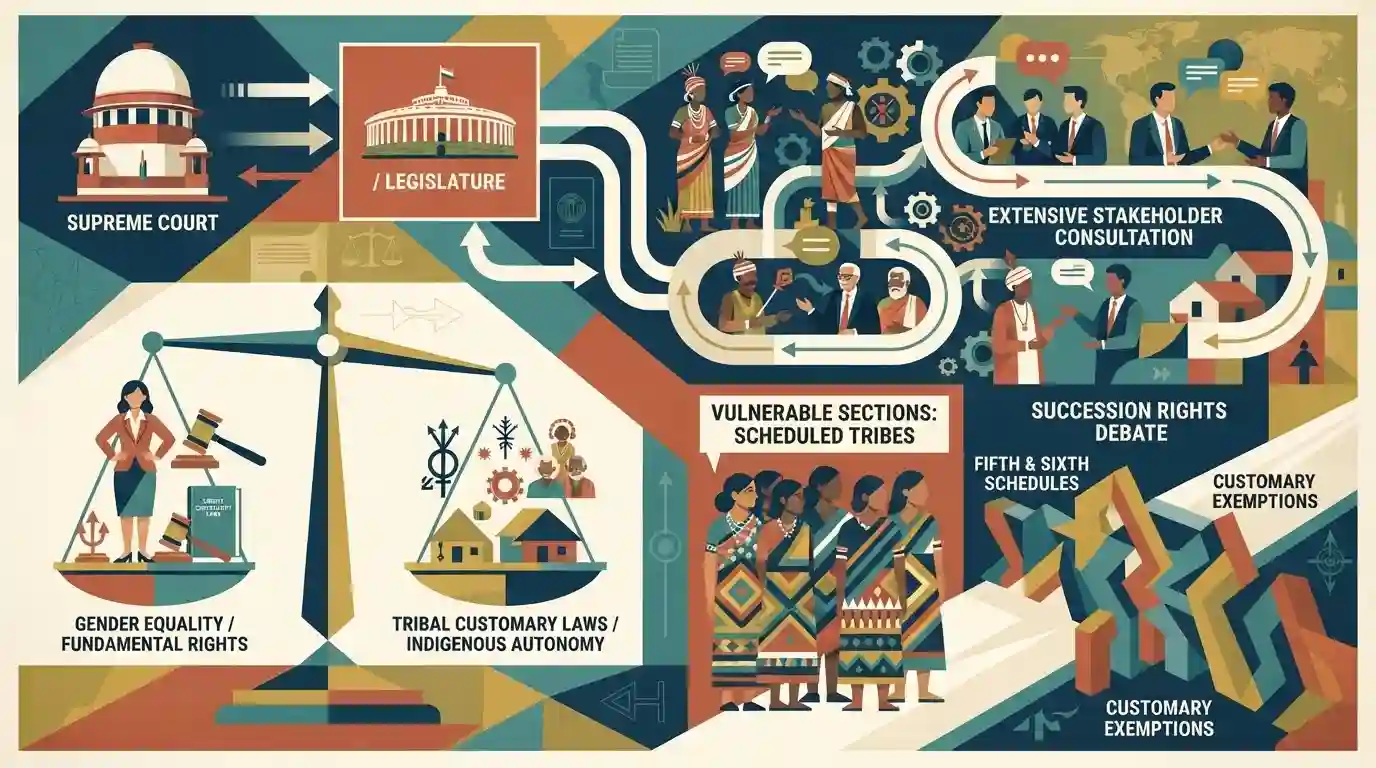
This issue brings to the fore the conflict between constitutional mandates of gender equality and the protection of indigenous customary laws and tribal autonomy, a recurring theme in Indian governance and constitutional law.
Summary
The Supreme Court and the Centre addressed the complex legal issue of succession rights for Scheduled Tribe women in India, who are historically exempt from central laws like the Hindu Succession Act. While balancing gender equality against tribal customary laws and constitutional protections under the Fifth and Sixth Schedules requires extensive stakeholder consultation, the debate highlights the tension between fundamental rights and indigenous autonomy.
Key Points
- The Supreme Court examined a plea seeking property and succession rights for Scheduled Tribe (ST) women, noting that tribal women are currently excluded from the purview of the Hindu Succession Act.
- The Centre submitted that wide-ranging consultations with tribal communities across states are necessary before making sweeping changes to customary laws governing tribal succession.
- Customary laws among various tribal groups heavily govern property inheritance, which often follows patriarchal lines despite diverse indigenous practices.
- Balancing constitutional guarantees of gender equality with the protection of indigenous customs, autonomy, and cultural identity under the Fifth and Sixth Schedules presents a complex legal challenge.
Important Terms
Hindu Succession Act

A 1956 central legislation governing intestate succession among Hindus, Buddhists, Jains, and Sikhs, which explicitly exempts Scheduled Tribes unless notified otherwise by the Central Government.
UPSC context
GS Paper II (Polity & Governance / Vulnerable Sections); tests statutory exemptions, gender equality, and tribal rights.
Fifth Schedule
Constitutional provision under Article 244(1) governing Scheduled Areas and Scheduled Tribes in states other than Assam, Meghalaya, Tripura, and Mizoram, focusing on resource protection and tribal welfare.
UPSC context
GS Paper II (Indian Constitution - Features & Federalism); tests administrative safeguards and tribal autonomy.
Sixth Schedule
Constitutional provision under Article 244(2) establishing Autonomous District Councils (ADCs) for tribal areas in Assam, Meghalaya, Tripura, and Mizoram with legislative and judicial powers.
UPSC context
GS Paper II (Governance & Federalism); tests regional autonomy, local self-governance, and customary laws in Northeast India.
Static Concepts Connected
What are the constitutional provisions governing Scheduled Areas and tribal autonomy in India?
- Fifth Schedule: Article 244(1) provisions apply administration and control of Scheduled Areas and Scheduled Tribes in any State other than Assam, Meghalaya, Tripura, and Mizoram to the Fifth Schedule.
- Sixth Schedule: Article 244(2) provisions apply to the administration of tribal areas in the states of Assam, Meghalaya, Tripura, and Mizoram through Autonomous District Councils (ADCs) under the Sixth Schedule.
- Customary Laws: Tribal customary laws regarding marriage, inheritance, and social practices are largely protected and given legal validity unless they violate fundamental human rights or specific statutory overrides.
Cross-Topic Patterns
Tribal Customary Law vs. Fundamental Rights
Scheduled Tribes under the Fifth and Sixth Schedules enjoy constitutional autonomy over customary laws, creating a complex interplay with fundamental rights to gender equality.

Expect statements on Section 2(2) of Hindu Succession Act and whether STs are automatically covered by central civil codes.
Linked PYQs · 2
Linked PYQs · 2
- 2023MainsGS2
Explain the constitutional perspectives of Gender Justice with the help of relevant Constitutional Provisions and case laws.
- 2026PrelimsGS1
Consider the following statements about the provisions pertaining to the Scheduled Castes and the Scheduled Tribes in India : 1. Provisions regarding the administration of the Tribal Areas in the States of Assam, Meghalaya, Tripura and Mizoram are given in the Fifth Schedule of the Constitution of India. 2. Some tribes of India are entitled to exemption from paying Income Tax on certain incomes. 3. The Constitution of India provides for reservation of seats in Panchayats for women belonging to the Scheduled Castes and the Scheduled Tribes. Which one of the following conclusions based on the above statements is correct ?
