Succession challenges in Indian family businesses and MSMEs
Source:Indian Express ↗
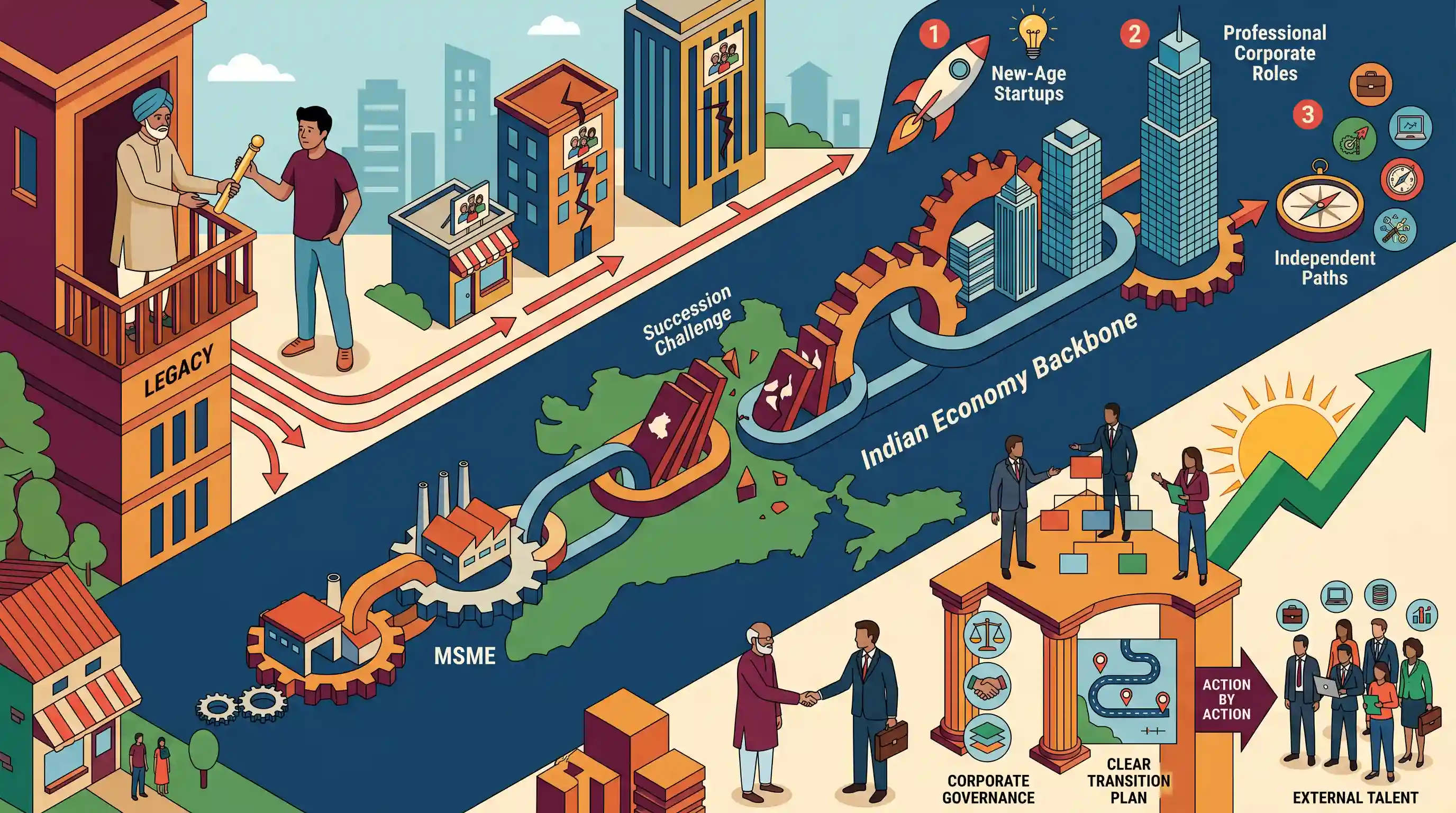
Why It Matters
Family businesses are major drivers of India's GDP and employment. Understanding their succession challenges is crucial for UPSC aspirants as it intersects with GS3 (MSME growth, corporate governance), GS1 (changing social values and youth aspirations), and GS4 (professional ethics and integrity in management).
Summary
A recent survey reveals that the next generation of Indian family business owners is increasingly hesitant to inherit and lead their family enterprises. This shift highlights changing career aspirations among the youth, who are leaning towards new-age startups, professional corporate roles, and independent paths. Given that family-owned businesses—ranging from large conglomerates to countless MSMEs—form the backbone of the Indian economy, this succession challenge is critical. While it threatens business continuity in the absence of clear transition plans, it also offers a vital opportunity to professionalize management, enhance corporate governance, and attract external talent to ensure long-term sustainability.
Key Points
- A recent survey indicates that the next generation of Indian family business owners is increasingly reluctant to take over leadership roles in their family enterprises.
- This trend reflects a shift in youth aspirations, with many opting for independent entrepreneurial ventures, professional corporate careers, or opportunities abroad rather than traditional family businesses.
- The reluctance poses a significant succession challenge, particularly for the MSME sector which is heavily reliant on family-run models, potentially threatening business continuity and institutional memory.
- Conversely, this transition phase presents an opportunity for family businesses to professionalize their management, establish independent boards, and enhance corporate governance.
- To ensure sustainable growth, Indian family enterprises must implement robust succession planning and integrate external professional talent.
Important Terms
MSMEs (Micro, Small and Medium Enterprises)

Enterprises classified by investment and turnover (revised 2020); they provide significant employment and form the backbone of India's manufacturing and services sectors.
UPSC context
GS Paper III: Indian Economy. Key for inclusive growth, employment generation, and industrial policy discussions.
Corporate Governance
The framework of rules and practices by which companies are directed; focuses on transparency, accountability, and fairness to protect stakeholder interests.
UPSC context
GS Paper II (Governance) and Paper IV (Ethics). Tests understanding of business ethics and regulatory frameworks.
Succession Planning
The process of identifying and developing internal leaders to succeed to key business positions, ensuring continuity and preservation of legacy.
UPSC context
GS Paper III: Economy. Vital for analyzing business continuity risks and long-term economic stability.
Professionalization of Management
The transition from personality-driven to process-driven management, where professional managers are hired based on merit rather than family ties.
UPSC context
GS Paper III: Industrial Growth. Concerns modernizing Indian businesses to improve global competitiveness and efficiency.
Family-Owned Businesses (FOBs)
Enterprises where ownership and strategic decision-making are controlled by a single family; they contribute approximately 79% to India's GDP.
UPSC context
GS Paper III: Indian Economy. Essential for understanding the structure of the private sector and wealth distribution.
MSMED Act, 2006
The legislative framework that governs the development and regulation of small businesses in India, providing the legal definition for MSME classification.
UPSC context
GS Paper II/III: Legislation and Policy. Tests knowledge of the legal pillars supporting the small-scale industrial sector.
Prelims Trap
The succession planning of family businesses does not fall under the purview of SEBI regulations.
SEBI’s Listing Obligations and Disclosure Requirements (LODR) explicitly mandate that boards of listed companies must satisfy themselves that plans are in place for orderly succession.
Static Concepts Connected
How does SEBI regulate promoter influence and succession in listed entities?
- Board Independence: Mandates that at least half the board comprise independent directors if the chairperson is a promoter or belongs to the promoter family.
- Succession Planning: SEBI LODR regulations require the board of directors to oversee and ensure orderly succession planning for top management.
- Related Party Transactions: Strict disclosure and audit committee approval norms exist to prevent the siphoning of funds by promoter families.
What is the macroeconomic footprint and definition of India's MSME sector?
- Composite Definition: Classification is now based on composite criteria of investment in plant/machinery and annual turnover, moving away from purely investment-based limits.
- GDP & Employment: MSMEs contribute roughly 30% to India's GDP and are the second-largest employer after agriculture.
- Export Share: The sector accounts for nearly 40-45% of India's total exports, predominantly functioning through traditional family-run models.
Cross-Topic Patterns
MSME Dwarfism & Governance
The push for professionalization links directly to the Economic Survey's concept of MSME 'dwarfism,' where family-run firms fail to scale due to poor governance and kinship-based management.
Occupational Mobility vs Kinship
Connects GS1 Society (weakening of joint family and occupational inheritance) with GS3 Economy (the pull factors of the modern startup ecosystem and professional corporate careers).

Mains 2026 GS3 could link MSME 'dwarfism' and stagnation directly to the lack of professional corporate governance and family succession.
Linked PYQs · 3
Linked PYQs · 3
- 2023MainsGS3
Faster economic growth requires increased share of the manufacturing sector in GDP, particularly of MSMEs. Comment on the present policies of the Government in this regard.
- 2023MainsGS4
What do you understand by 'moral integrity' and 'professional efficiency' in the context of corporate governance in India ? Illustrate with suitable examples.
- 2021MainsGS1
How does Indian society maintain continuity in traditional social values ? Enumerate the changes taking place in it.
