Non Tariff Barriers and Implementation Gaps in Free Trade Pacts
Source:The Hindu ↗
Why It Matters
This article is crucial for GS-3 (Economy) and GS-2 (International Relations) as it moves beyond the superficial success of signing FTAs to address the core structural hurdles (non-tariff barriers, regulatory frameworks) that limit India's export potential and integration into global value chains.
Summary
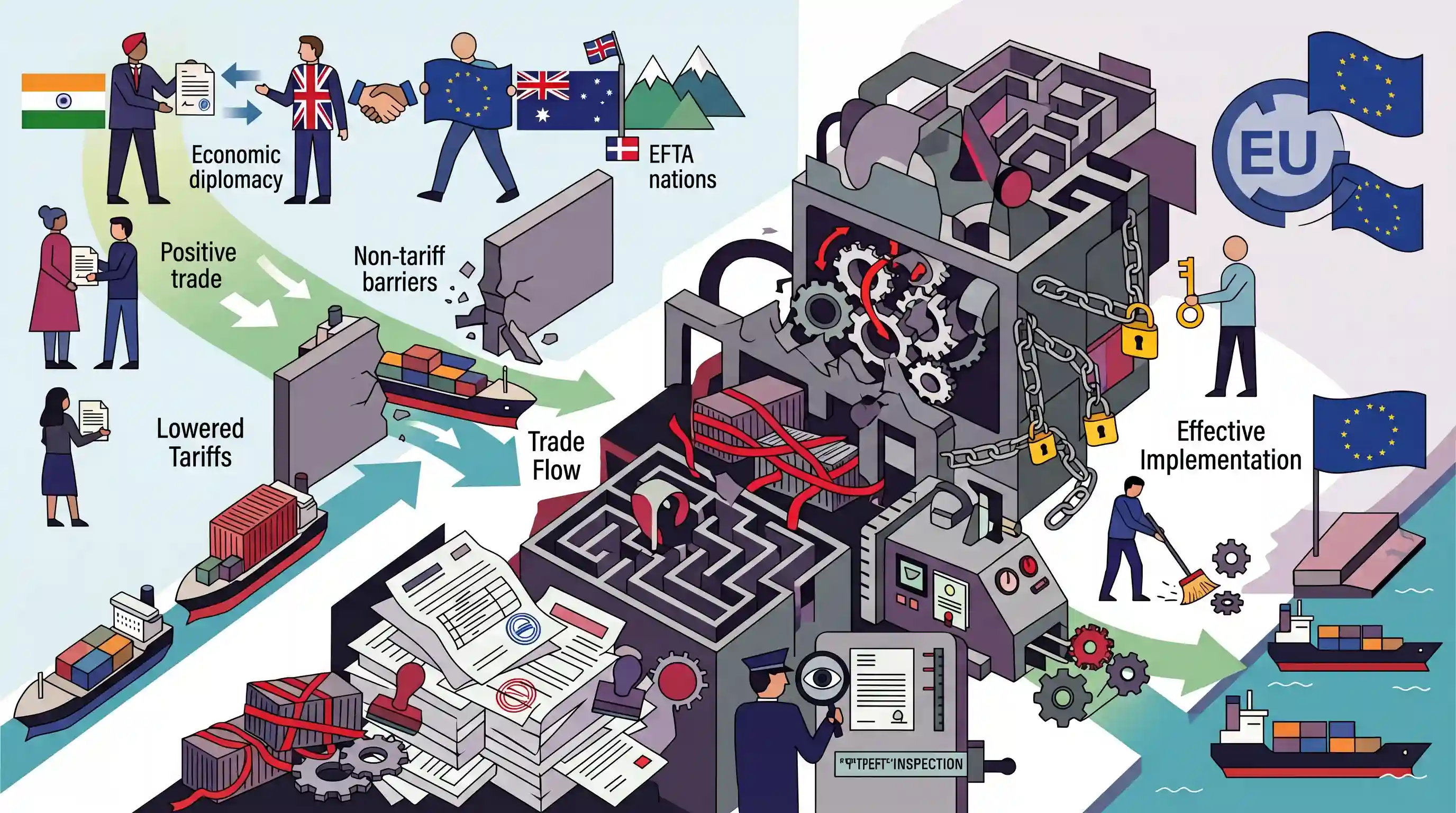
India's Chief Economic Advisor recently emphasized a substantial disconnect between the benefits promised by Free Trade Agreements (FTAs) and actual trade flow, due to complex domestic regulations and non-tariff barriers. Although India has aggressively signed or negotiated FTAs and CEPAs with partners like the UK, EU, EFTA, and Australia over the past five years to diversify its supply chains, cumbersome administrative and conformity requirements often cancel out the advantages of preferential tariffs. The article underscores that trade pacts yield real value only when implemented effectively on the ground, a sentiment also echoed by EU representatives regarding the prospective India-EU FTA.
Key Points
- Chief Economic Advisor V. Anantha Nageswaran highlighted a significant gap between the theoretical promises of Free Trade Agreements (FTAs) and the practical realities dictated by current regulations.
- Administrative hurdles, procedural burdens, and non-tariff compliance requirements frequently offset the financial benefits of preferential tariffs negotiated under FTAs.
- India views recent trade pacts negotiated with the UK, EU, EFTA, and others as strategic maneuvers to diversify its economic relationships and reduce reliance on single markets.
- EU Ambassador Herve Delphin similarly warned that structural and regulatory discrepancies continue to hinder the smooth integration of trade, particularly concerning the India-EU FTA.
- The overarching theme is that FTAs create genuine economic value only during their practical execution, not merely upon their signing.
Important Terms
Free Trade Agreements (FTAs)

A pact between nations to reduce or eliminate tariffs and quotas on goods, facilitating easier cross-border commerce while maintaining individual trade policies for non-members.
UPSC context
GS Paper 3: Indian Economy and issues relating to planning, mobilization of resources, growth, development, and employment.
Comprehensive Economic Partnership Agreements (CEPAs)
A broad bilateral agreement covering trade in goods, services, investments, and regulatory issues like IPR, typically more comprehensive than a standard FTA.
UPSC context
GS Paper 2: International Relations (Bilateral, regional and global groupings and agreements involving India).
Non-Tariff Barriers (NTBs)
Trade restrictions—such as quotas, licensing, technical regulations (TBT), and sanitary standards (SPS)—that impede imports without using direct taxes or duties.
UPSC context
GS Paper 3: Issues of trade protectionism and their impact on India's export-led growth strategy.
European Free Trade Association (EFTA)
An intergovernmental organization comprising Iceland, Liechtenstein, Norway, and Switzerland. It recently signed a Trade and Economic Partnership Agreement (TEPA) with India.
UPSC context
GS Paper 2 & Prelims: Knowledge of major trade blocs and India's recent economic diplomacy milestones.
Chief Economic Advisor (CEA)
The Secretary-rank head of the Economic Division in the Ministry of Finance, responsible for preparing the annual Economic Survey and advising on trade policy.
UPSC context
GS Paper 3 & Prelims: Understanding the institutional framework of India's economic policy and key constitutional/non-statutory roles.
European Union (EU)
An economic and political union of 27 European countries. It is currently negotiating a major FTA with India focusing on sustainability and market access.
UPSC context
GS Paper 2: Bilateral relations with major global powers and trade blocs.
Prelims Trap
Goods imported from an FTA partner nation automatically qualify for zero customs duty.
Goods must meet strict Rules of Origin (ROO) criteria to prevent third-country dumping. Mere transit or import from a partner doesn't guarantee exemption.
Static Concepts Connected
How do FTAs, CECAs, and CEPAs differ in scope?
- FTA: Focuses primarily on reducing or eliminating customs duties (tariffs) on a positive or negative list of traded goods.
- CECA: Often a stepping stone agreement focusing largely on tariff reduction on goods in a phased manner (e.g., India-Malaysia CECA).
- CEPA: The most comprehensive pact; covers goods, services, investments, intellectual property, and extensive regulatory cooperation (e.g., India-UAE CEPA).
What are the main Non-Tariff Barriers (NTBs) under the WTO framework?
- SPS Measures: Sanitary and Phytosanitary rules meant to protect human, animal, or plant health, often used to reject agricultural imports over pesticide limits.
- TBT Agreement: Technical Barriers to Trade dealing with mandatory product standards, testing, packaging, and certification procedures that complicate compliance.
- Rules of Origin: Strict stipulations dictating the minimum local value-addition a product needs to qualify as originating from an FTA partner.
Cross-Topic Patterns
CBAM as a new Non-Tariff Barrier
The EU's Carbon Border Adjustment Mechanism (CBAM) acts as a de facto environmental non-tariff barrier, complicating the India-EU FTA negotiations under the guise of climate action.
CAROTAR 2020 & FTA Utilization rate
Complex domestic regulations like CAROTAR 2020 shift the burden to Indian importers to prove value-addition (Rules of Origin), which directly explains India's remarkably low 25% FTA utilization rate.

Expect a multi-statement question in 2026 blending India's FTA utilization rates, Rules of Origin (ROO), and WTO's TBT/SPS agreements.
Linked PYQs · 3
Linked PYQs · 3
- 2025MainsGS3
What are the challenges before the Indian economy when the world is moving away from free trade and multilateralism to protectionism and bilateralism? How can these challenges be met?
- 2018PrelimsGS1
Consider the following countries: 1. Australia 2. Canada 3. China 4. India 5. Japan 6. USA Which of the above are among the 'free-trade partners' of ASEAN?
- 2017PrelimsGS1
'Broad-based Trade and Investment Agreement (BTIA)' is sometimes seen in the news in the context of negotiations held between India and
