New legislation to curb substandard seeds and pesticides
Source:Indian Express ↗
Why It Matters
Regulating the quality of agricultural inputs is essential for boosting productivity, especially for India's small and marginal farmers. FPOs play a crucial role in improving farmers' bargaining power and market integration, addressing structural supply chain issues that depress farm-gate prices and inflate consumer costs.
Summary
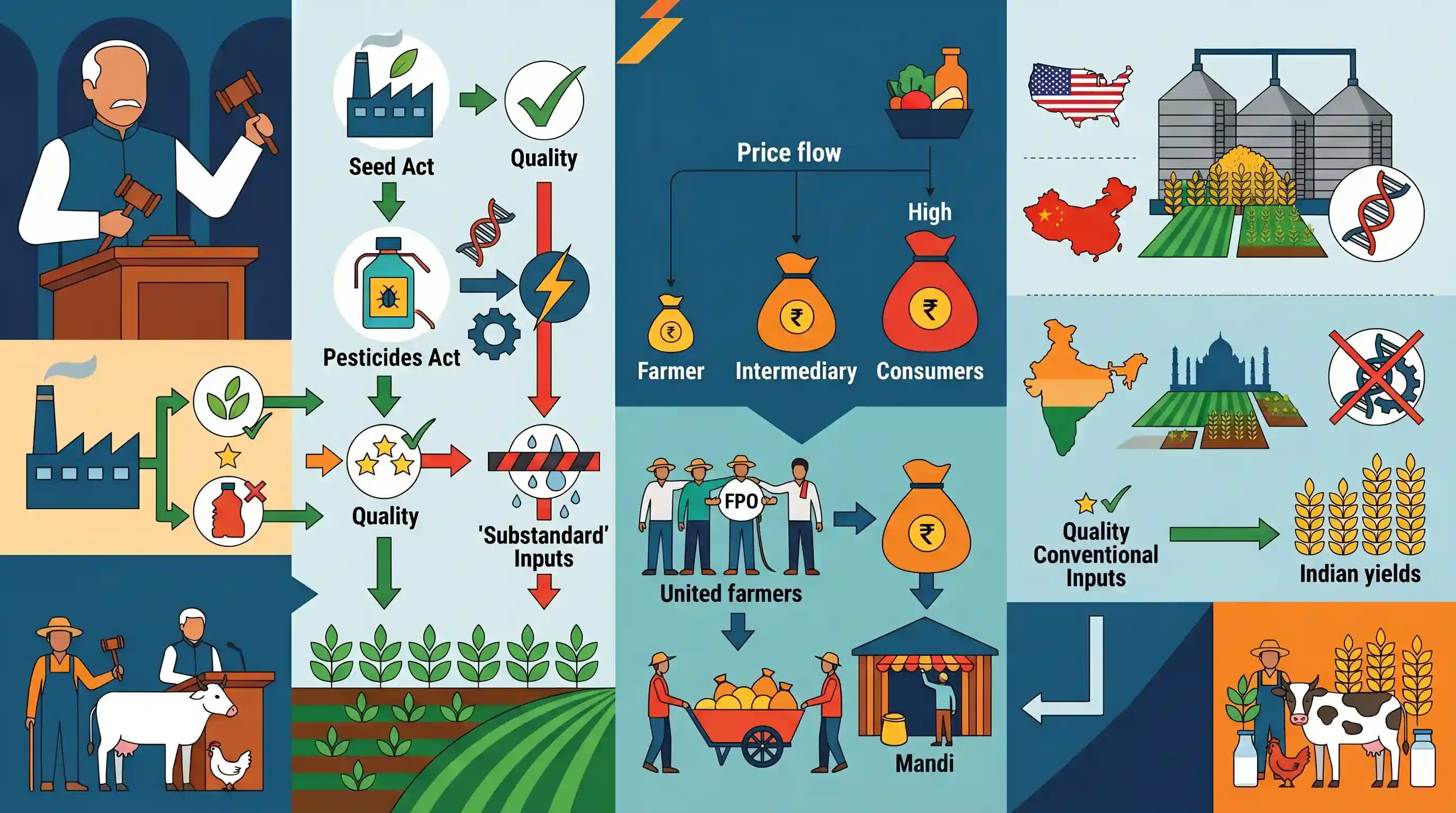
Union Agriculture Minister Shivraj Singh Chouhan announced the government's intent to introduce stringent new laws—a Seed Act and a Pesticides Act—during the upcoming Budget session to curb the sale of substandard agricultural inputs. Speaking at the National Conclave of Farmer Producer Organisations (FPOs), Chouhan highlighted the disparity between consumer prices and what farmers receive. He stressed that FPOs should actively participate in mandis (market yards) to ensure fair pricing and cut out middlemen. Additionally, despite India's low per-hectare productivity compared to the US and China, the Centre maintains its stance against Genetically Modified (GM) crops, banking instead on new legislation to enhance the quality of conventional inputs to boost farm yields.
Key Points
- The Centre plans to introduce a new Seed Act and Pesticides Act in the upcoming Budget session to heavily penalize the sale of substandard agricultural inputs.
- Union Agriculture Minister Shivraj Singh Chouhan emphasized that FPOs must be allocated space in APMC mandis to directly sell produce and eliminate middlemen.
- FPOs are encouraged to acquire input licenses to supply high-quality seeds, fertilizers, and pesticides to farmers at affordable rates.
- There is a stark disparity between consumer retail prices and the amount actually received by farmers, which the government aims to bridge.
- Despite India's lower per-hectare farm productivity compared to the US and China, the Centre reiterated its stance against permitting Genetically Modified (GM) seeds.
Important Terms
Farmer Producer Organisations (FPOs)

A legal entity formed by farmers to leverage economies of scale in procurement, processing, and marketing. They empower smallholders through collective bargaining and improved access to technology and credit.
UPSC context
GS-III: Agriculture; critical for doubling farmers' income, reducing intermediary exploitation, and improving market linkages.
Seed Act
Proposed legislation (e.g., Seeds Bill 2019) replacing the 1966 Act to regulate seed quality. It introduces compulsory registration for all varieties to ensure genetic purity and prevent the sale of spurious seeds.
UPSC context
GS-III: Agricultural Inputs; tests knowledge of regulatory frameworks, food security, and protection of farmers' rights.
Pesticides Management Bill
A framework replacing the Insecticides Act, 1968, intended to regulate the manufacture, import, and sale of pesticides. It focuses on efficacy, environmental safety, and compensation for farmers using substandard chemicals.
UPSC context
GS-III: Agriculture & Environment; focuses on chemical safety, export quality (MRLs), and sustainable farming practices.
Genetically Modified (GM) Crops
Plants whose DNA is altered through genetic engineering to introduce specific traits like pest resistance. In India, they are regulated by the Genetic Engineering Appraisal Committee (GEAC) under the Environment Protection Act.
UPSC context
GS-III: Science & Technology; covers biotechnology, biosafety regulations (1989 Rules), and indigenous innovations like DMH-11.
Agricultural Produce Market Committee (APMC)
Statutory market committees established by state governments to regulate the trade of agricultural produce. They provide market yards (mandis) for transparent price discovery and protection against exploitation by intermediaries.
UPSC context
GS-III: Agricultural Marketing; tests knowledge of market reforms, e-NAM, and supply chain management.
Prelims Trap
"The existing Seeds Act regulates all seed varieties sold in the Indian market."
The extant Seeds Act, 1966 only regulates officially "notified" seed varieties. Un-notified seeds and many private hybrids fall outside its strict quality control mechanisms.
Static Concepts Connected
What is the legal status and structure of Farmer Producer Organisations (FPOs)?
- Legal Status: Registered as Producer Companies under the Companies Act, 2013, or under State Cooperative Societies Acts.
- Ownership: Wholly owned, democratically governed, and controlled exclusively by primary producers like farmers, milk producers, and artisans.
- Core Objective: Leveraging economies of scale for bulk input procurement, value addition, and collective direct-to-market selling.
Who regulates Genetically Modified (GM) crops in India?
- Apex Body: Genetic Engineering Appraisal Committee (GEAC) under the Ministry of Environment, Forest and Climate Change (MoEFCC).
- Legal Backing: Constituted under the Rules for Manufacture, Use, Import, Export & Storage of Hazardous Microorganisms/Genetically Engineered Organisms or Cells, 1989, under the Environment (Protection) Act, 1986.
- Commercial Release: While GEAC is the statutory appraising body, final commercial release often requires a political nod from the Union Government.
Cross-Topic Patterns
FPOs as APMC Market Disruptors
By demanding space for FPOs in mandis, the Centre aims to bypass traditional APMC cartels, linking agricultural marketing reforms (GS3) with institutional collective models (GS2).
Agro-chemicals & Stockholm Convention
The shift from the outdated Insecticides Act, 1968 to a new Pesticides Act intersects with India’s environmental commitments to phase out Persistent Organic Pollutants (POPs).

Expect a 2026 Prelims question linking FPO legal structures (Companies Act), their role in APMC mandis, and input-licensing.
Linked PYQs · 3
Linked PYQs · 3
- 2021PrelimsGS1
Bollgard I and Bollgard II technologies are mentioned in the context of
- 2020MainsGS3
What are the main constraints in transport and marketing of agricultural produce in India?
- 2014MainsGS3
There is also a point of view that Agricultural Produce Market Committees (APMCs) set up under the State Acts have not only impeded the development of agriculture but also have been the cause of food inflation in India. Critically examine.
