Crop Residue Management and Subsidy Restrictions in Bihar
Source:The Hindu ↗
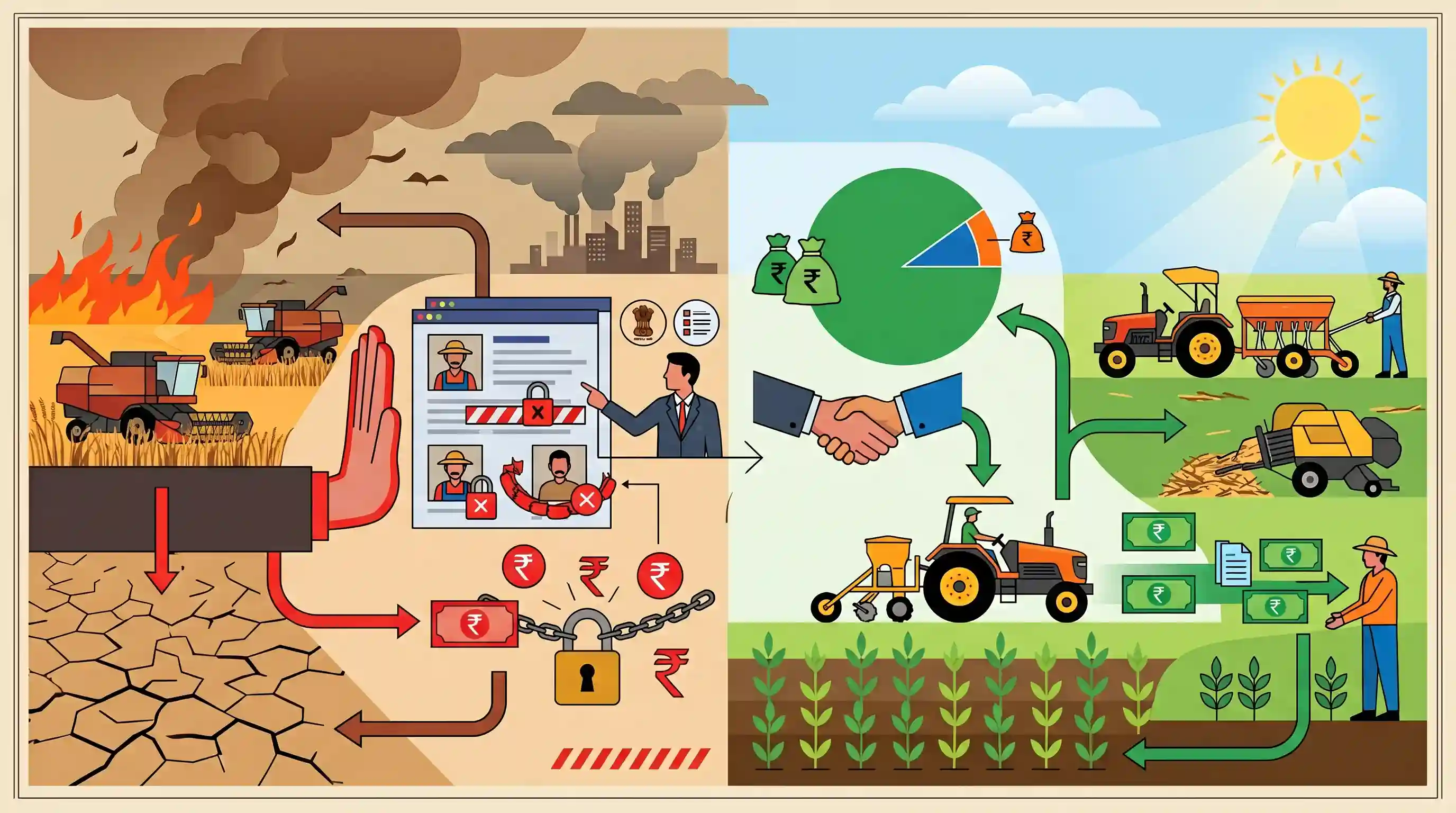
Why It Matters
It illustrates a vital governance strategy—leveraging DBT and agricultural subsidies as an economic disincentive rather than relying solely on punitive laws—to enforce environmentally sustainable agricultural practices.
Summary
The Bihar government has taken stringent administrative action against stubble burning by blocking the Direct Benefit Transfer (DBT) registrations of over 1,800 farmers for the 2025-26 period. By denying agricultural subsidies and incentives, the state aims to disincentivize a practice that causes severe air pollution and degrades soil fertility. Despite offering up to 80% subsidies on agricultural machinery via Custom Hiring Centres to manage crop residue, incidents of burning continue to rise in districts like Rohtas and Nalanda. Farmers attribute this to the short transition window between paddy and wheat crops and the residue left by combine harvesters.
Key Points
- The Bihar Agriculture Department has blocked Direct Benefit Transfer (DBT) registrations for over 1,800 farmers for the 2025-26 cycle as a penalty for burning crop residue.
- The highest number of penalised farmers are concentrated in Rohtas, Nalanda, and Patna districts.
- The state provides up to 80% subsidies on agricultural machinery through Custom Hiring Centres (CHCs) to encourage mechanized residue management and prevent burning.
- Awareness campaigns emphasize the detrimental effects of stubble burning, including severe air pollution, loss of essential soil nutrients, and the destruction of beneficial microorganisms.
- Farmers cite the narrow time window between paddy harvesting and wheat sowing, alongside the residue left by combine harvesters, as primary reasons for continuing the practice.
Important Terms
Stubble Burning (Parali Burning)

The intentional burning of crop residue (straw/stalks) after harvesting to quickly clear fields for the next crop, primarily paddy and wheat.
UPSC context
GS Paper 3 (Environment/Agriculture). Evaluates knowledge of air pollution causes, soil degradation, and sustainable farming solutions.
Direct Benefit Transfer (DBT)
A governance initiative to transfer subsidies and welfare benefits directly into beneficiaries' bank accounts, leveraging Aadhaar to minimize leakages and eliminate intermediaries.
UPSC context
GS Paper 2 (Governance) and GS Paper 3 (Economy). Tests understanding of digital inclusion and subsidy reform.
Custom Hiring Centres (CHCs)
Units providing expensive agricultural machinery and equipment on a rental basis to small and marginal farmers who cannot afford to purchase them.
UPSC context
GS Paper 3 (Agricultural Mechanization). Focuses on increasing farm productivity and managing crop residue through technology access.
Crop Residue Management (CRM)
The systematic handling of post-harvest plant leftovers using in-situ (incorporation/mulching) or ex-situ (bioenergy/industrial use) methods to prevent environmental degradation.
UPSC context
GS Paper 3 (Agriculture/Environment). Relevant for discussions on sustainable soil health and the circular economy.
Sub-Mission on Agricultural Mechanization (SMAM)
A Centrally Sponsored Scheme aimed at increasing the reach of farm mechanization to small and marginal farmers and regions with low farm power availability.
UPSC context
GS Paper 3 (Agriculture). Tests knowledge of government interventions to modernize farming and reduce labor dependency.
Prelims Trap
Mechanized combine harvesters act as an in-situ crop residue management tool to mitigate stubble burning.
Combine harvesters actually cause the stubble problem by leaving 10-30 cm long stalks that are hard to plough back, forcing farmers to burn them.
Static Concepts Connected
Why does stubble burning persist despite bans and subsidies?
- Narrow Window: Only 10-15 days exist between paddy harvesting and wheat sowing, making burning the fastest and cheapest field clearance method.
- Combine Harvesters: Their widespread use leaves 10-30 cm tall loose stalks that are difficult and expensive to manually extract.
- Machinery Constraints: In-situ management requires heavy implements like Happy Seeders and high-HP tractors, which are often unaffordable or unavailable during peak season.
What are the ecological impacts of stubble burning on soil health?
- Nutrient Depletion: Intense heat causes the irreversible loss of essential organic nutrients like nitrogen, sulfur, and carbon from the topsoil.
- Microbial Death: High temperatures destroy beneficial microorganisms, flora, and earthworms that are critical for natural soil aeration and fertility.
- Moisture Loss: The fire bakes and dries out the topsoil, severely reducing its moisture content and water-holding capacity.
Cross-Topic Patterns
DBT as a punitive enforcement tool
Linking DBT blockage to environmental offenses merges GS2 e-governance with GS3 pollution control, shifting from judicial fines to immediate administrative subsidy denial.
Eastward shift of crop residue fires
Penalties in Bihar highlight that mechanization-induced stubble burning is no longer just a Punjab/Haryana issue, reflecting its spread across the entire Indo-Gangetic plain.

Expect a 2026 prelims question linking the soil chemistry impacts of crop burning with the role of combine harvesters in exacerbating it.
Linked PYQs · 4
Linked PYQs · 4
- 2023MainsGS3
What are the direct and indirect subsidies provided to farm sector in India? Discuss the issues raised by the World Trade Organization (WTO) in relation to agricultural subsidies.
- 2015MainsGS3
In what way could replacement of price subsidy with Direct Benefit Transfer (DBT) change the scenario of subsidies in India ? Discuss.
- 2020PrelimsGS1
What is/are the advantage/advantages of zero tillage in agriculture ? 1. Sowing of wheat is possible without burning the residue of previous crop. 2. Without the need for nursery of rice saplings, direct planting of paddy seeds in the wet soil is possible. 3. Carbon sequestration in the soil is possible. Select the correct answer using the code given below:
- 2024PrelimsGS1
Consider the following materials : 1. Agricultural residues 2. Corn grain 3. Wastewater treatment sludge 4. Wood mill waste Which of the above can be used as feedstock for producing Sustainable Aviation Fuel?
