Governance Structures of Bretton Woods Financial Institutions
Source:Indian Express ↗
Why It Matters
The governance and structure of prominent global financial institutions like the IMF are recurring themes in UPSC Prelims and Mains (GS2). Understanding the distinction between the IMF's independent staff and the member-appointed Executive Directors clarifies how sovereign representation and voting power operate within the IMF's Executive Board.
Summary
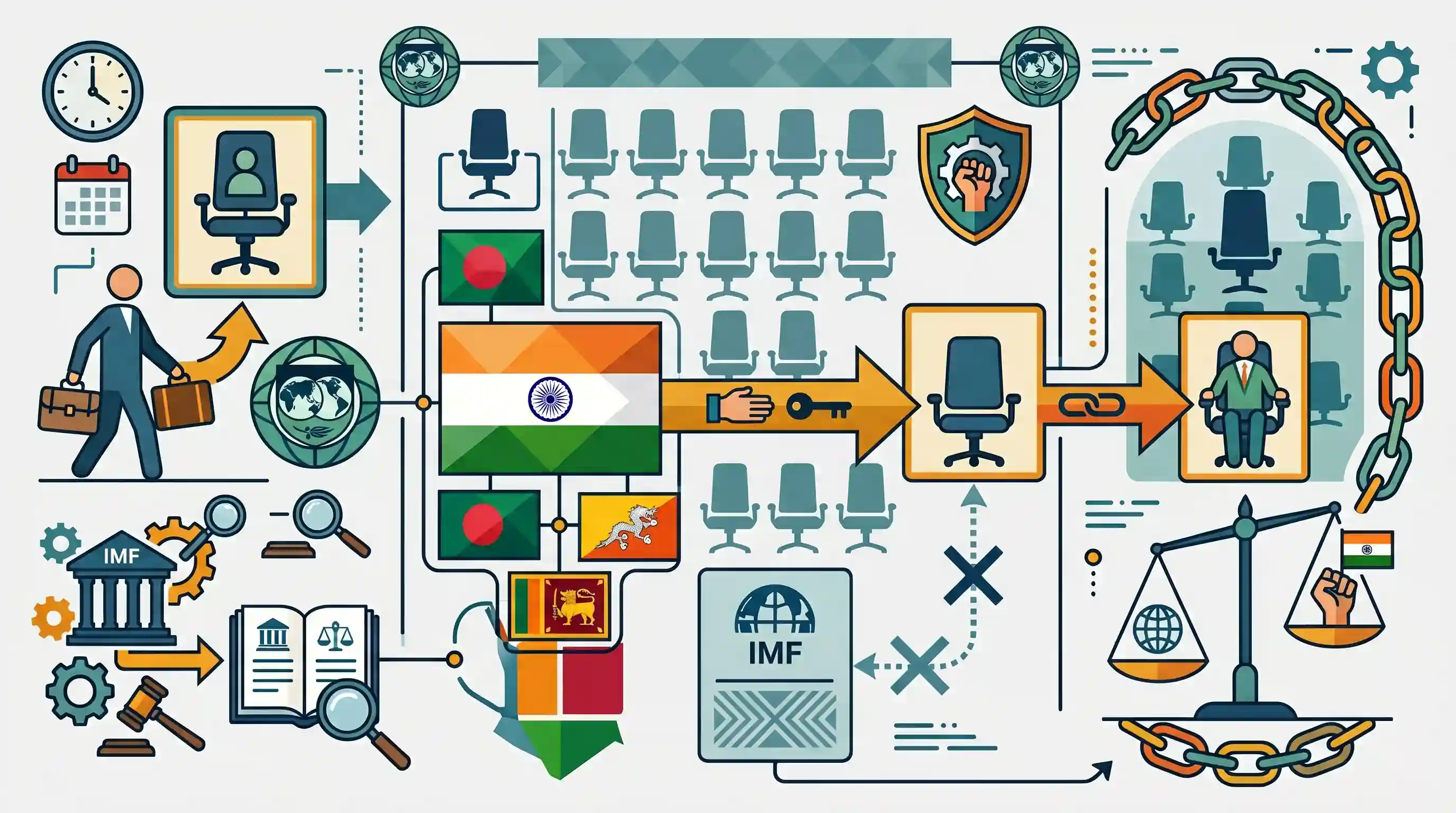
Following the exit of Krishnamurthy Subramanian from his role as Executive Director at the International Monetary Fund (IMF), the institution clarified its governance protocols regarding such diplomatic and administrative appointments. The IMF emphasized that the authority to appoint or terminate an Executive Director rests entirely with the member country or the constituency of countries they represent (in this case, India alongside Bangladesh, Bhutan, and Sri Lanka). This development highlights the structural design of the IMF's Executive Board, reinforcing that member nations retain sovereign control over their designated representatives rather than the IMF acting as an independent employer of these directors.
Key Points
- The International Monetary Fund (IMF) clarified that the appointment and termination of Executive Directors are the sole prerogative of the member countries they represent.
- The clarification follows the exit of Krishnamurthy Subramanian, who served as the Executive Director representing India, Bangladesh, Bhutan, and Sri Lanka at the IMF.
- This underscores the governance framework of the IMF, where the Executive Board comprises directors appointed or elected by member nations or constituencies, retaining sovereign control over their representation.
- The Executive Board is responsible for the day-to-day business of the IMF, making national representation a critical aspect of global financial governance.
Important Terms
International Monetary Fund (IMF)

A 190-member global organization promoting financial stability, international trade, and poverty reduction. It acts as a lender of last resort for countries facing balance-of-payments crises.
UPSC context
GS Paper II: Important International institutions. Tests knowledge of global economic governance and India's strategic role in multilateral bodies.
IMF Executive Board
The 24-member body responsible for the day-to-day operations of the IMF. It discusses economic policies and approves financial assistance to member nations.
UPSC context
GS Paper II: Structure and mandate of international agencies. Tests understanding of the operational decision-making framework of the IMF.
Executive Director (IMF)
A representative on the Executive Board. Some are appointed by individual large-economy countries, while others are elected by a constituency to represent a group of nations.
UPSC context
GS Paper II: Representation in international organizations. Relevant to India's bureaucratic and diplomatic presence in global financial architecture.
Constituency (IMF)
A group of member countries that share an Executive Director. India leads a constituency that includes Bangladesh, Bhutan, and Sri Lanka.
UPSC context
GS Paper II: Institutional structure. Highlights India’s regional leadership and collective voting power within the IMF framework.
Board of Governors (IMF)
The highest decision-making body of the IMF, comprising one governor (typically the Finance Minister) per member country. It delegates most daily powers to the Executive Board.
UPSC context
GS Paper II: Governance of international bodies. Identifies the peak authority level where sovereign nations exercise primary control.
Bretton Woods Institutions
Collective term for the IMF and World Bank, established at the 1944 New Hampshire conference to manage the post-WWII international economic order.
UPSC context
GS Paper II: History of global governance. Fundamental for questions on the evolution and reform of the international financial system.
IMF Quota
A member's assigned financial contribution, reflecting its relative economic size. It determines voting power, access to loans, and the allocation of Special Drawing Rights (SDRs).
UPSC context
GS Paper III: Indian Economy. Key to debates on governance reform and India's rising influence as a major economy.
Prelims Trap
"IMF Executive Directors are direct employees of the IMF and can be removed by its Managing Director."
Executive Directors are appointed/elected by member countries. The power to appoint or terminate rests solely with the member country (e.g., India's ACC), not the IMF itself.
Static Concepts Connected
How is the IMF Executive Board structured and how is voting power determined?
- Constituency system: The 24-member Board represents 190 countries. Large economies have individual directors, while others form constituencies.
- India's representation: India shares a constituency and officially represents itself alongside Bangladesh, Bhutan, and Sri Lanka.
- Quota-based voting: Voting is asymmetric and based on a member's quota (SDRs), which reflects GDP and economic openness, overriding the "one member, one vote" principle.
What is the role of the Appointments Committee of the Cabinet (ACC)?
- Composition: Chaired by the Prime Minister of India, with the Minister of Home Affairs as a key member.
- Multilateral appointments: Beyond domestic top bureaucracy, the ACC holds the sole prerogative to appoint India's representatives to international bodies like the IMF, World Bank, and ADB.
Cross-Topic Patterns
Bretton Woods vs. UN Secretariat
Contrasts with UN civil servants who pledge neutrality. IMF/WB Executive Directors explicitly represent national interests and are bound by their home country's cabinet decisions.
Neighborhood First in Multilateralism
India's leadership of its IMF constituency (representing Bangladesh, Bhutan, and Sri Lanka) acts as a soft-power extension of its 'Neighborhood First' policy in global financial governance.

Expect a 2026 prelims statement testing the specific composition of India's IMF constituency and whether IMF directors are UN staff.
Linked PYQs · 3
Linked PYQs · 3
- 2016PrelimsGS1
With reference to the International Monetary and Financial Committee (IMFC), consider the following statements: 1. IMFC discusses matters of concern affecting the global economy, and advises the International Monetary Fund (IMF) on the direction of its work. 2. The World Bank participates as observer in IMFC's meetings. Which of the statements given above is/are correct?
- 2016PrelimsGS1
'Global Financial Stability Report' is prepared by the
- 2025PrelimsGS1
Consider the following statements in respect of the International Bank for Reconstruction and Development (IBRD) : I. It provides loans and guarantees to middle income countries. II. It works single-handedly to help developing countries to reduce poverty. III. It was established to help Europe rebuild after the World War II. Which of the statements given above are correct?
