Addressing Exclusion in Mukhyamantri Ayushman Aarogya Yojana
Source:dvara-research ↗
Why It Matters
Welfare and social security schemes of Rajasthan (especially health schemes like MAAY/Chiranjeevi Swasthya Bima Yojana) are a core area of the RPSC RAS General Studies syllabus, frequently tested on parameters like eligibility, financial coverage limits, premium structures, and governance challenges.
Summary
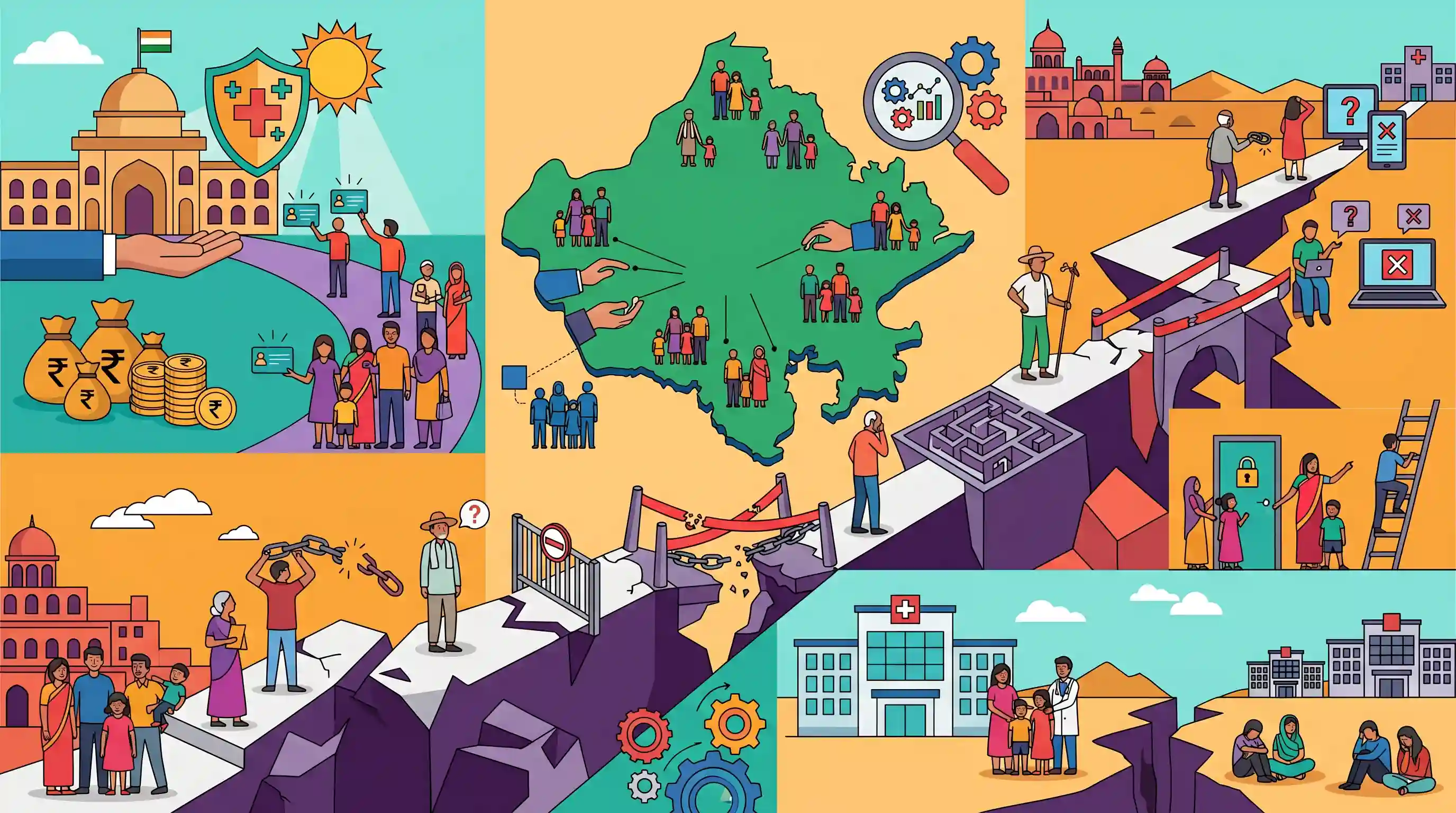
This article examines the implementation and exclusion challenges of Rajasthan's flagship health insurance scheme, the Mukhyamantri Ayushman Aarogya Yojana (MAAY). Launched in 2021 (originally as the Chiranjeevi Scheme), MAAY offers ₹25 lakh cashless treatment and ₹10 lakh accident cover per family. While the state finances the premium for 92% of the 1.4 crore registered families, many still face systemic exclusion. Dvara Research uses a citizen-centric framework to analyze user-journey and socio-economic hurdles that restrict citizen access to these vital healthcare benefits.
Key Points
- Mukhyamantri Ayushman Aarogya Yojana (MAAY) was launched by the Rajasthan state government in 2021 (previously known as the Mukhyamantri Chiranjeevi Swasthya Bima Yojana).
- MAAY offers cashless medical treatment of up to ₹25 lakh per family per year, along with an additional accident insurance cover of ₹10 lakh.
- The premium is fully sponsored by the state government for low-income and vulnerable categories (such as families under NFSA, SECC 2011, small and marginal farmers, contract workers, and destitute/ex-gratia categories).
- Other non-exempt families can enroll in the scheme by paying a heavily subsidized premium of ₹850 per family per year.
- As of 2024, approximately 1.4 crore families have registered under the scheme, with the state government sponsoring the premium for nearly 92% of them.
- The scheme covers 1,800 surgical procedures across 2,010 network hospitals, of which more than half are private healthcare providers.
- Dvara Research proposes a citizen-centric diagnostic framework consisting of 'stages of exclusion' (user journey map) and 'dimensions of exclusion' (social contexts) to identify why eligible citizens are falling through the cracks and failing to receive benefits.
Important Terms
Mukhyamantri Ayushman Aarogya Yojana (MAAY)

Rajasthan's flagship universal health insurance scheme (rebranded from Chiranjeevi Yojana in 2024), providing ₹25 lakh cashless treatment and ₹10 lakh accident cover per family annually.
UPSC context
GS Paper II (Government Schemes/Health); tests understanding of state welfare initiatives, fiscal burdens, and universal health coverage.
Mukhyamantri Chiranjeevi Swasthya Bima Yojana
The original name of Rajasthan’s flagship health insurance scheme launched in 2021, offering comprehensive cashless health coverage, renamed to Mukhyamantri Ayushman Aarogya Yojana in 2024.
UPSC context
GS Paper II (Welfare Schemes); tests knowledge of evolution, political continuity, and design of state-level health insurance mechanisms.
National Food Security Act (NFSA)
A 2013 Indian legislation that legally entitles up to 75% of rural and 50% of urban populations to highly subsidized foodgrains via the Targeted Public Distribution System.
UPSC context
GS Paper III (Food Security); tests understanding of rights-based welfare frameworks and poverty alleviation legislation in India.
Socio-Economic Caste Census (SECC) 2011
A comprehensive door-to-door national survey mapping socio-economic indicators and caste status across India to help target and rank beneficiary eligibility for government welfare schemes.
UPSC context
GS Paper II (Social Justice/Governance); tests knowledge of database-driven targeting and welfare policy planning.
National Health Authority
The apex government agency responsible for implementing India's flagship public health assurance scheme, Ayushman Bharat PM-JAY, and building the national digital health ecosystem under ABDM.
UPSC context
GS Paper II (Health Governance); tests understanding of the institutional design of national-level public health financing and e-governance.
Dvara Research
An independent, non-profit Indian research organization focused on financial inclusion, social protection, digital public infrastructure, and policy research on exclusion errors in welfare delivery.
UPSC context
GS Paper II (Governance); tests awareness of third-party policy reviews and digital welfare delivery bottlenecks.
Prelims Trap
The Mukhyamantri Ayushman Aarogya Yojana (MAAY) provides 100% free, state-sponsored premium coverage to all registered residents of Rajasthan.
While 92% of enrolled families are fully sponsored by the state, MAAY is not universally free. Non-exempt families must pay a subsidized annual contributory premium of ₹850 to access the benefits.
Static Concepts Connected
What is the difference between Social Insurance and Social Assistance?
- Social Insurance: Funded through pooled, contributory premiums from beneficiaries, employers, or the state (e.g., ESIC, contributory pension schemes).
- Social Assistance: Non-contributory, tax-financed welfare assistance targeted at vulnerable, low-income groups based on specific eligibility criteria (e.g., PM-JAY, NSAP).
What is Out-of-Pocket Expenditure (OOPE) and its status in Indian healthcare?
- Definition: Direct payments made by individuals to healthcare providers at the point of service, excluding any third-party insurance or public financing.
- Socio-Economic Impact: OOPE accounts for nearly 40-50% of total health expenditure in India, driving millions of households into poverty annually due to catastrophic health shocks.
- Policy Target: The National Health Policy (NHP) 2017 aims to progressively reduce OOPE by increasing public health expenditure to 2.5% of India's GDP.
Cross-Topic Patterns
Federalism in Public Health Delivery
Integration of state schemes like MAAY with central PM-JAY highlights the administrative and financial negotiation between state fiscal space and national health standards.
Digital Identification and Welfare Exclusion
Reliance on static databases like SECC 2011 and biometric authentication tools often leads to systemic administrative exclusion of genuine beneficiaries.

Mains 2026 may contrast state-led universal health models with PM-JAY to evaluate fiscal sustainability and cooperative federalism.
Linked PYQs · 3
Linked PYQs · 3
- 2021RPSC_PRELIMSGS1
Under the Ayushman Bharat Mahatma Gandhi Rajasthan Health Insurance Scheme, the amount provided per family per year in the event of a critical illness health insurance is
- 2021RPSC_PRELIMSGS1
Which of the following is responsible for the implementation of the ‘Ayushman Bharat Pradhan Mantri Jan Arogya Yojana’?
- 2024RPSC_PRELIMSGS1
Who among the following are eligible for Aastha Scheme in Rajasthan? (i) Persons with specially abled category. (ii) Specially abled category with more than 40 percent disability. (iii) If people are specially abled 2 or more people are specially abled. (iv) Families with 2 or more specially abled persons.
