Global Health Disparities: Early Cancer Diagnosis in Women
Source:The Hindu ↗
Why It Matters
The burden of non-communicable diseases, especially cancers affecting women, is a critical public health and social justice issue. The lack of early diagnosis infrastructure in LMICs ties directly to India's challenges with public health reach, preventive care, and addressing demographic-specific healthcare (such as geriatric and maternal/women's health). This data is highly relevant for GS-2 answers evaluating public health policies and global health inequities.
Summary
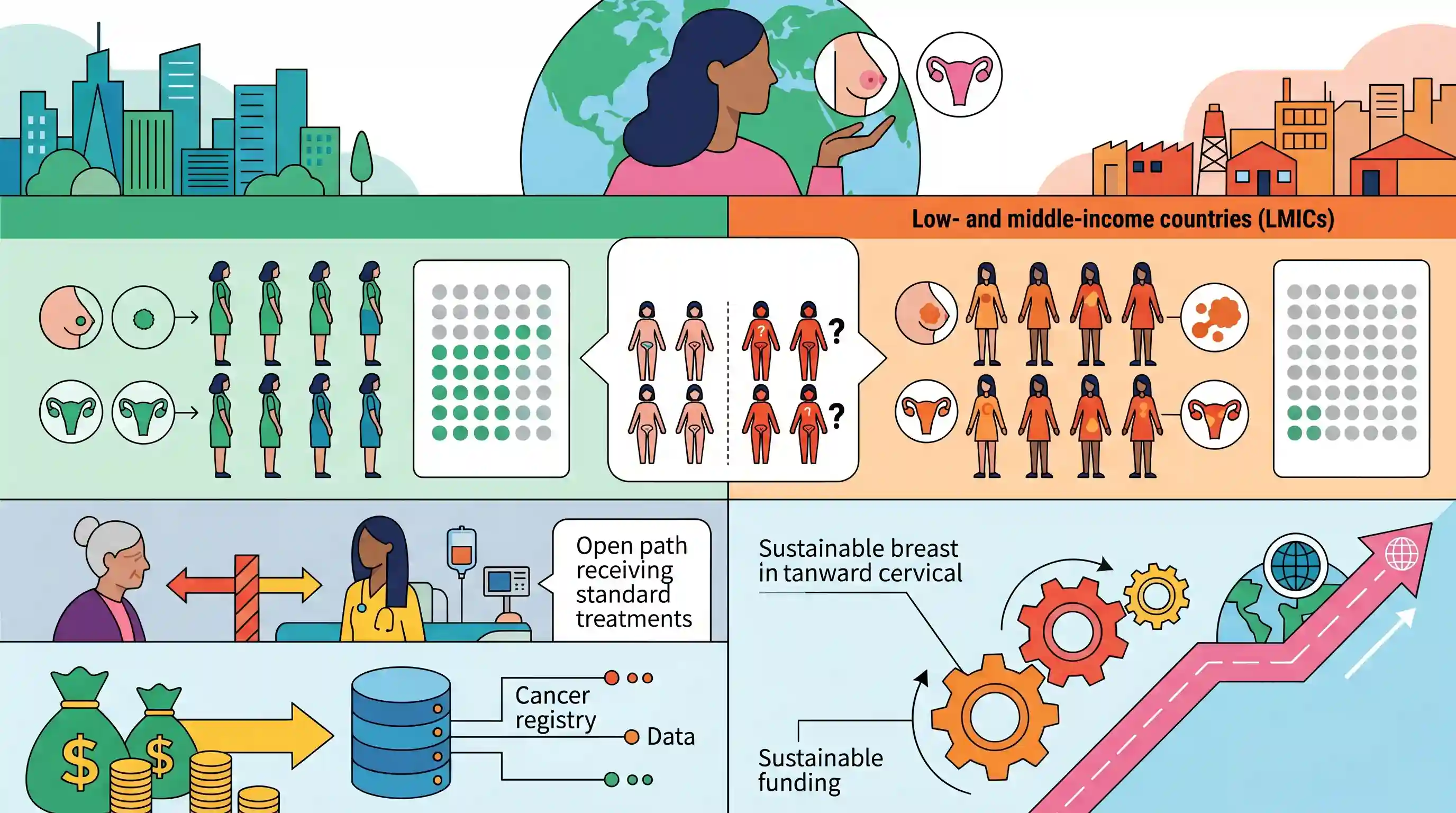
A study published in The Lancet reveals significant global disparities in cancer diagnosis and care for women. The VENUSCANCER study found that fewer than 20% of women in low- and middle-income countries (LMICs) are diagnosed with breast or cervical cancer at an early stage, compared to more than two in five in high-income countries. Ovarian cancer remains exceptionally difficult to diagnose early globally. The findings also underscore disparities related to age, with older women less likely to receive standard treatments. Researchers emphasize the urgent need for sustainable funding for population-based cancer registries and aligning efforts with WHO's Global Breast Cancer and Cervical Cancer Elimination Initiatives.
Key Points
- A study published in The Lancet (the VENUSCANCER study) highlights stark global disparities in early-stage cancer diagnosis for women.
- In low- and middle-income countries (LMICs), less than 20% of women with breast or cervical cancer receive an early diagnosis, compared to over 40% in high-income countries.
- Ovarian cancer remains the most difficult to detect early globally, with less than 20% of cases diagnosed at an early stage worldwide.
- Older women face age-based disparities, often not being offered treatment aligned with clinical guidelines.
- The study calls for stable financial support for population-based cancer registries to improve cancer control plans globally.
Important Terms
Global Breast Cancer Initiative (GBCI)

A WHO framework launched in 2021 aiming to reduce global breast cancer mortality by 2.5% annually through three pillars: early detection, timely diagnosis, and comprehensive treatment.
UPSC context
GS Paper 2: Social Justice/Health. Relevant for questions on women's health policies and international health frameworks.
Cervical Cancer Elimination Initiative
A global strategy adopted by the World Health Assembly in 2020 targeting '90-70-90' goals by 2030: 90% HPV vaccination, 70% screening, and 90% treatment access.
UPSC context
GS Paper 2: Health. Critical for discussing India’s HPV vaccination drive and Universal Immunization Programme (UIP).
Population-based cancer registries (PBCRs)
Systems that systematically collect data on all new cancer cases within a defined geographical area to monitor incidence, stage at diagnosis, and survival trends.
UPSC context
GS Paper 2: Health/Governance. Essential for evidence-based policy making in the National Cancer Control Programme.
VENUSCANCER study
A major global study (Lancet 2024) analyzing care patterns for breast, cervical, and ovarian cancers in 39 countries, revealing stark disparities in early diagnosis between income groups.
UPSC context
GS Paper 2/3: Health/Science. Provides data points on the 'global burden of disease' and health-access inequality.
Non-Communicable Diseases (NCDs)
Chronic conditions such as cancer, diabetes, and cardiovascular diseases that are not infectious. Reducing NCD premature mortality by one-third is a key target of SDG 3.4.
UPSC context
GS Paper 2: Issues relating to Health. A primary focus of the National Health Policy 2017.
World Health Organization (WHO)
The United Nations' specialized agency responsible for international public health, which coordinates global responses to pandemics and sets international health standards and initiatives.
UPSC context
GS Paper 2: International Relations/Institutions. Frequently tested regarding its mandate and role in global health governance.
Prelims Trap
"The '90-70-90' global target is associated with the elimination of HIV/AIDS by 2030."
A classic UPSC trap is swapping numerical targets. 90-90-90 is the UNAIDS target for HIV/AIDS, whereas 90-70-90 is the WHO target for Cervical Cancer.
Static Concepts Connected
What is the WHO 90-70-90 target for cervical cancer elimination?
- Vaccination (90%): 90% of girls must be fully vaccinated with the HPV vaccine by the age of 15.
- Screening (70%): 70% of women must be screened with a high-performance test by age 35, and again by age 45.
- Treatment (90%): 90% of women identified with cervical disease must receive appropriate treatment.
What is India's National Cancer Registry Programme (NCRP)?
- Nodal Body: It is administered by the Indian Council of Medical Research (ICMR) and has been operating since 1981.
- Primary Purpose: It provides reliable data on cancer incidence, mortality, and patterns to shape the National Cancer Control Programme.
- Structure: It operates through a network of Population Based Cancer Registries (PBCRs) and Hospital Based Cancer Registries (HBCRs) across the country.
Cross-Topic Patterns
Cervical cancer + Indigenous vaccines
The global push against cervical cancer connects directly to GS3 Biotechnology, notably India's recent development of CERVAVAC, its first indigenous quadrivalent HPV vaccine intended for mass immunization.
Epidemiological transition + Aging populaces
The study's finding on age-based cancer treatment neglect links to GS1 Demography; as India undergoes an epidemiological transition, geriatric care for NCDs is becoming a critical policy blind-spot.

Expect a matched-pair prelims question confusing UNAIDS's 90-90-90 HIV target with the WHO's 90-70-90 Cervical Cancer Elimination target.
Linked PYQs · 3
Linked PYQs · 3
- 2020MainsGS2
In order to enhance the prospects of social development, sound and adequate health care policies are needed particularly in the fields of geriatric and maternal health care. Discuss.
- 2024MainsGS2
In a crucial domain like the public healthcare system the Indian State should play a vital role to contain the adverse impact of marketisation of the system. Suggest some measures through which the State can enhance the reach of public healthcare at the grassroots level.
- 2023PrelimsGS1
Consider the following statements: Statement-I: India's public sector health care system largely focuses on curative care with limited preventive, promotive and rehabilitative care. Statement-II: Under India's decentralized approach to health care delivery, the States are primarily responsible for organizing health services. Which one of the following is correct in respect of the above statements?
