Patient Perceptions and Antimicrobial Resistance Drivers in India
Source:The Hindu ↗
Why It Matters
Antimicrobial Resistance is a critical global and national health threat. Understanding the behavioral and social drivers behind antibiotic misuse is essential for civil servants and policymakers to design effective awareness initiatives (like the Red Line Campaign) and improve the enforcement of medical regulations.
Summary
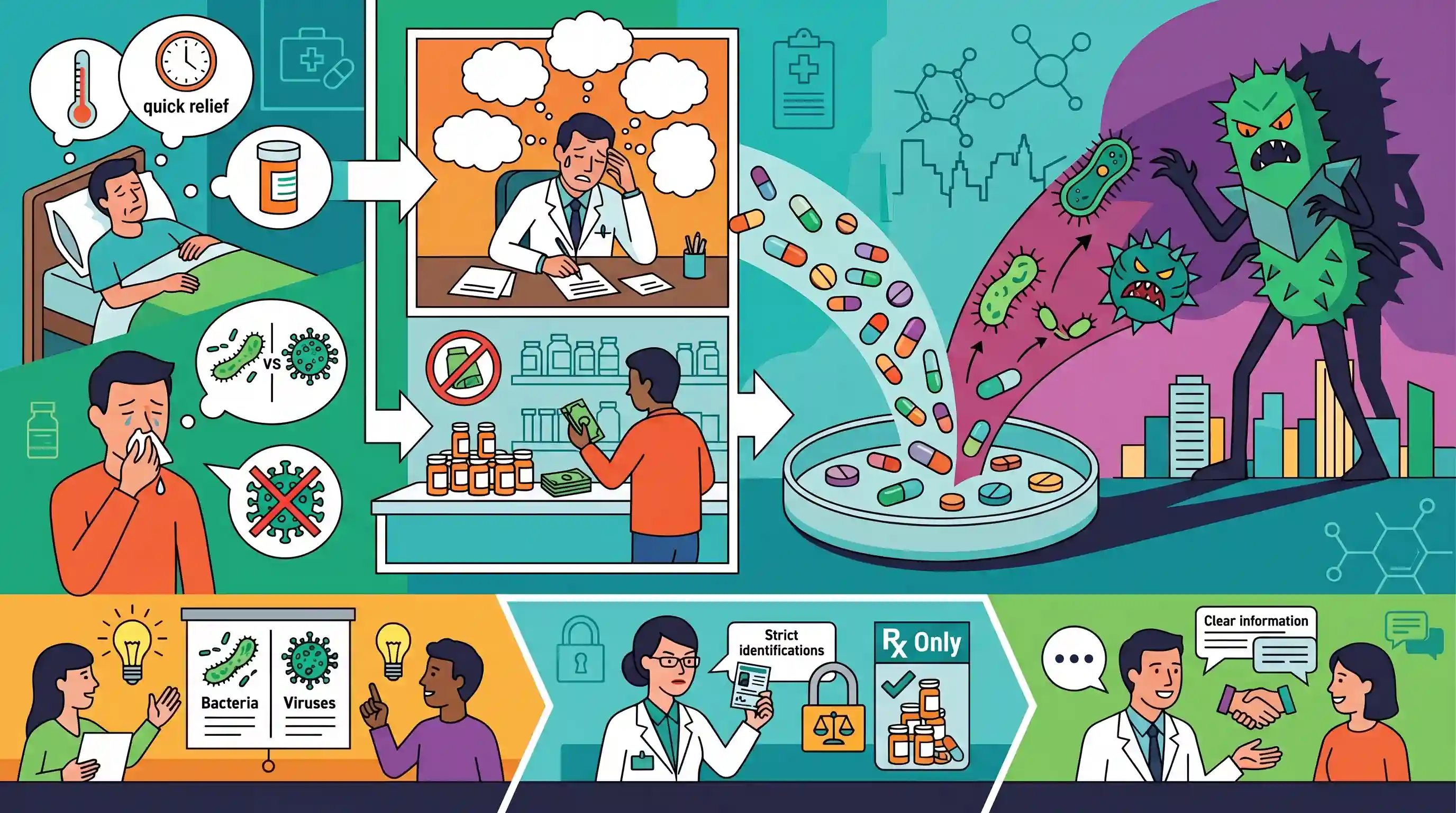
A recent study highlights that patient perceptions and demands are primary drivers of frivolous and unnecessary antibiotic use in India. Patients often hold misconceptions that antibiotics cure all ailments, including viral infections, and expect quick relief. This pressures physicians into overprescribing and encourages self-medication via over-the-counter purchases. This behavioral trend exacerbates the growing public health crisis of Antimicrobial Resistance (AMR), underscoring the urgent need for enhanced health literacy, stricter enforcement of pharmacy regulations, and improved doctor-patient communication.
Key Points
- Patient demand and misconceptions about the efficacy of antibiotics for viral ailments are major drivers of unnecessary antibiotic prescriptions.
- The expectation of quick relief pressures medical practitioners into overprescribing, while poor regulatory enforcement allows for rampant over-the-counter self-medication.
- This frivolous usage significantly accelerates Antimicrobial Resistance (AMR) and the rise of multi-drug resistant (MDR) pathogens in India.
- Addressing AMR requires targeted behavioral interventions and improved public health literacy alongside strict enforcement of drug dispensation laws.
Important Terms
Antimicrobial Resistance (AMR)

The ability of microorganisms like bacteria and viruses to resist drugs that once killed them, making infections harder to treat and increasing disease spread.
UPSC context
GS Paper 3 (Science & Technology); tests public health threats and the 'One Health' strategy.
Schedule H1 (Drugs and Cosmetics Rules)
A specific category under India's Drugs and Cosmetics Rules (1945) that mandates a red-bordered warning and prescription-only sale for high-end antibiotics and anti-TB drugs.
UPSC context
GS Paper 3 (Regulation/Health); tests domestic legal frameworks to curb self-medication and antibiotic misuse.
Red Line Campaign
An Indian government awareness initiative marking prescription-only antibiotics with a vertical red line on packaging to warn consumers against over-the-counter (OTC) purchases.
UPSC context
GS Paper 2 (Governance/Health); tests public health communication and behavioral interventions to prevent drug resistance.
Indian Council of Medical Research (ICMR)
The apex body in India for the formulation, coordination, and promotion of biomedical research; it operates the National AMR Surveillance and Research Network (AMRSN).
UPSC context
GS Paper 2 (Statutory/Non-statutory Bodies); tests knowledge of institutional frameworks for health surveillance.
AWaRe Classification (WHO)
A WHO stewardship tool categorizing antibiotics into Access, Watch, and Reserve groups to optimize use and preserve the effectiveness of 'last-resort' medicines.
UPSC context
GS Paper 2 (International Organizations); tests understanding of global health standards and drug stewardship.
Prelims Trap
"The 'Red Line Campaign' mandates a vertical red line to distinguish generic medicines from branded drugs."
The Red Line Campaign is exclusively for prescription antibiotics to deter unprescribed OTC usage, not to differentiate generics from branded drugs.
Static Concepts Connected
What is the regulatory difference between Schedule H and Schedule H1 drugs?
- Schedule H: General prescription drugs that cannot be sold retail without a registered medical practitioner's prescription.
- Schedule H1: Introduced in 2013 for 3rd/4th gen antibiotics and narcotics; requires pharmacists to maintain a separate sales register with patient/doctor details for three years.
- Red Line Campaign: A visual mandate on the packaging of Schedule H/H1 antibiotics to warn patients against over-the-counter consumption.
How does the 'One Health' approach address Antimicrobial Resistance (AMR)?
- Interconnectedness: It acknowledges that human health is inextricably linked to animal health and the shared environment.
- Animal Husbandry: Seeks to curb the prophylactic use of critical human antibiotics as artificial growth promoters in livestock and poultry.
- Environmental Management: Aims to regulate pharmaceutical manufacturing effluents and agricultural runoff that act as breeding grounds for superbugs.
Cross-Topic Patterns
AMR + Animal Husbandry
Colistin misuse in poultry farming for growth promotion acts as a major vector for AMR, linking human health challenges directly to agricultural economics.
Pharma Effluents + Water Pollution
Untreated Active Pharmaceutical Ingredient (API) manufacturing waste drives environmental genetic mutations in water bodies, creating Multi-Drug Resistant pathogens independently of human consumption.

Expect a multi-statement question in 2026 linking Schedule H1 rules, the Red Line campaign, and the One Health approach to tackling AMR.
Linked PYQs · 2
Linked PYQs · 2
- 2014MainsGS3
Can overuse and free availability of antibiotics without Doctor's prescription, be contributors to the emergence of drug-resistant diseases in India? What are the available mechanisms for monitoring and control? Critically discuss the various issues involved.
- 2019PrelimsGS1
Which of the following are the reasons for the occurrence of multi-drug resistance in microbial pathogens in India? 1. Genetic predisposition of some people 2. Taking incorrect doses of antibiotics to cure diseases 3. Using antibiotics in livestock farming 4. Multiple chronic diseases in some people Select the correct answer using the code given below.
