Implementation Performance and Wage Gaps in MGNREGA Scheme
Source:The Hindu ↗
Why It Matters
MGNREGA is a cornerstone of India's rural social safety net. Analyzing state-specific implementation gaps—such as wage deficits, declining workdays, and failure to mitigate drought distress—provides critical case-study material for UPSC Mains answers on poverty alleviation, welfare scheme evaluation, and rural governance.
Summary
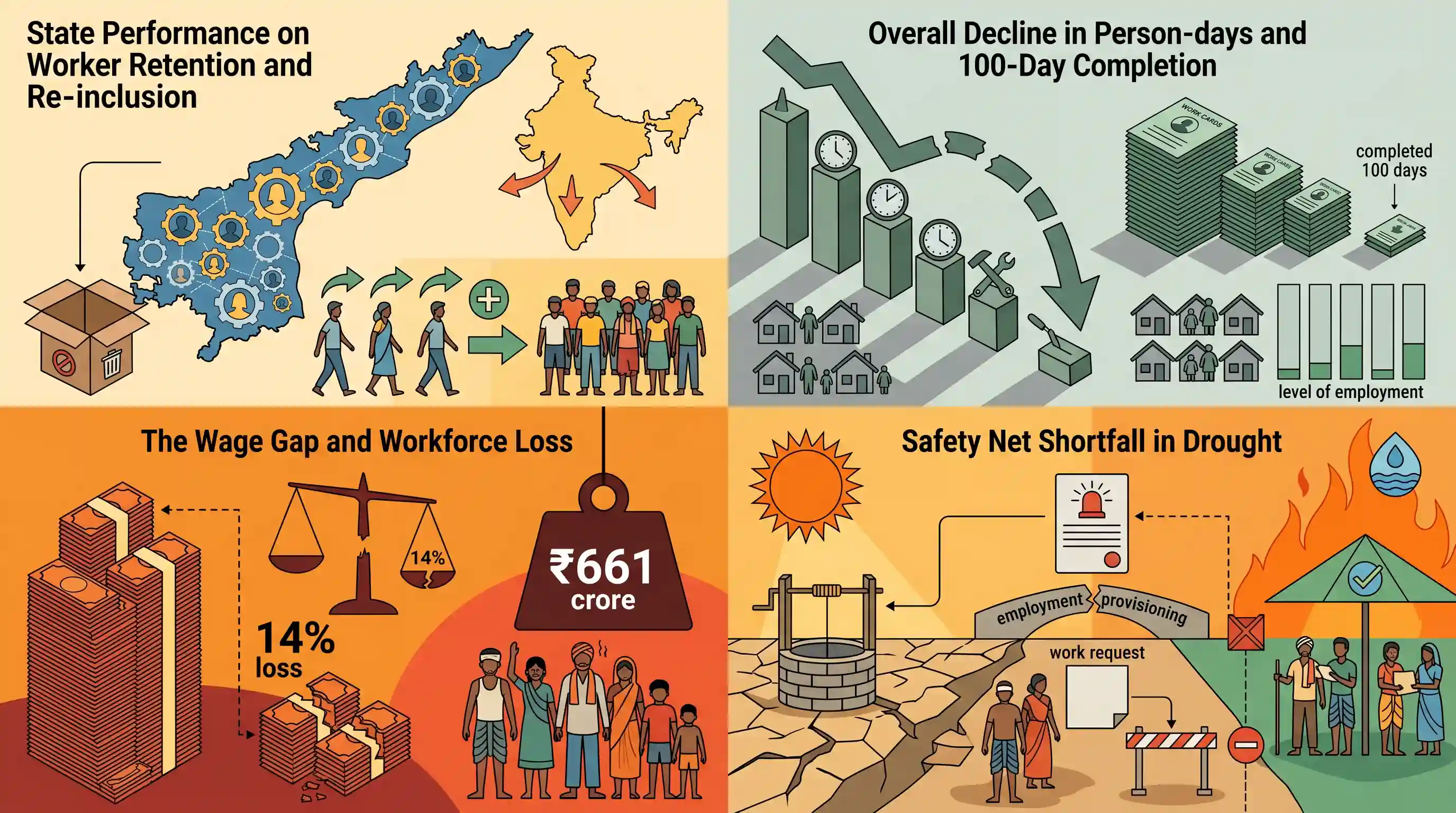
A study by LibTech India highlights both achievements and critical gaps in the implementation of the Mahatma Gandhi National Rural Employment Guarantee Act (MGNREGA) in Andhra Pradesh during FY 2024-25. While the state outperformed the national average in worker retention and successfully re-included many beneficiaries, it saw a significant overall decline in person-days generated and the number of households completing 100 days of work. A major concern is the persistent wage gap, with workers receiving 14% less than the notified minimum wage, leading to an estimated ₹661 crore loss for the rural workforce. Additionally, the scheme fell short in providing a crucial safety net during severe drought conditions in specific districts, indicating a disconnect between distress declarations and employment provisioning.
Key Points
- A recent study by LibTech India analyzed MGNREGA implementation in Andhra Pradesh for FY 2024-25, revealing a mixed performance.
- Positive outcomes include the successful re-inclusion of previously excluded workers and a participation retention rate of 56.6%, which is higher than the national average.
- However, overall employment generation declined, with 2.8 crore fewer person-days provided and a 33.7% drop in households completing the guaranteed 100 days of work.
- Workers faced a substantial wage gap, earning an average of ₹41.3 less than the notified wage of ₹300 per day, resulting in a collective income loss of ₹661 crore.
- The scheme also failed to act as a robust safety net during local droughts, with inadequate employment provisioning in 54 severely drought-affected mandals.
Important Terms
Mahatma Gandhi National Rural Employment Guarantee Act (MGNREGA)

A 2005 social security law guaranteeing 100 days of annual unskilled manual work to rural households, providing a legal "right to work" to alleviate poverty.
UPSC context
GS Paper II (Welfare Schemes) and GS Paper III (Employment/Inclusive Growth). Core topic for social justice and rural development.
Person-days
A unit of measurement for MGNREGA work where one person working for one day equals one person-day; it quantifies the total employment volume generated.
UPSC context
GS Paper III (Employment). Used to evaluate scheme performance and distress levels in rural economies.
Wage Gap (MGNREGA)
The disparity between the Centre-notified MGNREGA wage (linked to CPI-AL) and the statutory state minimum agricultural wage, often leading to workers earning less than legal minimums.
UPSC context
GS Paper II (Social Justice). Tests understanding of wage-setting mechanisms, federal issues, and worker rights.
LibTech India
An action-research collective of engineers and scientists that analyzes official data and digital infrastructure to improve transparency and accountability in Indian welfare delivery.
UPSC context
GS Paper II (Governance/Transparency). Example of civil society using "Liberation Technology" for social audits and policy advocacy.
Social Audit
A mandatory community-led assessment of MGNREGA works and records to ensure transparency, prevent corruption, and verify that assets were created and wages paid correctly.
UPSC context
GS Paper II (Governance/Accountability). Critical tool for participatory democracy and decentralization.
Unemployment Allowance
A legal provision where the State must pay workers a daily allowance if they are not provided work within 15 days of their formal demand.
UPSC context
GS Paper II (Social Justice). Highlights the rights-based nature and legal accountability of the scheme.
Demand-Driven Scheme
The unique design of MGNREGA where employment is not allocated top-down but is triggered only when a rural worker formally requests or "demands" work.
UPSC context
GS Paper III (Employment). Essential for understanding fiscal planning and counter-cyclical nature of the scheme.
Prelims Trap
"If work is not provided within 15 days, the Central Government pays an unemployment allowance."
While the Centre funds 100% of the unskilled wage cost, the financial burden of paying the unemployment allowance falls squarely on the State Government to enforce local accountability.
Static Concepts Connected
What are the core constitutional DPSP mandates actualized by MGNREGA?
- Article 41 (Right to Work): Directs the State to secure the right to work, education, and public assistance in cases of unemployment or distress.
- Article 43 (Living Wage): Mandates the State to secure a living wage, a decent standard of life, and full enjoyment of leisure for workers.
- Article 40 (Village Panchayats): Empowers Gram Panchayats as the principal planning, implementation, and social audit authorities for grassroots development schemes.
How is the financial burden for MGNREGA shared between the Centre and States?
- Unskilled Labour (100% Centre): The Central Government bears the entire cost of wages for unskilled manual labour.
- Material Costs (75:25 Split): The costs of materials and wages for skilled/semi-skilled workers are shared 75% by the Centre and 25% by the State.
- Unemployment Allowance (100% State): Fully funded by the State Government if the local administration fails to provide demanded work within 15 days.
Cross-Topic Patterns
Climate Adaptation and Rural Safety Nets
Expanding guaranteed work from 100 to 150 days during notified droughts bridges social welfare with disaster management, framing MGNREGA as India's primary rural climate adaptation tool.
Inflation Indexing vs Minimum Wages Act
Persistent wage gaps highlight the friction between State-notified minimum wages and MGNREGA wages, which are centrally notified and indexed to the Consumer Price Index for Agricultural Labourers (CPI-AL).

A 2026 multi-statement question will likely test the legal liability of the unemployment allowance and the CPI-AL wage-indexing mechanism.
Linked PYQs · 3
Linked PYQs · 3
- 2019PrelimsGS1
The Service Area Approach was implemented under the purview of
- 2015MainsGS2
Though there have been several different estimates of poverty in India, all indicate reduction in poverty levels over time. Do you agree? Critically examine with reference to urban and rural poverty indicators.
- 2020MainsGS2
Micro-Finance as an anti-poverty vaccine, is aimed at asset creation and income security of the rural poor in India". Evaluate the role of the Self Help Groups in achieving the twin objectives along with empowering women in rural India.
