Obstructive Sleep Apnoea and Geriatric Mental Health Risks
Source:The Hindu ↗
Why It Matters
The article highlights the interconnected nature of physical health (sleep disorders) and psychological/cognitive well-being in older adults. This underscores the necessity for comprehensive geriatric care policies and highlights gaps in routine mental health screening—a crucial aspect of welfare state healthcare planning under GS Paper 2.
Summary
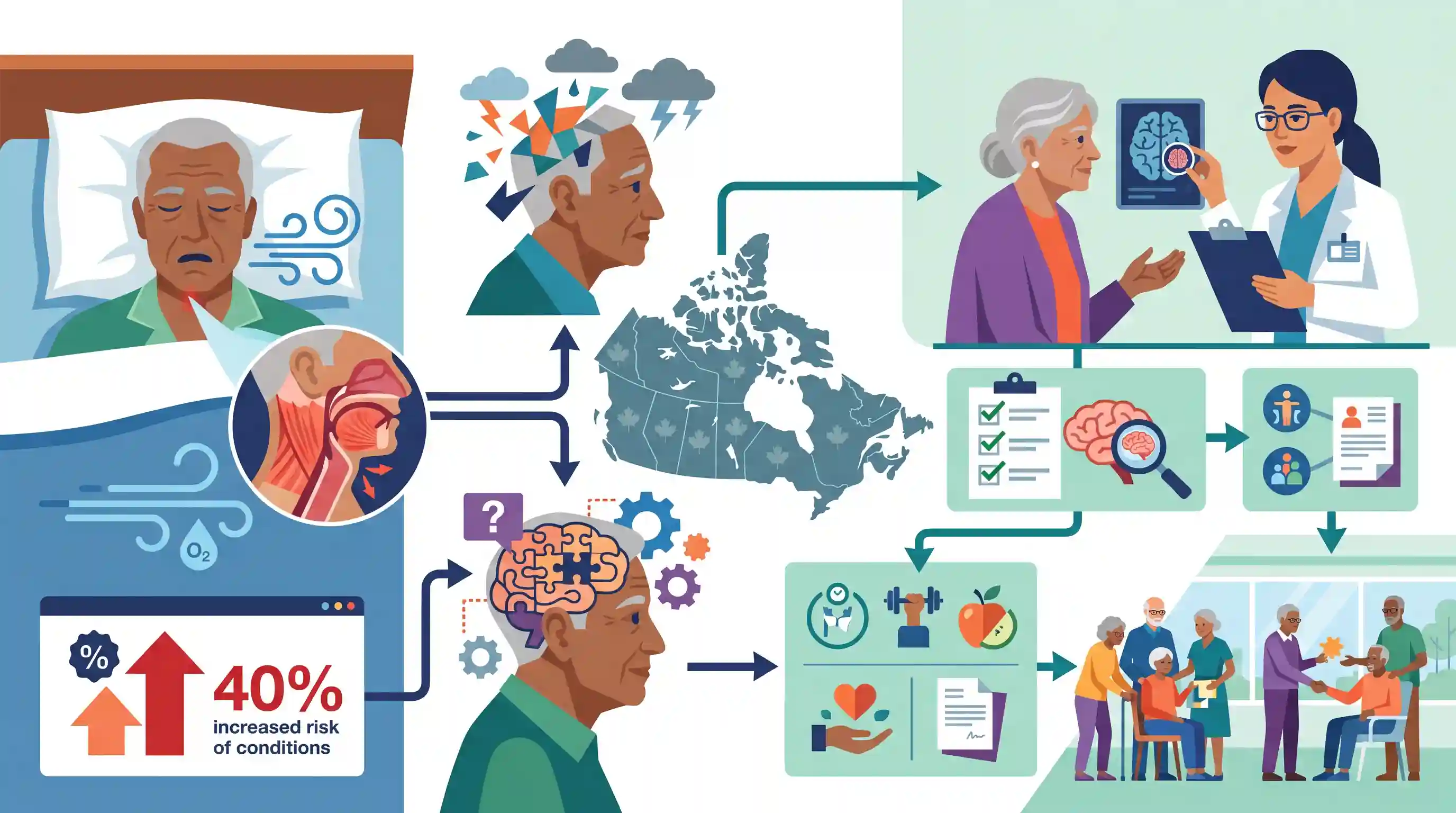
A comprehensive study of older adults in Canada, published in the JAMA Network Open, has linked obstructive sleep apnoea (OSA) with a 40% increased risk of mental health conditions like anxiety and mood disorders. OSA—a condition where throat muscles relax and narrow airways, disrupting breathing and oxygen levels during sleep—has also been tied to cognitive impairment and dementia. The findings underscore the importance of introducing systematic mental health screenings for the ageing population and integrating prevention measures to improve holistic cognitive and psychological outcomes in geriatric care.
Key Points
- A long-term Canadian study found that older adults with obstructive sleep apnoea (OSA) have a 40% increased chance of experiencing mental health conditions, such as anxiety and mood disorders.
- OSA occurs when throat muscles relax and restrict airways during sleep, causing poor sleep quality and decreased blood oxygen levels.
- Besides mental health issues, sleep apnoea is also linked to a heightened risk of cognitive impairment and dementia.
- Women, lower-income individuals, and those with poorer life satisfaction or health were shown to have a higher susceptibility to new mental health issues related to OSA.
- The findings emphasize the critical need to integrate systematic mental health and cognitive screening into geriatric care strategies for older adults with sleep disorders.
Important Terms
Obstructive Sleep Apnoea (OSA)

A respiratory disorder where throat muscles relax intermittently during sleep, blocking airways and causing significant oxygen desaturation and disrupted sleep patterns.
UPSC context
GS Paper III (Health); understanding chronic lifestyle diseases and their systemic impacts on mental and physical well-being.
Geriatric Care
Specialized medical and social care for the elderly (60+). India's elderly population is projected to reach 20% of the total population by 2050.
UPSC context
GS Paper II (Social Justice); addressing demographic transitions, dependency ratios, and the rights of vulnerable sections.
Cognitive Impairment
A state where mental skills like memory, attention, or language are less sharp than expected for a person's age, often serving as a precursor to dementia.
UPSC context
GS Paper II (Health); critical for designing screening protocols in mental health and geriatric care policy.
Dementia
A progressive syndrome involving deterioration in cognitive function beyond normal aging, affecting memory, thinking, and daily independence.
UPSC context
GS Paper II/III (Social Issues/Health); analyzing the socio-economic burden and the need for a national dementia policy.
Treatment Gap
The difference between the number of people who need care for a condition and those who actually receive it. India's mental health gap is approximately 85%.
UPSC context
GS Paper II (Health); used as a metric to evaluate the efficacy and accessibility of public health interventions.
Mental Healthcare Act, 2017
Legislation that guarantees every person access to mental healthcare and treatment from services run or funded by the government, while decriminalizing suicide.
UPSC context
GS Paper II (Governance); essential for questions on health rights, legal frameworks, and social welfare schemes.
Prelims Trap
Obstructive Sleep Apnoea is a neurological disorder where the brain fails to signal the breathing muscles.
This describes Central Sleep Apnoea (CSA). Obstructive Sleep Apnoea (OSA) is a physical airway blockage (throat muscles relaxing), even though it causes neurological and mental health consequences.
Static Concepts Connected
What are the primary types of Sleep Apnoea?
- Obstructive (OSA): The most common form, caused by a physical blockage of the airway due to throat muscles relaxing during sleep.
- Central (CSA): Occurs when the brain fails to send proper electrical signals to the muscles that control breathing.
- Complex Sleep Apnoea: Also known as treatment-emergent central sleep apnoea, it is a combination of both obstructive and central sleep apnoea.
What is the National Programme for the Health Care of the Elderly (NPHCE)?
- Objective: Launched in 2010 to provide accessible, affordable, and high-quality long-term, comprehensive care services to the ageing population (60+ years).
- Integration: Operates across primary, secondary, and tertiary healthcare levels, now increasingly synergizing with Ayushman Bharat Health and Wellness Centres for grassroots geriatric screening.
Cross-Topic Patterns
Intersecting vulnerabilities in Geriatric Care
The study highlights that lower-income individuals and women face higher susceptibility to OSA-induced mental health issues, bridging GS2 Health with GS1 Society (feminization of ageing and poverty).
NCDs and Mental Health convergence
Physical ailments (like OSA) causing cognitive decline (dementia/anxiety) demonstrates why India's NP-NCD (National Programme for Non-Communicable Diseases) must structurally converge with the National Mental Health Programme at primary care levels.

Expect a GS2 Mains question linking India's ageing demographic with the urgent need to converge NCD protocols and mental health (NMHP).
Linked PYQs · 2
Linked PYQs · 2
- 2020MainsGS2
In order to enhance the prospects of social development, sound and adequate health care policies are needed particularly in the fields of geriatric and maternal health care. Discuss.
- 2021MainsGS2
“Besides being a moral imperative of a Welfare State, primary health structure is a necessary precondition for sustainable development.” Analyze.
