Land Use Patterns Impacting Water Quality in Loktak Lake
Source:The Hindu ↗
Why It Matters
Loktak Lake, with its unique 'phumdi' ecosystem and Keibul Lamjao National Park, is a perennial favorite for UPSC Prelims. Additionally, this study provides a concrete, real-world case study for Mains GS3 answers regarding the environmental impacts of shifting cultivation (jhum), agricultural runoff, and the importance of forest cover in maintaining riverine water quality.
Summary
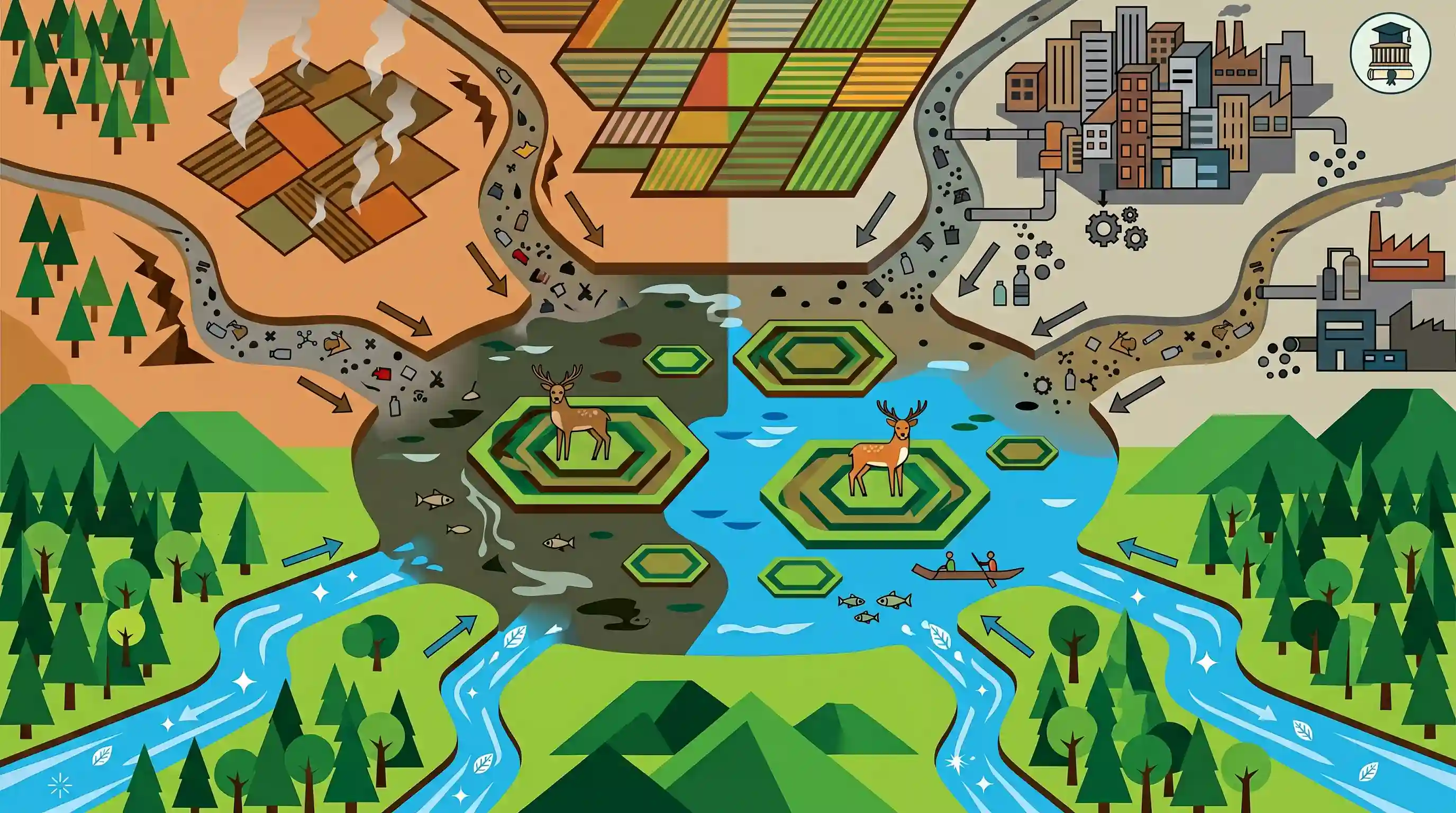
A recent study by Nagaland University has highlighted the direct link between changing land-use patterns—particularly agriculture, shifting cultivation (jhum), and urbanization—and the declining water quality of rivers feeding Manipur’s Loktak Lake. The Nambul River, heavily impacted by agriculture and human settlements, was found to be the most polluted, followed by the Khuga River, which suffers from extensive jhum cultivation. In contrast, rivers like the Iril and Thoubal, which flow through forested areas, maintain far better water quality. The findings underscore the urgent need for sustainable land-use management to protect the Loktak Lake ecosystem, a Ramsar Site vital to the region's economy and the sole habitat of the endangered Sangai deer.
Key Points
- A study by Nagaland University linked changing land-use patterns, such as agriculture and urbanization, to deteriorating water quality in rivers feeding Manipur's Loktak Lake.
- The Nambul River is the most polluted due to agricultural runoff and human settlements, while the Khuga River suffers primarily from extensive shifting (jhum) cultivation in its catchment.
- Rivers flowing through heavily forested landscapes, such as the Iril and Thoubal rivers, displayed significantly better water quality, demonstrating the protective ecosystem services of forests.
- Loktak Lake is an internationally recognized Ramsar Site and is listed on the Montreux Record; it features unique floating vegetation called 'phumdi' and hosts the Keibul Lamjao National Park, the last natural refuge of the endangered Sangai deer.
Important Terms
Loktak Lake

The largest freshwater lake in Northeast India, located in Manipur. It is a Ramsar site known for its unique floating islands (phumdis) and high biodiversity, including the endangered Sangai deer.
UPSC context
GS Paper I/III; significant for Northeast India's drainage systems, biodiversity hotspots, and wetland conservation.
Ramsar Convention
An intergovernmental treaty signed in 1971 in Ramsar, Iran, providing a framework for the conservation and 'wise use' of wetlands of international importance through national and international cooperation.
UPSC context
GS Paper III; core environmental framework for wetland management and international treaties.
Montreux Record
A register under the Ramsar Convention listing wetlands where ecological changes have occurred or are likely to occur due to human interference. Loktak Lake and Keoladeo National Park are India's current listings.
UPSC context
GS Paper III; critical for identifying threatened ecosystems and national conservation priorities.
Keibul Lamjao National Park
The world’s only floating national park, located in Manipur's Loktak Lake. It consists primarily of floating phumdis and serves as the last natural refuge for the endangered Sangai deer.
UPSC context
GS Paper I/III; unique geographical feature and a primary site for wildlife conservation in India.
Sangai (Brow-antlered deer)
Also called the brow-antlered or 'dancing' deer, this endangered species is endemic to Manipur. It is the state animal and resides exclusively on the phumdis of Keibul Lamjao.
UPSC context
GS Paper III; flagship species often tested under Biodiversity and Endangered Species sections.
Phumdis
Heterogeneous masses of vegetation, soil, and organic matter that float on Loktak Lake. They form thick, resilient mats that support local livelihoods, wildlife, and even the world's only floating national park.
UPSC context
GS Paper I/III; unique ecological and physical geographical feature of the Manipur river basin.
Shifting Cultivation (Jhum)
A traditional slash-and-burn agricultural method where forest patches are cleared and burned for cultivation. Shortened cycles are now linked to significant soil erosion and pollution of water bodies.
UPSC context
GS Paper I/III; key topic for agricultural patterns, tribal economy, and environmental degradation.
Prelims Trap
Loktak Lake was successfully removed from the Montreux Record.
Aspirants confuse Loktak with Chilika Lake (removed in 2002). Loktak is still on the Montreux Record due to continuous pollution and hydrological changes.
Static Concepts Connected
What is the Montreux Record under the Ramsar Convention?
- Definition: A register of Ramsar wetland sites where ecological character has changed, is changing, or is likely to change.
- Root Causes: Primarily driven by technological developments, pollution, or other human interference.
- Indian Sites: Currently, only Keoladeo National Park (Rajasthan) and Loktak Lake (Manipur) are on the record. Chilika Lake (Odisha) was removed.
What are the unique characteristics of the Sangai deer?
- Strict Endemism: Endemic to Manipur and strictly restricted to the floating phumdis (biomass) of Keibul Lamjao National Park.
- Conservation Status: Listed as Endangered on the IUCN Red List and protected under Schedule I of the Wildlife Protection Act, 1972.
- Physical Adaptation: Evolved distinctive hooves adapted to walking on the spongy, floating biomass, earning it the moniker 'dancing deer'.
Cross-Topic Patterns
Jhum agriculture and downstream siltation
Shifting cultivation strips catchment forests, triggering severe soil erosion. This runoff transports heavy silt and agricultural nutrients downstream, degrading Ramsar wetlands through eutrophication and sedimentation.
Hydropower infrastructure vs. Wetland ecology
UPSC often connects infrastructure to wetland decline. The Ithai Barrage prevents Loktak's phumdis from settling during the dry season, robbing the floating biomass of essential soil nutrients.

Expect a multi-statement question matching NE Indian rivers (Nambul, Iril) to their basins, or linking land-use to Montreux Record status.
Linked PYQs · 3
Linked PYQs · 3
- 2015PrelimsGS1
Which of the following National Parks is unique in being a swamp with floating vegetation that supports a rich biodiversity?
- 2024MainsGS3
Industrial pollution of river water is a significant environmental issue in India. Discuss the various mitigation measures to deal with this problem and also the government's initiatives in this regard.
- 2021PrelimsGS1
With reference to India, Didwana, Kuchaman, Sargol and Khatu are the names of
