STEM Education Awareness Gaps and Gender Barriers in India
Source:The Hindu ↗
Why It Matters
Highlights the socio-economic and cultural barriers hindering women in STEM, crucial for GS1 (Society/Women's Empowerment) and GS2 (Social Justice/Education/Human Resources). It provides empirical data points on the gender gap and underscores the importance of career counseling and female role models.
Summary
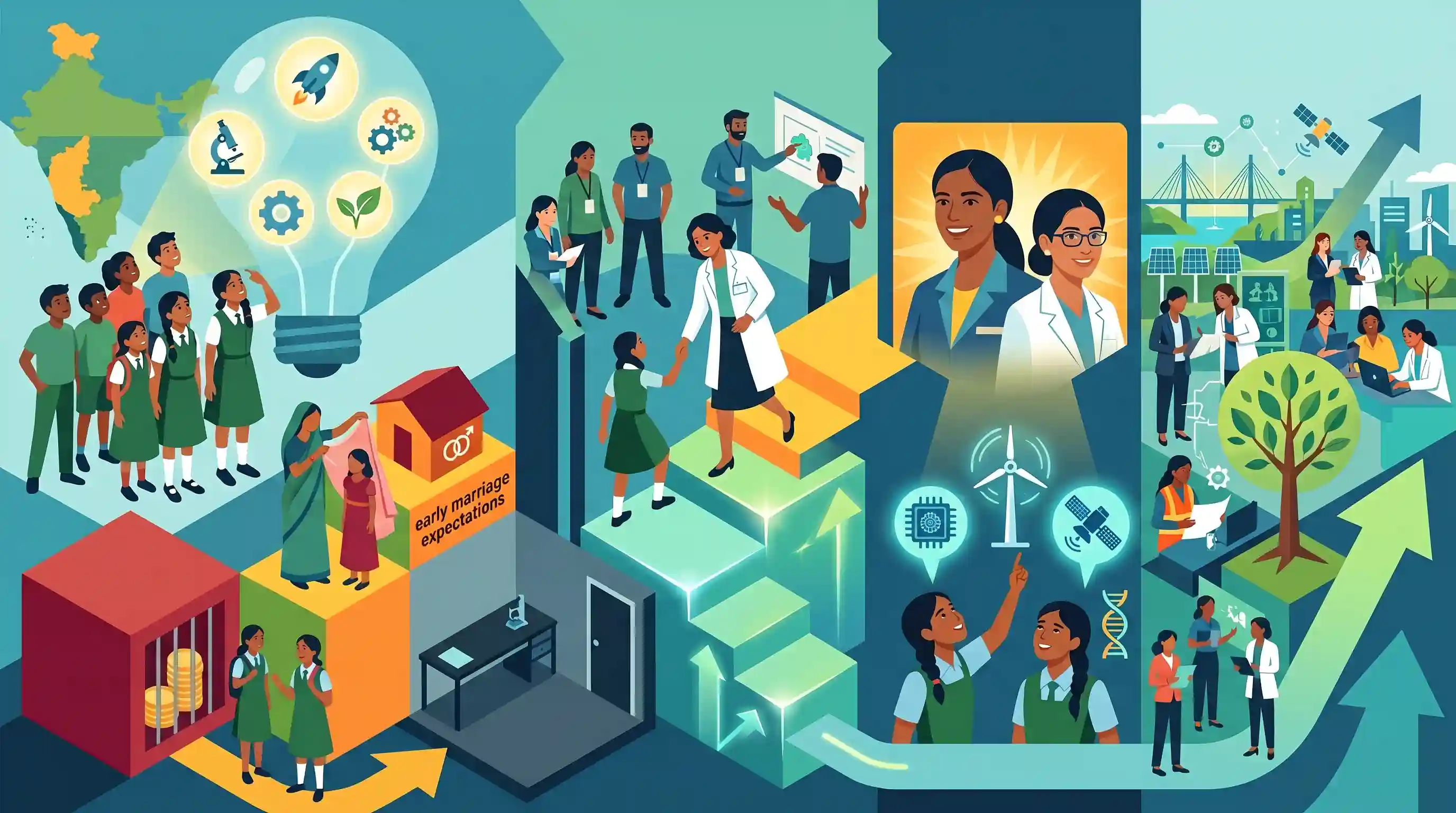
A study by Child Rights and You (CRY) highlights a widespread lack of awareness about STEM (Science, Technology, Engineering, and Mathematics) fields among adolescents in South India. Despite a high intrinsic interest in science, particularly among girls, systemic barriers such as financial constraints, cultural norms, early marriage expectations, and poor access to labs and career counseling hinder their progress. The study emphasizes the urgent need for targeted interventions to bridge the gender gap in education and notes that exposure to female role models in STEM significantly increases girls' career aspirations.
Key Points
- Over 50% of adolescents in South India are unaware of what STEM stands for, despite 54% of girls showing enthusiasm for science streams.
- Access to critical resources is poor: only around 20% have regular access to science labs and roughly a third receive career counseling.
- Major barriers to STEM education include financial constraints, lack of family support, early marriage expectations, and cultural norms (particularly for girls).
- The presence of female role models in STEM significantly boosts aspirations among adolescents to pursue similar careers (53% vs. 46%).
Important Terms
Child Rights and You (CRY)

Indian NGO (est. 1979) focused on underprivileged children’s rights to education, healthcare, and protection from exploitation through community and policy advocacy.
UPSC context
GS II (Social Justice/NGOs); examines the role of civil society in implementing child-centric welfare schemes and educational reforms.
STEM (Science, Technology, Engineering, and Mathematics)
Educational curriculum integrating Science, Technology, Engineering, and Mathematics to foster interdisciplinary learning, critical thinking, and innovation essential for a technology-driven workforce.
UPSC context
GS III (Science & Tech); focuses on educational frameworks required for India’s global competitiveness and technological self-reliance.
Gender Gap in STEM
The statistical disparity between high female enrollment in STEM education and low professional workforce representation, often attributed to systemic societal and institutional barriers.
UPSC context
GS II/III (Social Justice/Women Empowerment); analyzes structural challenges hindering women’s participation in high-productivity sectors and economic inclusivity.
Human Resource Development (HRD)
Process of enhancing the workforce's knowledge, skills, and productivity through education and training to drive inclusive economic growth and social development.
UPSC context
GS II (Management of Social Sector); tests understanding of policies aimed at improving human capital for sustainable development.
Skill Development
Practical, industry-aligned training designed to bridge the gap between formal education and professional employability, exemplified by the "Skill India" mission.
UPSC context
GS III (Economy/HRD); focuses on vocational training strategies to improve youth employability and fulfill industry labor demands.
Demographic Dividend
Economic growth potential arising from a larger proportion of working-age individuals (15-64 years) relative to dependents, requiring investments in education and health.
UPSC context
GS I/III (Population/Economy); examines India's opportunity to leverage its young population for growth through policy interventions.
Prelims Trap
"The report highlighting widespread lack of STEM awareness among adolescents was released by NITI Aayog."
Aspirants often assume major education/STEM statistics are published by official government bodies like NITI Aayog or the Ministry of Education, not NGOs.
Static Concepts Connected
What are the key government initiatives to promote Women in STEM?
- Vigyan Jyoti: Encourages meritorious girls in high school to pursue higher education in underrepresented Science, Technology, Engineering, and Mathematics (STEM) fields.
- KIRAN Scheme: Knowledge Involvement in Research Advancement through Nurturing aims to bring women scientists back into the workforce after career breaks.
- GATI Framework: Gender Advancement for Transforming Institutions is a pilot framework assessing and promoting gender equity within higher education and S&T institutions.
What constitutional and legal backing do NGOs have in India?
- Article 19(1)(c): Grants citizens the fundamental right to form associations or unions, forming the constitutional basis for civil society organizations.
- Registration Laws: NGOs typically register under the Societies Registration Act (1860), the Indian Trusts Act (1882), or Section 8 of the Companies Act (2013).
- FCRA 2010: Foreign funding for domestic NGOs is strictly monitored and regulated under the Foreign Contribution (Regulation) Act, 2010.
Cross-Topic Patterns
Women in STEM + Demographic Dividend
India's transition to a knowledge economy requires leveraging its female demographic dividend, making STEM equity both a critical social justice goal and a macroeconomic imperative.
Civil Society Audits + Governance
Similar to Pratham's ASER for foundational literacy, grassroots studies by NGOs like CRY expose infrastructure blind spots, steering targeted educational policy interventions.

Expect a Mains 2026 question linking the 'leaky pipeline' of Women in STEM to grassroots infrastructure deficits and socio-cultural norms.
Linked PYQs · 3
Linked PYQs · 3
- 2016MainsGS2
Demographic Dividend in India will remain only theoretical unless our manpower becomes more educated, aware, skilled and creative." What measures have been taken by the government to enhance the capacity of our population to be more productive and employable?
- 2021MainsGS2
“Though women in post-Independent India have excelled in various fields, the social attitude towards women and feminist movement has been patriarchal." Apart from women education and women empowerment schemes, what interventions can help change this milieu?
- 2024MainsGS1
Distinguish between gender equality, gender equity and women's empowerment. Why is it important to take gender concerns into account in programme design and implementation?
