Climate change impact on monsoon rainfall diurnal patterns
Source:The Hindu ↗
Why It Matters
Understanding the shift in rainfall patterns is critical for UPSC aspirants as it directly links climate change to tangible socio-economic challenges, such as urban disaster management, agricultural planning, and water security. It integrates physical geography with environmental ecology and urban planning.
Summary
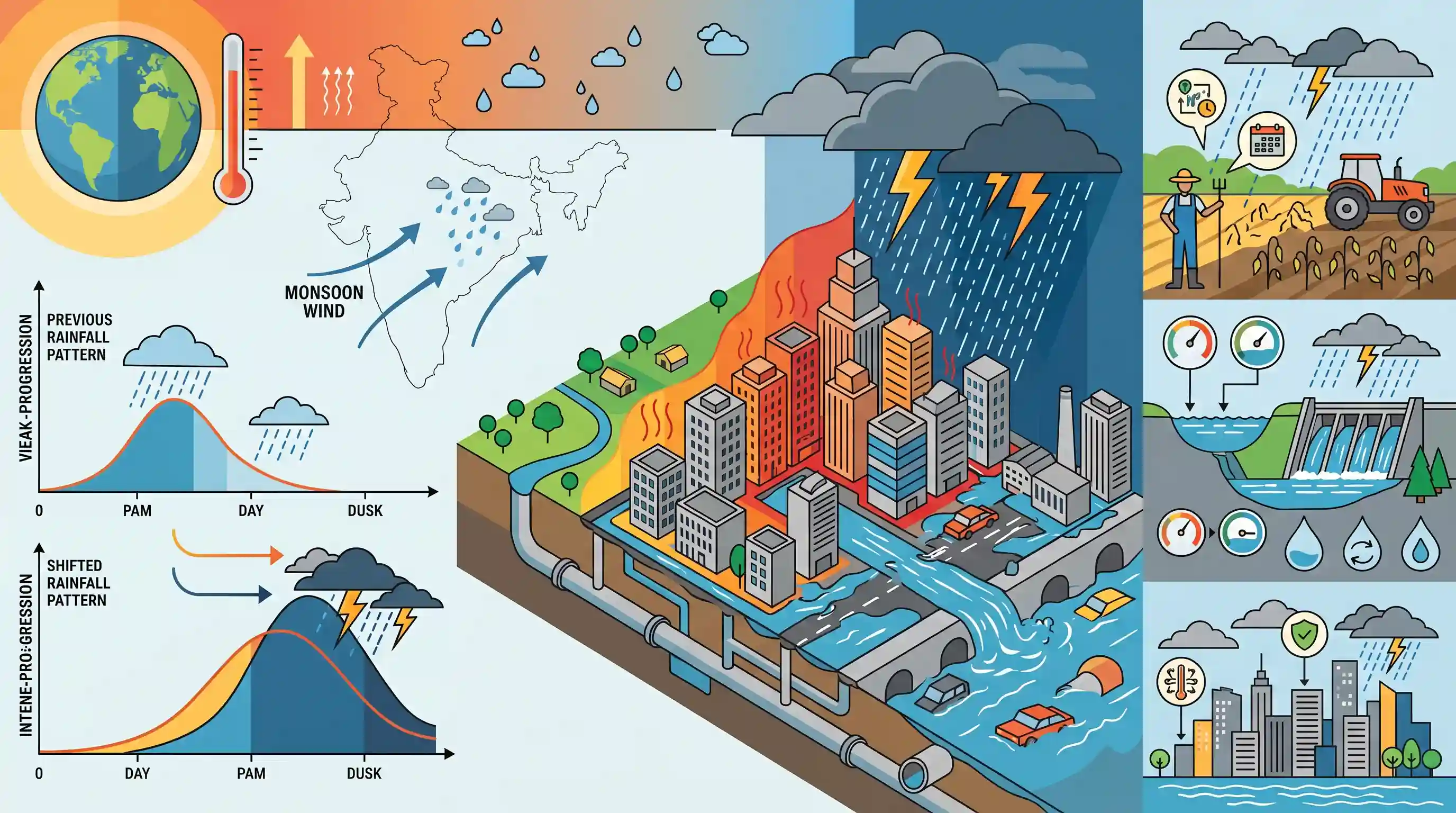
A recent study highlights a significant shift in the peak timing of maximum rainfall, driven by global warming and changing atmospheric thermodynamics. Increased temperatures enhance the atmosphere's moisture-holding capacity, altering both diurnal and seasonal precipitation cycles. In regions like India, this shift manifests in the changing behavior of the monsoon, with intense, short-duration rainfall events increasingly occurring later in the day or season. Coupled with local factors like the Urban Heat Island effect, these shifting rainfall patterns increase the vulnerability of major cities to sudden urban flooding, while also disrupting agricultural schedules and water security planning.
Key Points
- Climate change and rising atmospheric temperatures are altering the thermodynamic structure of the atmosphere, leading to a noticeable shift in the peak time of maximum rainfall.
- The diurnal cycle of precipitation is increasingly affected, with heavy, intense rainfall events often shifting towards late evening or night due to increased moisture-holding capacity of the air.
- Such shifts in the Indian monsoon's behavior delay seasonal rainfall peaks, heavily disrupting traditional agricultural sowing cycles and challenging water resource management.
- Local factors like rapid urbanization and the Urban Heat Island (UHI) effect further modify microclimates, exacerbating the unpredictability of rainfall and increasing the risk of urban flooding.
Important Terms
India Meteorological Department (IMD)

Established in 1875, it is India's principal agency under the Ministry of Earth Sciences for meteorological observations, weather forecasting, and seismology.
UPSC context
GS Paper 1 (Geography) & GS Paper 3 (Disaster Management); tests knowledge of institutional frameworks for weather monitoring and disaster preparedness.
Intergovernmental Panel on Climate Change (IPCC)
A UN body established in 1988 by WMO and UNEP to provide scientific assessments on climate change, its implications, and potential future risks.
UPSC context
GS Paper 3 (Environment); critical for understanding global climate reports (e.g., AR6) and international climate policy frameworks.
Urban Heat Island (UHI) Effect
A localized phenomenon where urban areas experience significantly higher temperatures than surrounding rural areas due to human activity, concrete surfaces, and lack of vegetation.
UPSC context
GS Paper 1 (Urbanization) & GS Paper 3 (Environment); relevant for urban planning, heatwave management, and urban flooding studies.
Diurnal Cycle of Precipitation
The 24-hour variation in precipitation, typically peaking in the late afternoon or early evening over land due to solar heating and convective instability.
UPSC context
GS Paper 1 (Geography); tests understanding of meso-scale weather patterns and their interaction with global warming.
Atmospheric Thermodynamics
The study of heat, energy, and moisture transformations in the atmosphere, such as increased moisture-holding capacity (7% per degree Celsius) under the Clausius-Clapeyron relationship.
UPSC context
GS Paper 1 (Climatology); fundamental for explaining extreme weather events and shifts in rainfall intensity due to warming.
Indian Monsoon Dynamics
The seasonal reversal of winds and associated rainfall patterns in India, increasingly characterized by extreme variability and 'erratic' shifts due to climate change.
UPSC context
GS Paper 1 (Geography); a core syllabus topic testing knowledge of monsoon mechanisms, variability, and agricultural impacts.
Prelims Trap
Global warming increases the total number of evenly distributed rainy days across the monsoon season.
Warming increases moisture capacity, leading to fewer but highly intense rainfall bursts. Aspirants often confuse 'more extreme rainfall' with 'more rainy days'.
Static Concepts Connected
How does the Urban Heat Island (UHI) effect alter local precipitation?
- Thermal low-pressure: Concrete and asphalt absorb heat, creating localized thermal low-pressure zones over cities.
- Moisture convergence: These low-pressure zones draw in surrounding moist air, forcing it to rise rapidly and condense over the urban area.
- Aerosol cloud seeding: High urban particulate matter acts as condensation nuclei, further intensifying sudden heavy downpours in and downwind of cities.
What is the thermodynamic relationship between temperature and atmospheric moisture?
- Moisture-holding capacity: Dictated by the Clausius-Clapeyron relation, the atmosphere can hold approximately 7% more moisture for every 1°C rise in temperature.
- Burst intensity: This elevated threshold means precipitation requires more time to build up but releases in highly concentrated, massive bursts rather than gentle drizzles.
Cross-Topic Patterns
Late monsoon shifts vs. Dam rule curves
Delayed monsoon withdrawal clashes with traditional reservoir 'rule curves' (which aim for full capacity by September), directly linking atmospheric shifts to man-made flood disasters under GS3.
Urban microclimates & Sponge City infrastructure
The intersection of UHI-induced heavy localized rains and rapid concretization necessitates 'Sponge City' urban planning guidelines (permeable pavements, urban wetlands) to mitigate sudden waterlogging.

Expect a 2026 multi-statement Prelims question linking the Clausius-Clapeyron relation, UHI-induced low-pressure, and urban flooding.
Linked PYQs · 4
Linked PYQs · 4
- 2015MainsGS1
How far do you agree that the behaviour of the Indian monsoon has been changing due to humanizing landscapes? Discuss.
- 2016MainsGS1
Major cities of India are becoming more vulnerable to flood conditions. Discuss.
- 2022MainsGS3
Discuss global warming and mention its effects on the global climate. Explain the control measures to bring down the level of greenhouse gases which cause global warming, in the light of the Kyoto Protocol, 1997.
- 2013MainsGS1
Bring out the causes for the formation of heat islands in the urban habitat of the world.
