Government Rejects Foreign Study on Riverine Antibiotic Levels
Source:The Hindu ↗
Why It Matters
The environmental spread of antibiotics is a major driver of Antimicrobial Resistance (AMR), a critical public health and environmental security issue. Understanding India's regulatory countermeasures—such as NAP-AMR, Bio-medical Waste Rules, and Zero Liquid Discharge mandates—is vital for questions on pollution mitigation and health policy.
Summary
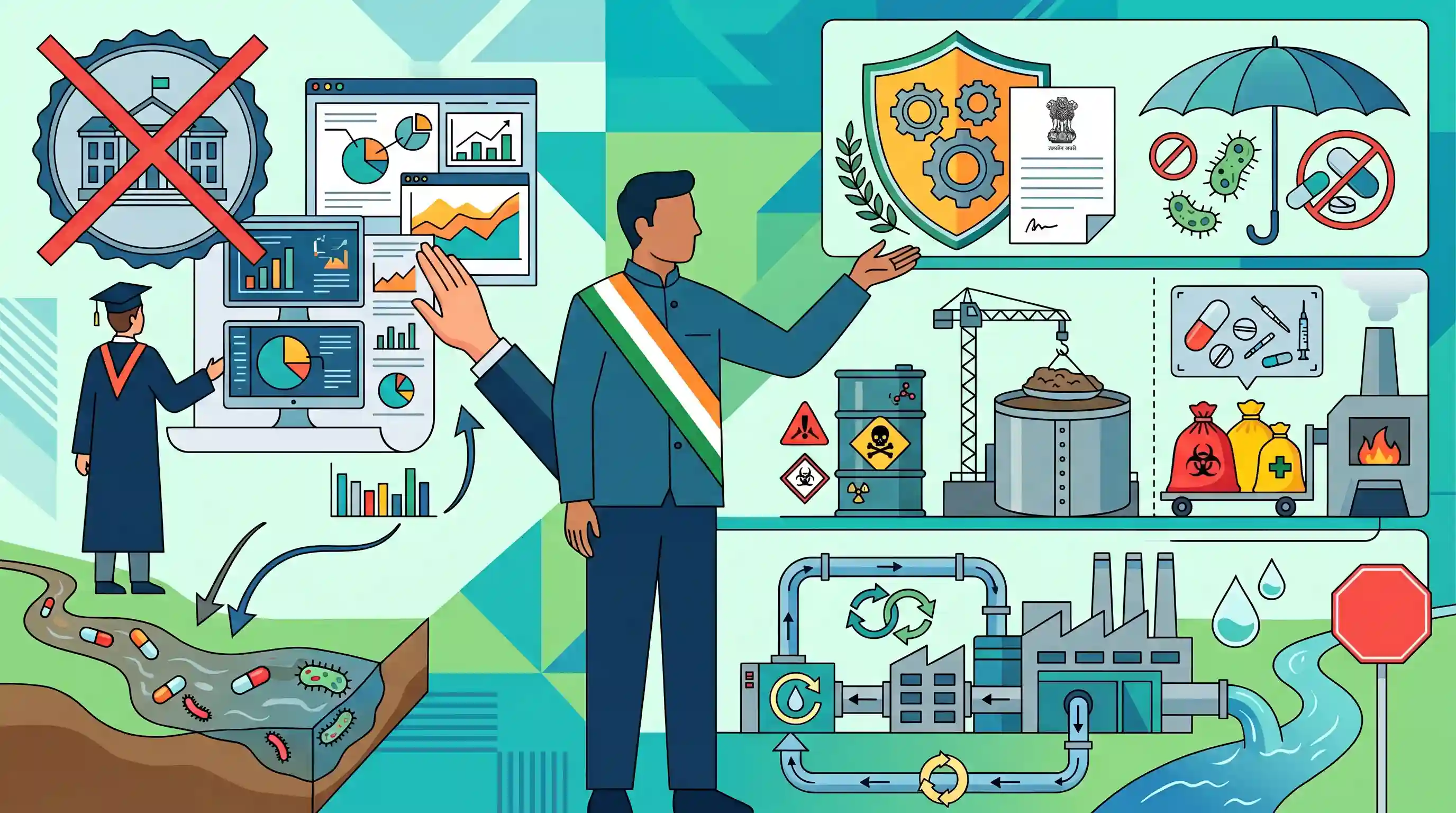
The Indian government has dismissed a study by McGill University that alleged widespread antibiotic contamination in Indian rivers, clarifying that the research was based on models and "assumptions" rather than actual water sampling. Responding in Parliament, the Ministry of Environment highlighted that despite the lack of a targeted government study on riverine antibiotic levels, robust regulatory frameworks are in place. These include the National Action Plan on Antimicrobial Resistance (NAP-AMR) and strict waste management protocols. The government emphasized that pharmaceutical sludge is classified as hazardous waste, expired drugs are managed under Bio-medical Waste Management Rules, and the CPCB mandates Zero Liquid Discharge for pharmaceutical effluents to prevent water pollution.
Key Points
- The Indian government rejected a McGill University study alleging severe antibiotic contamination in Indian rivers, stating it relied on modelling and assumptions rather than empirical testing.
- Union Minister Kirti Vardhan Singh stated that while India has not conducted a specific study on antibiotic pollution in rivers, it has implemented the National Action Plan on Antimicrobial Resistance (NAP-AMR).
- Under the Hazardous Waste Rules 2016, chemical and biological sludge generated from wastewater treatment in pharmaceutical manufacturing is classified as hazardous waste.
- The Central Pollution Control Board promotes Zero Liquid Discharge for treated effluents from pharmaceutical industries, and expired medicines are governed by Bio-medical Waste Management Rules.
Important Terms
National Action Plan on Antimicrobial Resistance (NAP-AMR)

India's strategic framework to combat antimicrobial resistance using a 'One Health' approach. The updated NAP-AMR 2.0 (2025-2029) integrates human, animal, and environmental sectors to regulate antibiotic misuse.
UPSC context
GS Paper II (Health) and Paper III (S&T/Environment). Vital for understanding public health policy and disease containment.
Bio-medical Waste Management Rules, 2016
Regulations mandating the scientific segregation and disposal of healthcare waste. It simplifies waste classification into four color-coded categories (Yellow, Red, White, Blue) to prevent environmental and infectious contamination.
UPSC context
GS Paper III (Environment). Tests knowledge of waste management legislation and pollution control in the healthcare sector.
Hazardous and Other Wastes (Management and Transboundary Movement) Rules, 2016
Framework for regulating hazardous waste handling and cross-border movement. It prioritizes the "3Rs" (Reduce, Reuse, Recycle) and prohibits the import of hazardous waste into India for final disposal.
UPSC context
GS Paper III (Environment). Relevant for industrial pollution governance and compliance with the international Basel Convention.
Central Pollution Control Board (CPCB)
A statutory body established under the Water Act, 1974. It coordinates pollution control activities, sets environmental quality standards, and provides technical guidance to the Ministry of Environment.
UPSC context
GS Paper II (Statutory Bodies) and Paper III (Environment). Essential for institutional frameworks monitoring air and water quality.
Ministry of Environment, Forest and Climate Change (MoEFCC)
The nodal administrative agency of the Central Government for planning, promoting, and overseeing India’s environmental, forestry, and climate change policies, including pollution control and wildlife conservation.
UPSC context
GS Paper II (Governance). Central to understanding the executive structure and implementation of environmental laws in India.
Prelims Trap
Expired and discarded medicines are legally regulated under the Hazardous Waste Management Rules, 2016.
This is false. Expired medicines from healthcare facilities fall under the Bio-medical Waste Management Rules, whereas pharmaceutical manufacturing sludge is classified as Hazardous Waste.
Static Concepts Connected
What is the Zero Liquid Discharge (ZLD) policy mandated by CPCB?
- Core Concept: An engineering approach where 100% of wastewater is purified and recycled, leaving zero liquid discharge at the end of the industrial treatment cycle.
- Regulatory Target: Mandated by the CPCB for highly polluting industrial sectors, including pharmaceuticals, distilleries, and tanneries.
- Byproduct: The residual contaminants are reduced to solid waste (sludge) which must then be disposed of under Hazardous Waste Rules.
What are the core pillars of India's NAP-AMR?
- One Health Framework: Addresses AMR through the interconnected health of humans, animals, and the environment (including agricultural runoff and pharma wastewater).
- Surveillance: Establishes a national tracking network to monitor the emergence and spread of multi-drug resistant (MDR) pathogens.
- Infection Control: Focuses on optimizing antimicrobial usage across sectors, raising public awareness, and improving sanitation to prevent initial infections.
Cross-Topic Patterns
Environmental vectors in AMR
Pharma effluents in rivers act as a 'selective pressure' incubator for superbugs. This firmly links environmental pollution control to public epidemiology under the global One Health approach.
Waste Management Rule silos
UPSC often tests exact waste categorizations. E-waste, Biomedical, Hazardous, and Solid Waste are governed by distinct statutory frameworks notified under the umbrella Environment (Protection) Act, 1986.

AMR's 'One Health' approach combined with specific CPCB effluent norms or waste rule categorizations (Bio-medical vs Hazardous) is highly likely.
Linked PYQs · 5
Linked PYQs · 5
- 2024MainsGS3
Industrial pollution of river water is a significant environmental issue in India. Discuss the various mitigation measures to deal with this problem and also the government's initiatives in this regard.
- 2019PrelimsGS1
Which of the following are the reasons for the occurrence of multi-drug resistance in microbial pathogens in India? 1. Genetic predisposition of some people 2. Taking incorrect doses of antibiotics to cure diseases 3. Using antibiotics in livestock farming 4. Multiple chronic diseases in some people Select the correct answer using the code given below.
- 2022PrelimsGS1
Consider the following statements: 1. Biofilms can form on medical implants within human tissues. 2. Biofilms can form on food and food processing surfaces. 3. Biofilms can exhibit antibiotic resistance. Which of the statements given above are correct?
- 2024PrelimsGS1
"Membrane Bioreactors" are often discussed in the context of:
- 2019PrelimsGS1
In India, 'extended producer responsibility' was introduced as an important feature in which of the following?
