Supreme Court Ruling on Three-Language Option for Students
Source:The Hindu ↗
Why It Matters
Important for understanding judicial oversight on educational policies, language frameworks, and administrative implementation affecting students across states.
Summary
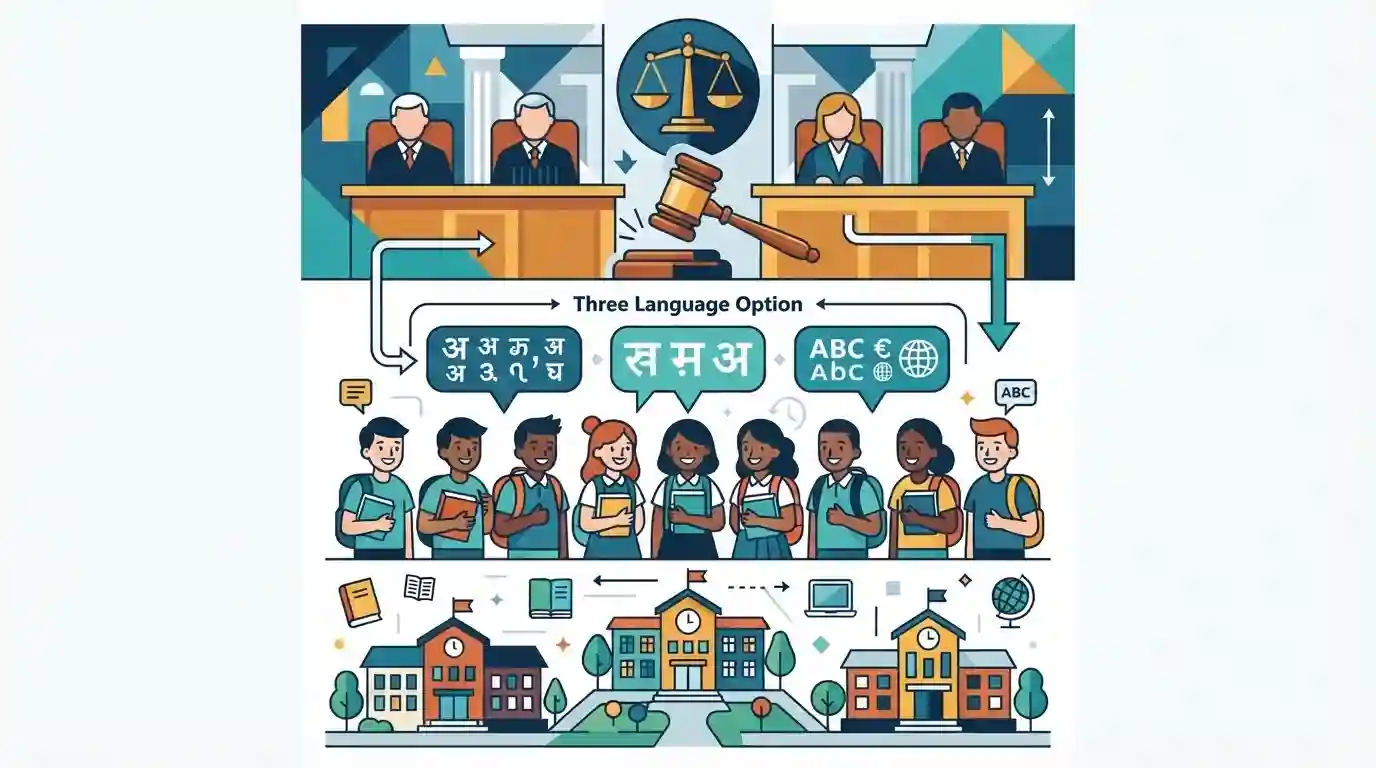
The Supreme Court ruled that students who opted for three languages can continue with them, addressing ongoing legal and policy dimensions surrounding language education frameworks in schools.
Key Points
- The Supreme Court clarified that students who have opted for three languages can continue with them.
- The ruling addresses issues related to educational policy implementation and student choices regarding language learning.
- Language education formulas often intersect with regional diversity, federal concerns, and administrative feasibility in schools.
Important Terms
Three-Language Formula

An educational framework originating from the Kothari Commission and reinforced in the NEP 2020, requiring students to study three languages (including at least two native Indian languages) in schools.
UPSC context
Important for GS Paper II (Social Justice - Education Policies, Federalism and Diversity). Tests your understanding of language policies in India.
Supreme Court
The highest judicial tribunal in India, which interprets the Constitution and resolves disputes involving fundamental rights, federal issues, and educational administration.
UPSC context
Crucial for GS Paper II (Indian Constitution, Judiciary, Judicial Review). Tests knowledge of judicial pronouncements on education and administrative frameworks.
Prelims Trap
uniform central statutory mandate
Aspirants often assume the Three-Language Formula is a rigid, mandatory central statute across all states, whereas education falls on the Concurrent List with significant state-level executive and legislative discretion.
Static Concepts Connected
What are the constitutional provisions and historical committee recommendations regarding the Three-Language Formula in India?
- Kothari Commission: Originated in the 1968 National Policy on Education, mandating study of Hindi, English, and a modern Indian language (preferably south Indian in non-Hindi states) in Hindi-speaking states, and regional language, Hindi, and English in non-Hindi states.
- Article 350A: Article 350A directs states to provide adequate facilities for instruction in the mother tongue at the primary stage to children belonging to linguistic minority groups.
- Special Officer: Appointed under Article 350B to investigate all matters relating to safeguards provided for linguistic minorities under the Constitution.
Cross-Topic Patterns
Three-Language Formula & Cooperative Federalism
Judicial interpretation of language formulas under educational boards mirrors debates on administrative federalism and regional legislative autonomy under Article 246 and the Concurrent List.

Supreme Court rulings on language formulas + Article 350A/350B safeguards likely to be tested via multi-statement prelims questions.
Linked PYQs · 3
Linked PYQs · 3
- 2019MainsGS2
From the resolution of contentious issues regarding distribution of legislative powers by the courts, 'Principle of Federal Supremacy' and 'Harmonious Construction' have emerged. Explain.
- 2020MainsGS2
How far do you think cooperation, competition and confrontation have shaped the nature of federation in India? Cite some recent examples to validate your answer.
- 2024PrelimsGS1
The Constitution (71st Amendment) Act, 1992 amends the Eighth Schedule to the Constitution to include which of the following languages? 1. Konkani 2. Manipuri 3. Nepali 4. Maithili Select the correct answer using the code given below:
