Birsa Munda Legacy and Tribal Welfare Campaigns
Source:The Hindu ↗
Why It Matters
Birsa Munda is a highly significant figure in Modern Indian History; his Ulgulan rebellion frequently features in both Prelims and Mains (GS1). Furthermore, the 150th anniversary celebrations tie into contemporary governance efforts like the PM-JANMAN campaign and Janjatiya Gaurav Divas, highlighting the ongoing focus on tribal welfare and social justice (GS2).
Summary
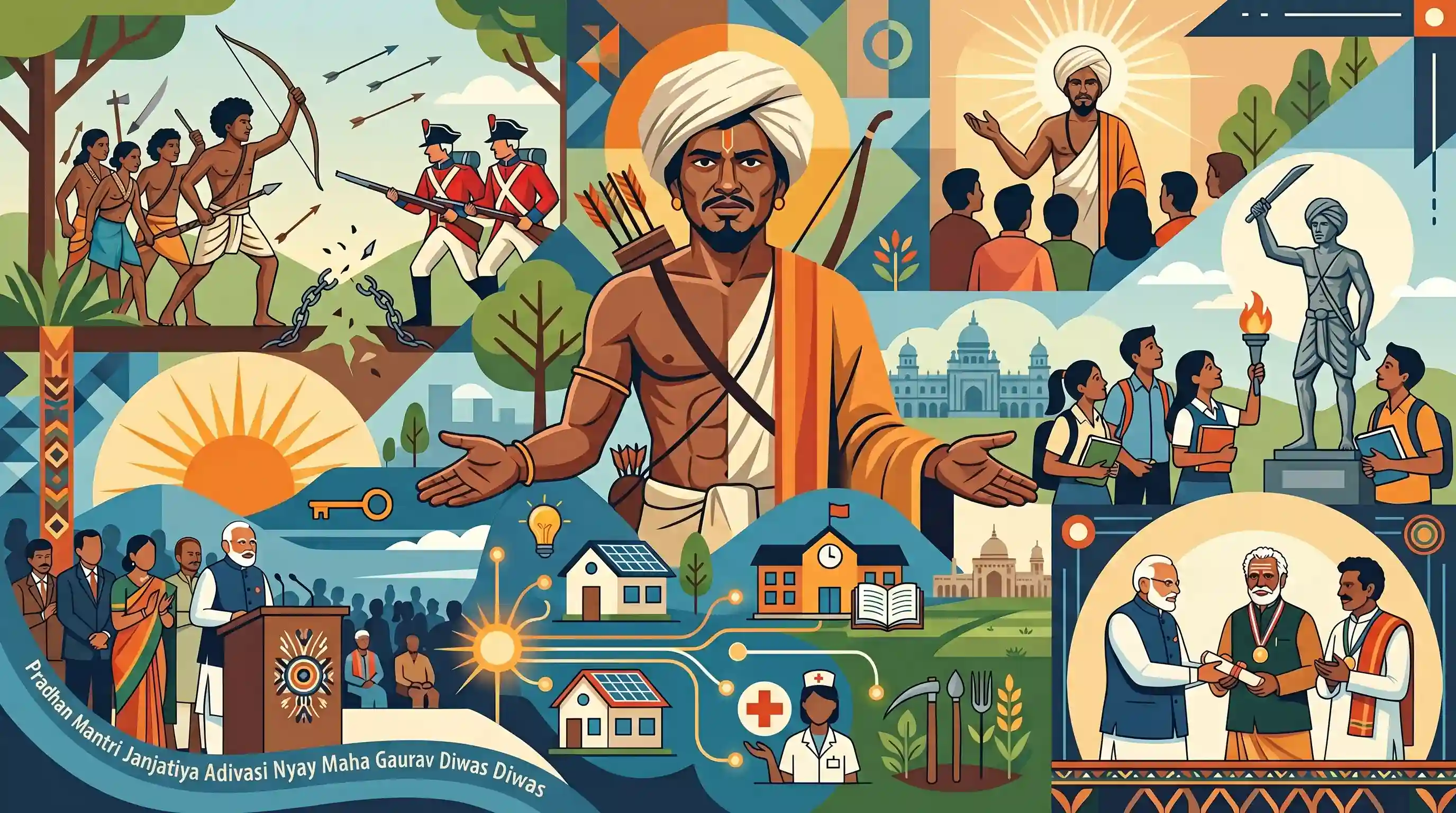
The 150th birth anniversary of tribal leader Birsa Munda was celebrated in Mysuru by the Karnataka State Tribal Research Institute and the district administration. Highlighting his early struggle against the British and his role as a spiritual guide, officials urged students to draw inspiration from his life. The event also saw the inauguration of the Pradhan Mantri Janjatiya Adivasi Nyay Maha Gaurav Diwas campaign, alongside calls for the effective implementation of tribal welfare schemes. Padma Shri awardees Amai Mahalinga Naik and Somanna were felicitated during the program.
Key Points
- The 150th birth anniversary of Birsa Munda was commemorated in Mysuru to honor his role as a tribal leader, spiritual guide, and freedom fighter against the British.
- The Pradhan Mantri Janjatiya Adivasi Nyay Maha Gaurav Diwas campaign was formally inaugurated during the event.
- Leaders emphasized the importance of tribal welfare schemes and ensuring that their benefits actually reach marginalized communities.
- The government has taken up the construction of 33 multipurpose buildings dedicated to the welfare of tribal communities.
- Padma Shri awardees Amai Mahalinga Naik and Somanna were felicitated at the ceremony.
Important Terms
Birsa Munda

A 19th-century tribal revolutionary from the Munda tribe who led the 'Ulgulan' uprising against British colonial exploitation and land dispossession in the Chotanagpur region.
UPSC context
GS Paper 1 (Modern Indian History); tests knowledge of tribal resistance movements and their socio-religious dimensions.
Janjatiya Gaurav Divas
Observed annually on November 15 since 2021 to honor tribal freedom fighters and preserve their legacy; it coincides with the birth anniversary of Birsa Munda.
UPSC context
Current Affairs/GS Paper 1 & 2; signifies state recognition of tribal history and tribal welfare policy shifts.
Ulgulan
Meaning 'Great Tumult,' this was the Munda Rebellion (1899–1900) led by Birsa Munda against British authorities, missionaries, and exploitative middlemen (Dikus) to establish self-rule.
UPSC context
GS Paper 1; a high-priority historical event frequently tested in Prelims for its unique terminology and specific location.
PM-JANMAN
A flagship mission launched in 2023 for the holistic development of Particularly Vulnerable Tribal Groups (PVTGs) through inter-ministerial convergence and saturation of basic facilities.
UPSC context
GS Paper 2 (Social Justice); critical for questions on government interventions for vulnerable sections and last-mile service delivery.
Particularly Vulnerable Tribal Groups (PVTGs)
A sub-category of Scheduled Tribes (75 groups) identified as having stagnant populations, extremely low literacy, and pre-agricultural technology, requiring prioritized government support.
UPSC context
GS Paper 2; essential for understanding tribal vulnerability frameworks and specific committee recommendations like the Dhebar Commission.
Tribal Research Institute (TRI)
State-level bodies (e.g., KSTRI in Mysuru) sponsored by the Ministry of Tribal Affairs to conduct research, document indigenous culture, and evaluate tribal welfare schemes.
UPSC context
GS Paper 2 (Governance); highlights institutional mechanisms for evidence-based policy formulation for tribal populations.
Prelims Trap
"The PM-JANMAN scheme aims to achieve 100% saturation of basic welfare services for all Scheduled Tribes across India."
PM-JANMAN specifically targets the 75 Particularly Vulnerable Tribal Groups (PVTGs), not all Scheduled Tribes. It focuses on 11 critical interventions like housing and road connectivity.
Static Concepts Connected
What were the core features and outcomes of the Munda Rebellion (Ulgulan)?
- Agrarian root: Protested the systematic erosion of the traditional Khuntkatti system (joint landholding) by colonial-backed jagirdars and thikadars.
- Spiritual dimension: Birsa declared himself a messenger of God (founder of the Birsait sect), blending socio-religious reform with political uprising against 'Dikus' (outsiders).
- Legislative outcome: Led to the enactment of the Chotanagpur Tenancy Act (1908), which legally restricted the transfer of tribal land to non-tribals.
How are Particularly Vulnerable Tribal Groups (PVTGs) classified in India?
- Dhebar Commission: Created the "Primitive Tribal Groups" (PTGs) category in 1973, which was later renamed to PVTGs in 2006.
- Identification criteria: Characterized by pre-agricultural level of technology, stagnant or declining population, extremely low literacy, and subsistence-level economy.
- Current demographics: There are 75 recognized PVTGs across 18 states and 1 Union Territory (A&N Islands), with Odisha having the highest number.
Cross-Topic Patterns
Indigenous knowledge & climate resilience
Amai Mahalinga Naik's revival of 'Surangas' (tunnel wells) connects tribal/indigenous ecological knowledge with traditional water harvesting systems, a recurring Geography and Disaster Management theme.
Forest Rights vs. Protected Areas
Somanna’s fight for Jenu Kuruba land rights highlights the continuous UPSC focus on the friction between wildlife conservation (like Nilgiri Biosphere Reserve) and the Forest Rights Act (FRA).

With Birsa Munda's 150th anniversary, expect a 2026 Prelims question mixing Ulgulan's socio-religious tenets with the 1908 CNT Act.
Linked PYQs · 3
Linked PYQs · 3
- 2020PrelimsGS1
With reference to the history of India, "Ulgulan" or the Great Tumult is the description of which of the following events?
- 2023MainsGS1
How did the colonial rule affect the tribals in India and what was the tribal response to the colonial oppression?
- 2023MainsGS2
“Development and welfare schemes for the vulnerable, by its nature, are discriminatory in approach.” Do you agree? Give reasons for your answer.
