State regulatory authority over educational institutions in India
Source:Indian Express ↗
Why It Matters
Provides a concrete example of how state governments use administrative tools (like NOCs) to assert regulatory authority over schools, reflecting broader federal dynamics and debates on ideological neutrality in education.
Summary
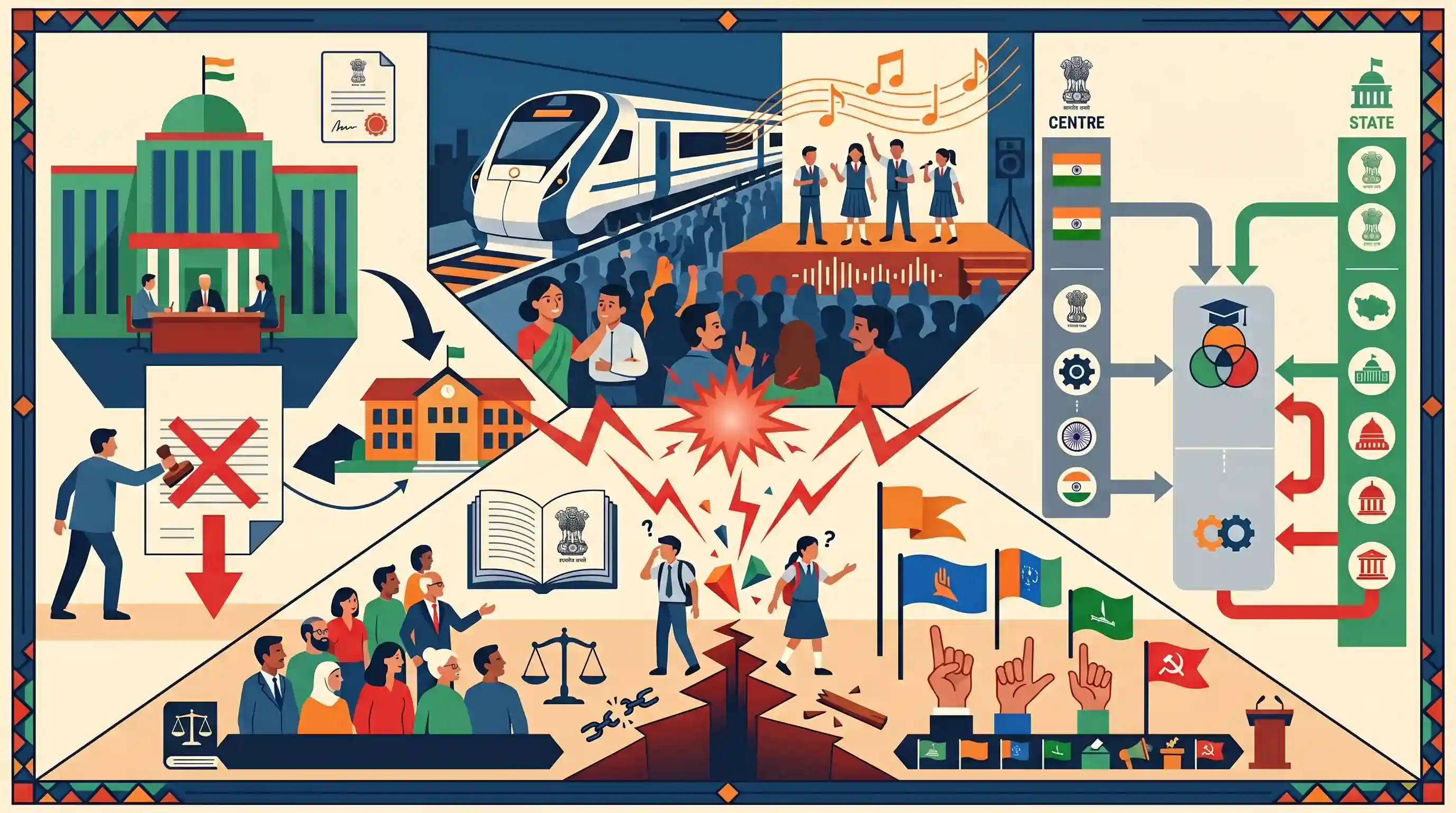
The controversy over students singing an RSS song at a Vande Bharat launch in Kerala brings the governance of educational institutions into focus. The state government's threat to revoke the school's No Objection Certificate (NOC) underscores the administrative control states exercise over education, which lies on the Concurrent List. The incident serves as a case study for topics involving Centre-State friction, the politicisation of educational spaces, and the balance between ideological expression and constitutional duties in public functions.
Key Points
- Kerala Education Minister ordered a probe after students of a private school sang an RSS song at a Vande Bharat train launch event.
- The minister warned that the school could lose its No Objection Certificate (NOC) if found violating state education guidelines.
- The incident highlights the regulatory power state governments hold over private schools via NOCs, even if they are affiliated with Central boards.
- It raises debates around the politicisation of students and the boundaries of ideological expression at official government functions.
Important Terms
Concurrent List

A list of 52 subjects in the Seventh Schedule of the Indian Constitution where both Union and State governments have the authority to legislate.
UPSC context
GS II: Federalism. Tests understanding of the division of powers and legislative competence between Centre and States.
Vande Bharat Express
India's first indigenously designed semi-high-speed, self-propelled train set, developed under the 'Make in India' initiative at the Integral Coach Factory, Chennai.
UPSC context
GS III: Infrastructure. Tests knowledge of indigenous technology and modernization of Indian Railways.
No Objection Certificate (NOC)
An administrative document issued by state authorities permitting private educational institutions to seek affiliation with national boards like CBSE or ICSE.
UPSC context
GS II: Governance. Tests knowledge of administrative control and regulatory frameworks governing the education sector.
Rashtriya Swayamsevak Sangh (RSS)
A right-wing Hindu nationalist volunteer organization founded in 1925, serving as the ideological progenitor for numerous Indian political and social affiliates.
UPSC context
GS I/II: Social/Political Organizations. Tests understanding of ideological movements and their role in the socio-political landscape.
42nd Constitutional Amendment Act
A landmark 1976 amendment that transferred 'Education' from the State List to the Concurrent List, significantly expanding Central legislative authority.
UPSC context
GS II: Constitution. Tests knowledge of major amendments and their impact on the federal balance of power.
Centre-State Relations
The constitutional framework (Articles 245-263) governing the legislative, administrative, and financial interactions between the Union and State governments.
UPSC context
GS II: Federalism. A core topic analyzing constitutional friction, cooperation, and the division of authority.
Prelims Trap
"Private schools affiliated to CBSE are exclusively regulated by the Union Government and exempt from State recognition."
Despite central curriculum affiliation, education is on the Concurrent List. State governments retain regulatory control via mandatory No Objection Certificates (NOCs) and RTE recognition.
Static Concepts Connected
How is jurisdiction over Education divided under the 7th Schedule?
- Original Status: Originally, education was placed under Entry 11 of the State List, giving states exclusive control.
- 42nd Amendment: The 42nd Constitutional Amendment Act (1976) transferred Education to the Concurrent List (Entry 25).
- Shared Jurisdiction: Both Union and States can legislate on it, but state laws yield to central laws in cases of repugnancy under Article 254.
What constitutional protections exist against forced singing in schools?
- Bijoe Emmanuel (1986): The Supreme Court held that expelling students for refusing to sing the National Anthem violates Articles 19(1)(a) and 25(1).
- Silent Respect: Standing respectfully during the National Anthem fulfills constitutional obligations; compelling vocal participation against deeply held religious beliefs is unconstitutional.
- Fundamental Duties: While Article 51A(a) makes respecting the National Anthem a fundamental duty, it cannot be legally enforced in a manner that infringes fundamental rights.
Cross-Topic Patterns
Education as a friction point
The NOC revocation threat adds to growing Centre-State friction over Concurrent List entries, mirroring recent disputes involving state opposition to NEET and the National Education Policy.
Freedom of Conscience vs Duties
Connects to fundamental rights jurisprudence (Bijoe Emmanuel case), frequently used to test the limits of free speech, religious freedom, and Article 51A duties in educational settings.

Expect a multi-statement question interlinking the 42nd Amendment's shift of 'Education', State NOC rules, and Art 19(1)(a).
Linked PYQs · 3
Linked PYQs · 3
- 2019MainsGS2
From the resolution of contentious issues regarding distribution of legislative powers by the courts, 'Principle of Federal Supremacy' and 'Harmonious Construction' have emerged. Explain.
- 2015PrelimsGS1
"To uphold and protect the Sovereignty, Unity and Integrity of India" is a provision made in the
- 2020PrelimsGS1
Other than the Fundamental Rights, which of the following parts of the Constitution of India reflect/reflects the principles and provisions of the Universal Declaration of Human Rights (1948)? 1. Preamble 2. Directive Principles of State Policy 3. Fundamental Duties Select the correct answer using the code given below:
