Student protests disrupt final day of Bihar Assembly monsoon session
Source:The Hindu ↗
Why It Matters
The disruption of the Bihar Assembly highlights parliamentary procedures such as the role of the Speaker in adjourning sessions and the use of censure motions. These procedural aspects, along with the dynamics of regional political parties (RJD, LJP) and ongoing controversies surrounding national entrance exams (NEET), are key focal points for BPSC Prelims testing State Governance and Current Affairs.
Summary
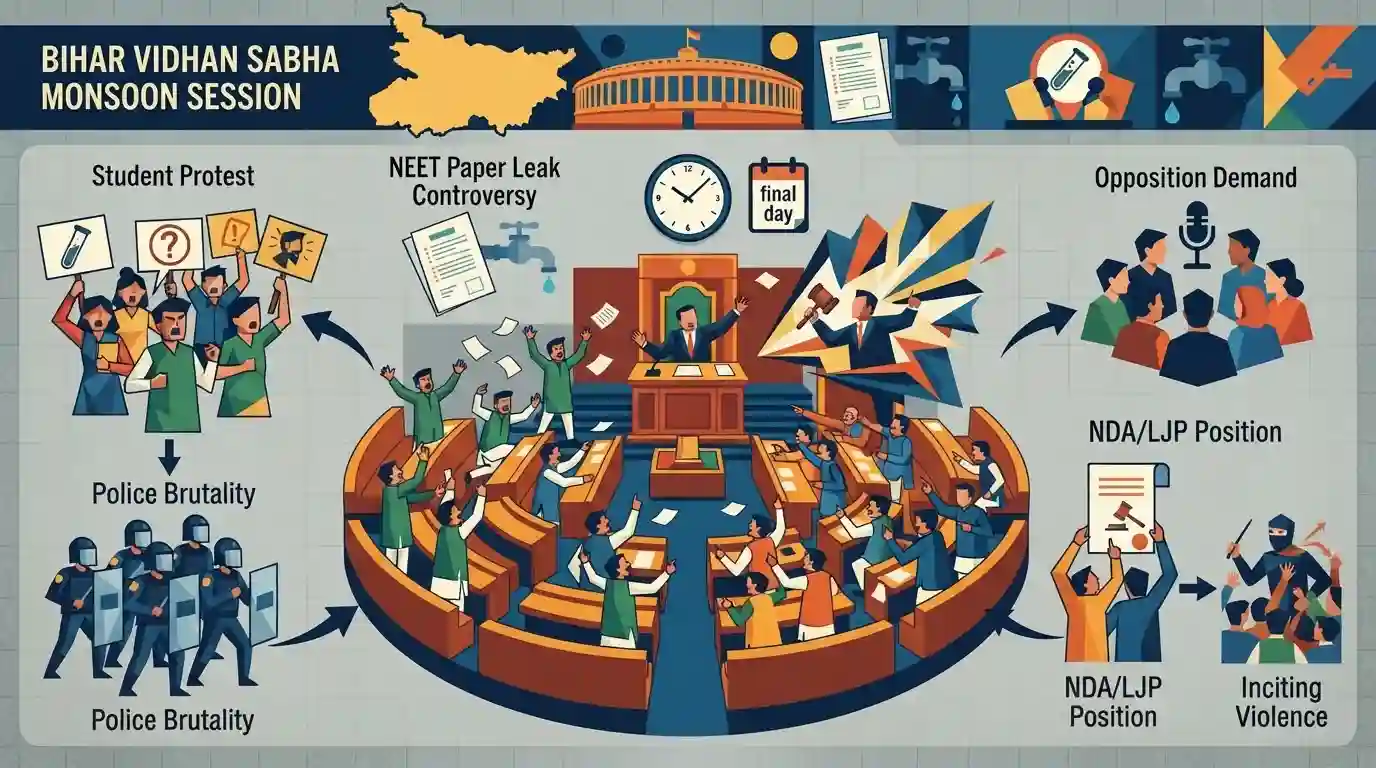
The final day of the Bihar Assembly's Monsoon session was adjourned due to massive uproar over the NEET paper leak controversy. Opposition parties, particularly the RJD, demanded discussions on student protests and alleged police brutality, while NDA partners like the LJP sought a censure motion, claiming miscreants were inciting violence under the guise of student protests.
Key Points
- The Bihar Assembly's Monsoon session concluded prematurely as Speaker Prem Kumar adjourned the House amid heavy protests over the NEET paper leak.
- RJD MLA Alok Mehta demanded an urgent discussion on the issue, citing student unrest and alleging police lathi charges and firing in places like Patna and Jehanabad.
- Student bodies in Bihar intensified their agitation, triggered by a parallel stir in Delhi led by the Cockroach Janta Party over irregularities in the NEET medical entrance test.
- LJP (Ram Vilas) MLA Raju Tiwari demanded a censure motion, alleging that goons disguised as students were responsible for the mayhem.
Important Terms
National Eligibility cum Entrance Test (NEET)

A nationwide entrance examination in India for admission to undergraduate medical programs like MBBS and BDS, conducted by the National Testing Agency (NTA).
UPSC context
Relevant for GS-2 (Education, Governance). It tests the state's capacity to ensure fairness and transparency in high-stakes professional education.
Rashtriya Janata Dal (RJD)
A regional Indian political party primarily based in Bihar. Founded in 1997 by Lalu Prasad Yadav, its traditional support base includes backward classes, Dalits, and Muslims.
UPSC context
Relevant for GS-2 (Indian Polity). Important for understanding regional politics, coalition dynamics, and representation of marginalized communities in India.
Lok Janshakti Party (Ram Vilas)
A regional political party based in Bihar, focusing on Dalit empowerment and social justice. Founded in 2000 by Ram Vilas Paswan, currently led by Chirag Paswan.
UPSC context
Relevant for GS-2 (Indian Polity). Highlights the role of regional parties, Dalit politics, and shifting alliances in state and national governments.
National Democratic Alliance (NDA)
A right-leaning coalition of political parties in India, formed in 1998 and led by the Bharatiya Janata Party (BJP). It currently forms the central government.
UPSC context
Relevant for GS-2 (Indian Polity). Key to understanding coalition governments, national politics, and center-state relations.
INDIA bloc
The Indian National Developmental Inclusive Alliance is a coalition of opposition parties formed ahead of the 2024 General Elections to challenge the ruling NDA.
UPSC context
Relevant for GS-2 (Indian Polity). Tests knowledge of political alliances, opposition unity, and their impact on India's democratic structure.
Prelims Trap
The Speaker of the State Legislative Assembly has the exclusive power to prorogue the House session amid massive uproar.
The Speaker can only adjourn a sitting. The power to prorogue (terminate) a session rests exclusively with the Governor under Article 174(2)(a) of the Constitution.
Static Concepts Connected
How does a Censure Motion differ from a No-Confidence Motion?
- Specific Target: It can be moved against an individual minister, a group, or the entire council, unlike a No-Confidence motion which only targets the entire council.
- Stating Reasons: It requires stating specific reasons or policies for its adoption, whereas a No-Confidence Motion does not need to state reasons.
- Resignation Not Bound: If passed, the Council of Ministers is not bound to resign, whereas a passed No-Confidence motion mandates immediate resignation.
What is the legal status of the National Testing Agency (NTA)?
- Non-Statutory: It is an autonomous testing organization, not a statutory body created by an Act of Parliament.
- Society Registration: It is registered as a society under the Indian Societies Registration Act, 1860.
Cross-Topic Patterns
Exam leaks & Federal dynamics
The NEET controversy frequently overlaps with center-state friction, prompting questions on the 42nd Amendment which shifted 'Education' to the Concurrent List, allowing both Centre and States to legislate.
Protests vs. Strikes under Article 19
Violent agitation triggers questions on Article 19(1)(b) (peaceable assembly) versus reasonable restrictions under 19(3) and the Supreme Court's stance that there is no fundamental right to strike.

Expect a 2026 question contrasting Censure/No-Confidence motions with the Governor's prorogation powers under Article 174.
Linked PYQs · 3
Linked PYQs · 3
- 2025BPSC_PRELIMSGS1
What is true about Censure Motion?
- 2024-EBPSC_PRELIMSGS1
Who decides the disqualification of members of State Legislative Assembly, for matters other than those in the tenth schedule of the Constitution?
- 2011BPSC_PRELIMSGS1
Which party-wise performance is correct for Bihar Assembly Elections, 2010 in comparison to the elections of 2005? JDU, BJP, RJD, LJP, CONG, OTHERS:
