Bihar Job Aspirants Protests Against BPSC Examination Format
Source:The Hindu ↗
Why It Matters
The repeated protests over state recruitment exams highlight structural governance issues within State Public Service Commissions (Part XIV of the Constitution). The police response also raises crucial points regarding the reasonable restrictions on the Right to Freedom of Speech and Assembly (Article 19) in the interest of public order, which is a frequent theme in BPSC Polity questions.
Summary
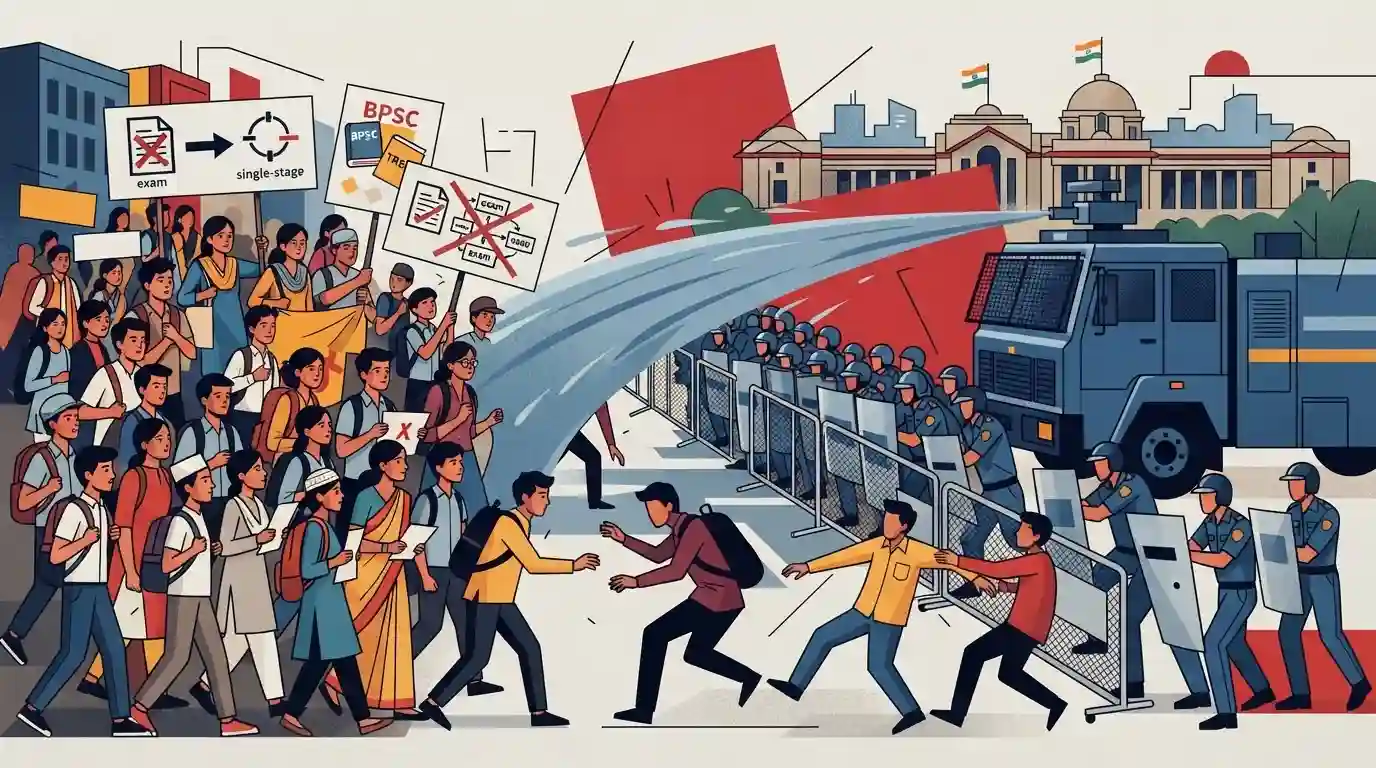
Several students and job aspirants in Bihar were injured when police used water cannons and lathis to disperse a protest march heading toward the Chief Minister's residence in Patna. The protesters, primarily preparing for the Bihar Public Service Commission (BPSC) and Teachers' Recruitment Exams (TRE), are demanding a single-stage examination instead of the current multi-stage format. Police cited the disruption of law and order and the breaching of restricted zones as reasons for the crackdown. The incident highlights recurring grievances regarding state recruitment processes and the tension between the fundamental right to protest and public order maintenance.
Key Points
- Job aspirants in Bihar, mainly preparing for BPSC and Teachers' Recruitment Exams (TRE), protested in Patna against exam structures and alleged irregularities.
- The students broke through police barricades during a march to the Chief Minister's residence, prompting the police to use water cannons and resort to a lathi-charge.
- The primary demand of the protesting students is to replace the multi-stage preliminary and mains examination structure with a single-stage test.
- Left parties, specifically the CPI(ML) Liberation, have supported the students' demands and criticized the state's use of force against peaceful job seekers.
- The police justified the use of force by stating that the protesters deviated from the permitted route and entered restricted areas, affecting law and order.
Important Terms
Bihar Public Service Commission (BPSC)

A state-level constitutional body (Article 315) responsible for conducting competitive exams to recruit civil servants in Bihar. It is currently facing massive protests over alleged irregularities and its multi-stage examination formats.
UPSC context
Crucial for GS Paper 2 (Polity); tests knowledge of state constitutional bodies, their functions, and issues of administrative transparency.
Teachers' Recruitment Exam (TRE)
A major competitive exam conducted by the BPSC to recruit permanent school teachers across Bihar. Recent massive protests by candidates have demanded a shift to a single-stage examination format without negative marking.
UPSC context
Important for Bihar Current Affairs and GS Paper 2 (Education/Employment); highlights state recruitment policies and youth employment challenges.
CPI(ML) Liberation
A prominent left-wing political party in Bihar. It actively supported the recent BPSC student protests, strongly condemning police lathi-charges and demanding government accountability regarding education and employment grievances.
UPSC context
Relevant for Bihar-specific political dynamics and GS Paper 2; tests knowledge of regional political parties and their role in civil movements.
Right to Protest (Article 19)
A constitutional right derived from Article 19(1)(a) and (b), guaranteeing freedom of speech and peaceful assembly. However, it is not absolute and is subject to "reasonable restrictions" for maintaining public order.
UPSC context
Highly relevant for GS Paper 2 (Polity); tests the constitutional balance between Fundamental Rights (civil liberties) and State Law & Order.
Prelims Trap
"The right to strike is guaranteed alongside the right to peaceful assembly as a Fundamental Right under Article 19."
While peaceful assembly is a Fundamental Right under Article 19(1)(b), the Supreme Court has consistently ruled that the "right to strike" is only a statutory or legal right, not a Fundamental Right.
Static Concepts Connected
Under which lists do Public Order, Police, and Education fall in the 7th Schedule?
- State List: Public Order (Entry 1) and Police (Entry 2) are exclusively under the jurisdiction of the State government.
- Concurrent List: Education was moved from the State List to the Concurrent List (Entry 25) by the 42nd Amendment Act of 1976.
What are the core Constitutional provisions governing State Public Service Commissions (SPSCs)?
- Part XIV: Articles 315 to 323 in Part XIV of the Constitution deal with the composition, appointment, and independence of SPSCs.
- Article 320: Article 320 mandates SPSCs to conduct examinations for appointments to the services of the state.
Cross-Topic Patterns
Reasonable Restrictions & Shaheen Bagh ruling
The police crackdown citing restricted zone breaches parallels the Supreme Court's Shaheen Bagh ruling, which emphasized that the right to protest is subject to reasonable restrictions and public spaces cannot be occupied indefinitely.
State recruitment bottlenecks & structural unemployment
Recurring protests over BPSC and TRE exam structures highlight broader socio-economic issues in Bihar, linking state administrative recruitment bottlenecks directly to youth structural unemployment.

Expect a statement-based polity question mixing Article 19 restrictions (Public Order) with 7th Schedule entries (Police vs Education).
Linked PYQs · 3
Linked PYQs · 3
- 2025BPSC_PRELIMSGS1
The constitution of India provides for reasonable restrictions on Fundamental Rights but reasonableness must keep in mind that: 1. The restrictions must be necessary for the protection of the rights of others. 2. The restrictions must be proportionate to the end sought. 3. The restrictions must be reasonable in the light of the circumstances. 4. The restrictions must be in the public interest.
- 2016BPSC_PRELIMSGS1
Choose the fundamental rights available to Indian Citizen but not to aliens: I. Equality before Law II. Freedom of Expression and Speech III. Right of Minorities to conserve their language and culture IV. Protection to life and liberty
- 2025BPSC_PRELIMSGS1
Consider the following subjects belonging to different lists of the constitution of India. Which of the following subjects belong to concurrent list? 1) Protection of wildlife 2) Income on Agriculture 3) Tax on Electricity consumption or sale 4) Price control Out of these:
