National Task Force must tackle systemic roots of student suicides
Source:Indian Express ↗
Why It Matters
Student suicides reflect a critical failure in human resource development and the education system. It highlights the urgent need for structural educational reforms and mental health infrastructure, making it highly relevant for GS2 (Education/Health) and GS4 (Ethical perspectives on societal success and youth stress).
Summary
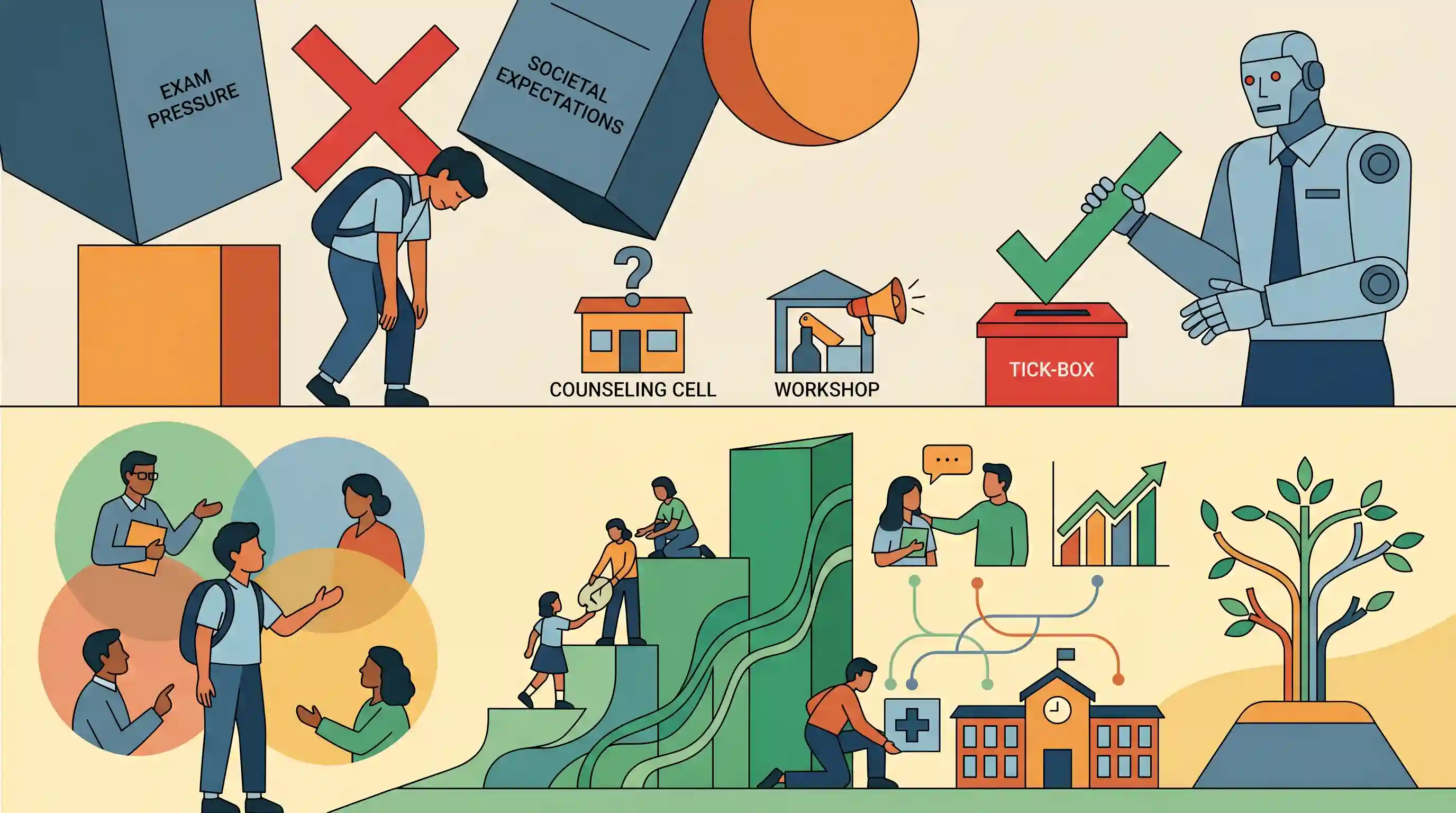
The article critiques the often superficial administrative responses to the rising crisis of student suicides in India. It argues that the National Task Force (NTF) created to address this issue must go beyond mere "tick-box" compliance, such as setting up rudimentary counseling cells or organizing isolated workshops. Instead, it calls for deep, structural reforms in the education system to mitigate the immense pressures of competitive exams, academic burden, and societal expectations. True progress requires building robust mental healthcare infrastructure, reforming assessment paradigms, and cultivating an empathetic ecosystem that prioritizes holistic student well-being over hyper-competitive academic success.
Key Points
- The ongoing crisis of student suicides highlights severe systemic flaws within India's highly competitive education and examination ecosystem.
- The National Task Force (NTF) must move beyond superficial, "tick-box" administrative measures, such as isolated counseling workshops, to tackle the root causes of academic distress.
- Meaningful interventions require structural reforms, including overhauling assessment frameworks, reducing academic burdens, and building accessible, robust campus mental health infrastructure.
- Addressing this crisis comprehensively demands a cultural shift away from a narrow perception of success toward fostering an empathetic and supportive educational environment.
Important Terms
National Task Force (NTF) on Student Mental Health

A body formed by the Ministry of Education following Supreme Court directions, chaired by Justice (Retd) S. Ravindra Bhat, to identify suicide causes and recommend systemic reforms in Higher Educational Institutions.
UPSC context
GS Paper II: Issues relating to Education and Human Resources; tests understanding of institutional responses to student vulnerability.
UMMEED Guidelines
Ministry of Education guidelines (Understand, Motivate, Manage, Empathise, Empower, Develop) for schools to prevent self-harm by forming School Wellness Teams and fostering a sensitive environment.
UPSC context
GS Paper II: Social Sector/Education; tests knowledge of specific government interventions for student well-being.
National Suicide Prevention Strategy (NSPS)
India's first national strategy (2022) aiming to reduce suicide mortality by 10% by 2030 through multisectoral collaboration, improved surveillance, and district-level psychiatric services.
UPSC context
GS Paper II: Health; tests policy-level understanding of public health challenges and SDG-aligned national targets.
Mental Healthcare Act, 2017
Legislation that decriminalized suicide attempts in India by presuming severe stress, while mandating the state to provide healthcare and rehabilitation for persons with mental illness.
UPSC context
GS Paper II: Polity & Laws; tests awareness of rights-based legislation and decriminalization of social issues.
National Education Policy (NEP) 2020
A comprehensive framework for Indian education reform that prioritizes holistic, multidisciplinary learning and explicitly incorporates mental health and emotional well-being into the curriculum.
UPSC context
GS Paper II: Education; foundational for discussing structural changes in the Indian social and academic landscape.
Prelims Trap
"The UMMEED guidelines were launched by the Ministry of Health to prevent suicides in higher educational institutions."
UMMEED was launched by the Ministry of Education specifically for schools (mandating School Wellness Teams). The Supreme Court's NTF is the body focused on higher educational institutions (HEIs).
Static Concepts Connected
What are India's key policy frameworks for mental health and suicide prevention?
- Mental Healthcare Act 2017: Decriminalized attempted suicide (Section 115) by presuming severe stress, and guaranteed the right to access mental healthcare.
- National Suicide Prevention Strategy: India's first dedicated policy targeting a 10% reduction in suicide mortality by 2030 through multi-sectoral collaboration.
- Manodarpan Initiative: A Ministry of Education initiative offering psychosocial support and counseling for students, teachers, and families.
How does NEP 2020 aim to structurally reduce academic pressure?
- Formative Assessment: Shift from high-stakes rote-learning board exams to continuous, competency-based evaluations via the new national assessment centre, PARAKH.
- Academic Bank of Credits: Facilitates multiple entry and exit points in higher education, reducing the 'do-or-die' stigma associated with dropping out.
- Curricular Flexibility: Eliminates hard separations between arts/sciences and academic/vocational streams, diversifying the accepted metrics of student success.
Cross-Topic Patterns
Demographic Dividend vs Human Capital Loss
The surge in student suicides (now outpacing farmer suicides) highlights a critical vulnerability in India's human capital formation, contrasting sharply with the 'demographic dividend' narrative.
Right to Health & Decriminalization
Links the legal transition of suicide—from a criminal offense under IPC Section 309 to a right-to-health framework under the Mental Healthcare Act 2017 (Article 21).

Expect a GS2 Mains question evaluating whether administrative guidelines (UMMEED) and NEP 2020 can structurally fix India's toxic exam ecosystem.
Linked PYQs · 4
Linked PYQs · 4
- 2024MainsGS2
What are the aims and objects of recently passed and enforced, The Public Examination (Prevention of Unfair Means) Act, 2024? Whether University/State Education Board examinations, too, are covered under the Act ?
- 2023MainsGS2
Skill development programmes have succeeded in increasing human resources supply to various sectors. In the context of the statement analyse the linkages between education, skill and employment.
- 2021MainsGS2
“Besides being a moral imperative of a Welfare State, primary health structure is a necessary precondition for sustainable development.” Analyze.
- 2017MainsGS4
The crisis of ethical values in modern times is traced to a narrow perception of the good life. Discuss.
