Stubble Burning Protocols and Air Quality Management in North India
Source:Indian Express ↗
Why It Matters
Crucial for understanding environmental governance, judicial mandates, and technological monitoring of agricultural pollution in India.
Summary
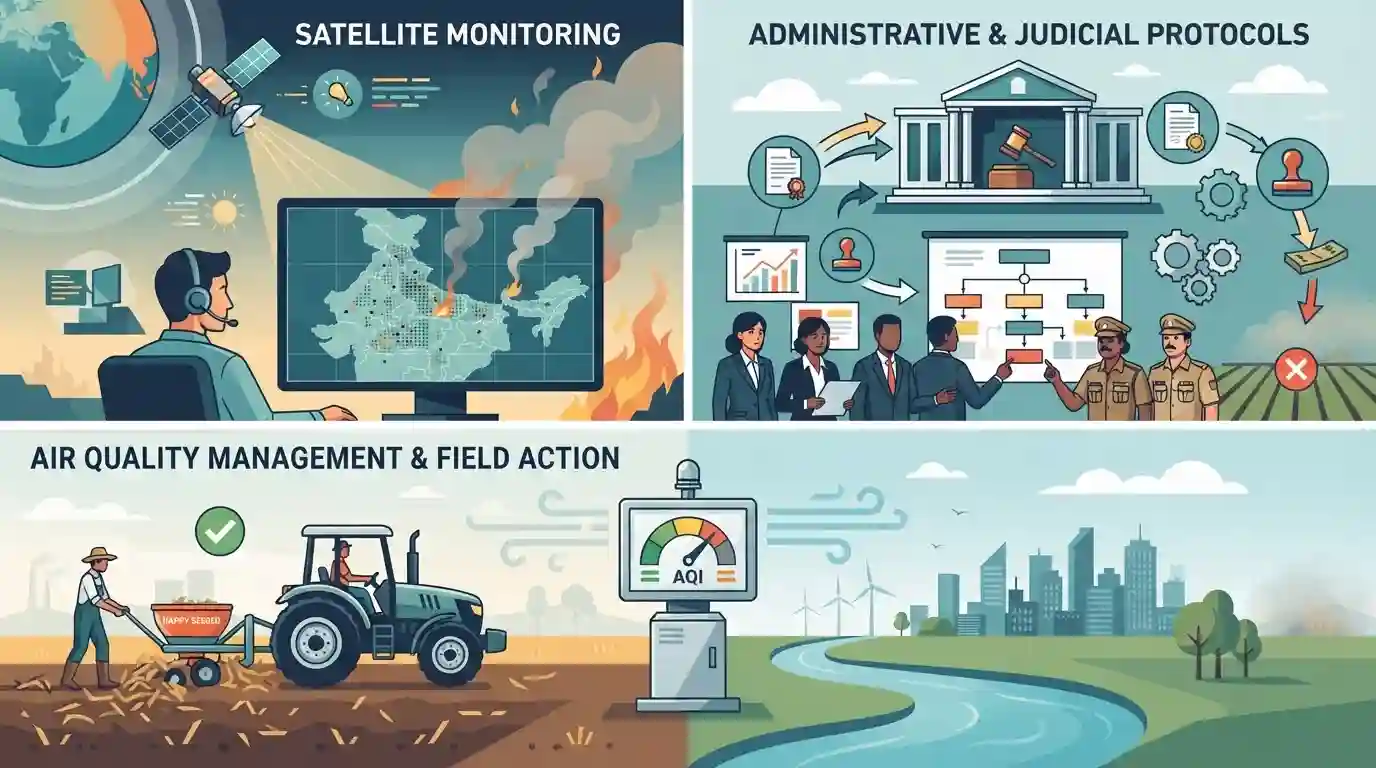
The article examines the implementation and challenges of judicial and administrative protocols surrounding stubble burning and farm fires in northern India, focusing on satellite monitoring, burnt area estimation, and air quality management.
Key Points
- Stubble burning remains a major driver of seasonal air pollution in northern India, prompting judicial oversight through Supreme Court protocols.
- Accurate estimation of burnt area and farm fires requires standardized satellite and ground-truthing mechanisms.
- Coordinated inter-state governance and enforcement are critical to mitigating agricultural residue burning.
Important Terms
Supreme Court

The apex judicial body of India, which has actively intervened in northern India's air pollution crisis by monitoring stubble burning, reviewing remote sensing protocols, and directing states to enforce pollution control measures.
UPSC context
UPSC GS Paper II (Polity & Judiciary) and GS Paper III (Environment & Pollution Control). Tests understanding of judicial activism in environmental governance.
Prelims Trap
The Supreme Court directly administers and executes punitive strategies against stubble burning through its own specialized pollution control wing.
Aspirants often confuse CAQM as a judicial body or a department under the Ministry of Environment, whereas it is an independent statutory body created via a 2021 Act.
Static Concepts Connected
What is the mandate, composition, and legal backing of the Commission for Air Quality Management (CAQM)?
- Statutory Status: Statutory Origin created under the Commission for Air Quality Management in National Capital Region and Adjoining Areas Act, 2021.
- Geographic Scope: Jurisdiction covers NCR and adjoining areas in Punjab, Haryana, Rajasthan, and Uttar Pradesh, superseding state pollution control boards on air matters.
- Regulatory Powers: Powers include issuing directions, entertaining complaints, imposing environmental compensation, and coordinating stubble burning abatement plans.
Cross-Topic Patterns
Judicial Activism vs Executive Federalism in NCR Air Quality
The CAQM statutory framework and Supreme Court oversight illustrate how judicial activism steps into executive governance voids for regional environmental commons.
Remote Sensing Evasion Tactics in Environmental Governance
Farmers shifting burning times to bypass polar-orbiting satellite passes demonstrates how technological surveillance spurs tactical evasions in decentralized agriculture.

CAQM statutory powers, satellite monitoring limitations (polar orbits), and environmental compensation penalties likely to feature in Prelims.
Linked PYQs · 2
Linked PYQs · 2
- 2019PrelimsGS1
Consider the following: 1. Carbon monoxide 2. Methane 3. Ozone 4. Sulphur dioxide Which of the above are released into atmosphere due to the burning of crop/biomass residue?
- 2020MainsGS3
What are the major factors responsible for making rice-wheat system a success? In spite of this success how has this system become bane in India?
