AI Study Links Upper Body Muscle Density to Lower Heart Attack Risk
Source:Indian Express ↗
Why It Matters
As non-communicable diseases (especially cardiovascular diseases) pose a significant public health challenge globally and in India, integrating AI with standard medical imaging can revolutionize preventive healthcare. It provides a cost-effective, opportunistic method to screen and stratify high-risk patients without needing additional clinical procedures. This aligns with UPSC syllabus topics regarding technological advancements in everyday life, health sectors, and the developmental potential of AI in medicine.
Summary
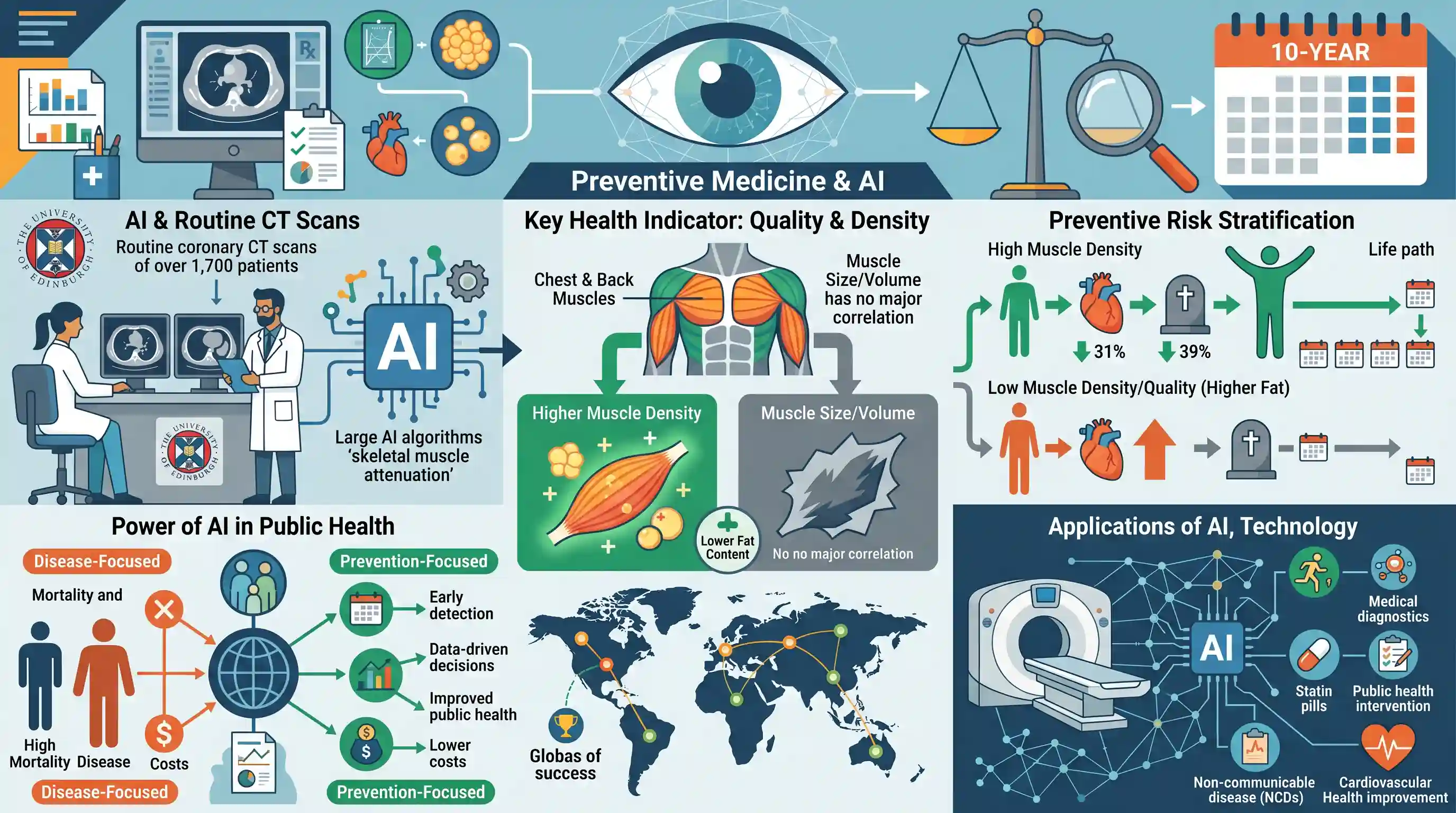
A landmark study by researchers at the University of Edinburgh, published in the journal Radiology, has found that the quality and density of chest and back muscles, rather than overall muscle size, are key indicators of long-term cardiovascular health. Utilizing Artificial Intelligence (AI) to evaluate 'skeletal muscle attenuation' from routine coronary CT scans of over 1,700 patients, the study revealed that higher muscle density (which signifies lower fat content) is associated with a 31% lower risk of heart attacks and a 39% lower risk of mortality over a decade. This study demonstrates the power of AI-driven clinical imaging in preventive medicine and risk stratification for cardiovascular diseases.
Key Points
- Muscle density (quality) in the chest and back, rather than overall muscle size or bulk, is strongly associated with a lower risk of heart attacks and premature death.
- The study used artificial intelligence (AI) to analyze coronary CT angiography scans of 1,722 patients, measuring muscle, fat, bone, and organ composition in the upper body.
- Researchers measured 'skeletal muscle attenuation' (muscle density); denser muscles contain less fat and appear brighter on scans because they absorb more X-rays.
- For every 10-point increase in muscle density, patients were 31% less likely to suffer a heart attack and 39% less likely to die over the subsequent decade.
- The findings suggest that AI can be used to analyze routine diagnostic scans to identify individuals with poor muscle quality, enabling early preventive care, personalized exercise regimens (like Pilates, planks, and core workouts), and targeted treatments.
Important Terms
Skeletal Muscle Attenuation

A measure of skeletal muscle density on CT scans, where higher attenuation indicates lower fat infiltration and better muscle quality, strongly linked to lower cardiovascular and mortality risks.
UPSC context
GS Paper 3 (Science & Tech). Tests understanding of clinical imaging concepts, body composition indicators, and advanced diagnostics.
Artificial Intelligence (AI) in Healthcare
The application of machine learning, algorithms, and cognitive technologies in medical settings to automate administrative tasks, assist diagnostics, and personalize patient risk stratification.
UPSC context
GS Paper 3 (Applications of AI). Tests understanding of clinical automation, diagnostics, and related ethical and regulatory issues.
Preventive Healthcare
Proactive healthcare measures, including routine screenings, vaccinations, and lifestyle modifications, aimed at preventing illnesses and reducing disease burdens before symptoms manifest.
UPSC context
GS Paper 2 (Health Issues). Tests knowledge of public health paradigms and shifting from curative to preventive healthcare.
Non-Communicable Diseases (NCDs)
Chronic, non-infectious medical conditions caused by a combination of genetic, environmental, physiological, and behavioral factors, such as cardiovascular diseases, diabetes, and cancers.
UPSC context
GS Paper 2 (Health). Tests awareness of India's epidemiological transition, lifestyle diseases, and national disease-control programs.
Coronary CT Angiography (CCTA)
A non-invasive imaging test that uses CT scans and contrast dye to visualize blockages, narrowing, and structural features of the coronary arteries supplying the heart.
UPSC context
GS Paper 3 (Science & Tech). Tests familiarity with modern medical imaging technologies and diagnostic tools for chronic conditions.
Prelims Trap
On CT scans, higher-density muscle appears darker, and overall muscle mass is the primary indicator of lower cardiovascular risk.
Denser muscle (lower fat) actually absorbs more X-rays, appearing brighter (attenuation). Crucially, the study established density (quality), not overall muscle bulk, as the key cardiovascular predictor.
Static Concepts Connected
What is the National Programme for Prevention and Control of Non-Communicable Diseases (NP-NCD)?
- Key Target: Aims for a 25% relative reduction in premature mortality from NCDs like cardiovascular diseases by 2025.
- NCD Components: Targets four major NCD groups: cardiovascular diseases, cancer, diabetes, and chronic respiratory diseases.
- Operational Framework: Integrates screening, management, and primary healthcare infrastructure through district-level NCD clinics and health-and-wellness centers.
How are medical devices regulated under India's Medical Devices Rules (MDR), 2017?
- Risk-Based Classes: Divides devices into Class A (low), Class B (low-moderate), Class C (moderate-high), and Class D (high risk).
- Licensing Authority: CDSCO acts as Central Licensing Authority for high-risk Class C and D, while State authorities manage Class A and B.
- Software Inclusion: Covers Software as a Medical Device (SaMD), subjecting diagnostic AI tools to strict clinical and regulatory validation.
Cross-Topic Patterns
AI diagnostics & health data privacy
Deploying AI tools like SaMD requires analyzing extensive patient CT data, directly engaging compliance standards under India's Digital Personal Data Protection (DPDP) Act, 2023.
NCD burden & demographic dividend
Premature cardiovascular deaths peaking in the 40-69 age bracket directly erode India's economic potential, highlighting how preventive healthcare delivery impacts macro-economic stability.

With CDSCO joining the IMDRF, expect a 2026 prelims question on risk-based classification of Software as a Medical Device (SaMD) in India.
Linked PYQs · 2
Linked PYQs · 2
- 2023MainsGS3
Introduce the concept of Artificial Intelligence (AI). How does Al help clinical diagnosis? Do you perceive any threat to privacy of the individual in the use of Al in healthcare?
- 2020PrelimsGS1
With the present state of development, Artificial Intelligence can effectively do which of the following? 1. Bring down electricity consumption in industrial units 2. Create meaningful short stories and songs 3. Disease diagnosis 4. Text-to-Speech Conversion 5. Wireless transmission of electrical energy Select the correct answer using the code given below:
