Western Japan Earthquake Sparks Seismic Safety and Tsunami Review
Source:The Hindu ↗
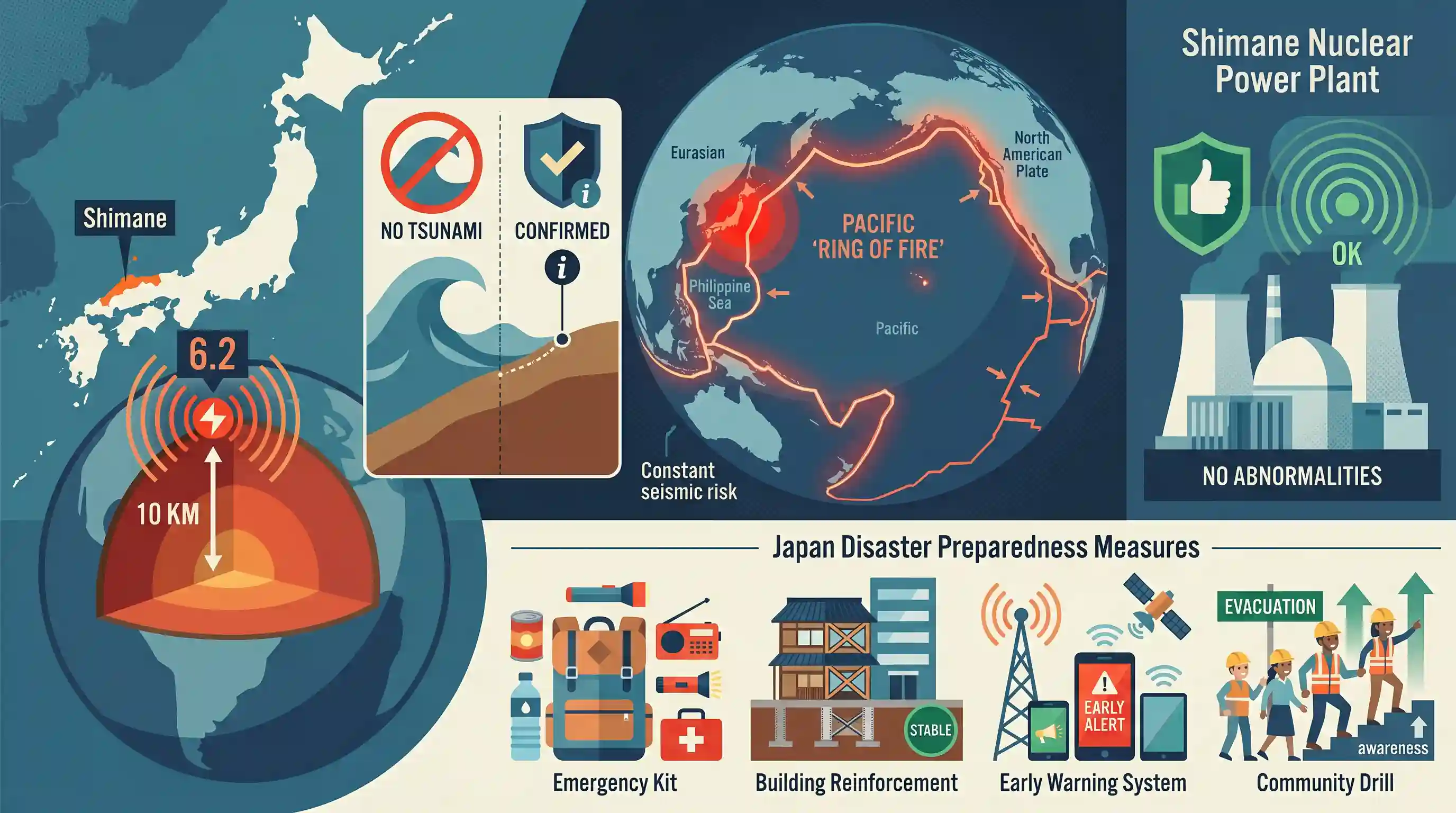
Why It Matters
Provides a practical context for studying tectonic activity along the Pacific Ring of Fire, the conditions required for tsunami formation, and the importance of critical infrastructure (nuclear plant) safety protocols during natural disasters.
Summary
A 6.2-magnitude earthquake struck western Japan's Shimane prefecture, with officials confirming no risk of a tsunami since the epicenter was located inland at a depth of 10 kilometers. Despite the strong tremors, no abnormalities were reported at the local Shimane nuclear power plant. The event highlights the constant seismic risks and disaster preparedness measures in Japan, which is situated on the tectonically active Pacific 'Ring of Fire'.
Key Points
- A strong 6.2-magnitude earthquake hit western Japan's Shimane prefecture.
- Authorities confirmed there was no risk of a tsunami because the epicenter was located inland at a depth of 10 kilometers.
- No operational abnormalities were detected at the nearby Shimane nuclear power plant following the tremors.
- The event underscores Japan's high seismic vulnerability due to its location on the Pacific Ring of Fire, a highly active tectonic zone.
Prelims Trap
"High-magnitude earthquakes in coastal island nations like Japan inevitably generate tsunamis."
Tsunamis require sudden vertical displacement of the ocean floor. Inland epicenters, even in coastal nations, do not directly generate tsunamis regardless of their magnitude.
Static Concepts Connected
What are the essential geological conditions for an earthquake to generate a tsunami?
- Submarine Epicenter: The earthquake's epicenter must be located underwater or extremely close to the coast.
- Vertical Displacement: The tectonic fault must involve vertical movement (dip-slip or megathrust) to displace the massive water column above it; horizontal (strike-slip) movement rarely causes tsunamis.
- High Magnitude & Shallow Depth: Generally requires a high magnitude (usually >6.5) and a shallow focal depth to transfer sufficient energy to the ocean floor.
Why is Japan's tectonic location uniquely vulnerable to extreme seismic activity?
- Triple Junction: Japan sits on a complex tectonic 'triple junction' where the Pacific, Philippine Sea, and Eurasian/North American plates converge.
- Subduction Zones: Heavier oceanic plates subducting under lighter plates cause immense friction, building stress that releases as megathrust earthquakes.
- Volcanic Arcs: This subduction also triggers flux melting in the mantle, feeding the dense network of volcanoes along the Pacific Ring of Fire.
Cross-Topic Patterns
Sendai Framework + Critical Infrastructure
The safety of the Shimane nuclear plant during strong tremors directly highlights Sendai Framework Target D: substantially reducing disaster damage to critical infrastructure and disruption of basic services.
Focal Depth + Seismic Attenuation
Shallow-focus earthquakes (under 70km) like this 10km quake cause severe surface shaking because seismic waves travel shorter distances, minimizing energy loss (attenuation) before hitting the crust.

Expect a Prelims question differentiating tsunami genesis conditions (vertical ocean-floor displacement) from standard inland earthquakes.
Linked PYQs · 4
Linked PYQs · 4
- 2025MainsGS1
What are Tsunamis? How and where are they formed? What are their consequences? Explain with examples.
- 2025MainsGS1
Discuss how the changes in shape and sizes of continents and ocean basins of the planet take place due to tectonic movements of the crustal masses.
- 2017MainsGS3
On December 2004, tsunami brought havoc on fourteen countries including India. Discuss the factors responsible for occurrence of tsunami and its effects on life and economy. In the light of guidelines of NDMA (2010) describe the mechanisms for preparedness to reduce the risk during such events.
- 2024MainsGS3
What is disaster resilience? How is it determined? Describe various elements of a resilience framework. Also mention the global targets of Sendai Framework for Disaster Risk Reduction (2015–2030).
