Cross-Border Counter-Terrorism Operations and National Security
Source:The Hindu ↗
Why It Matters
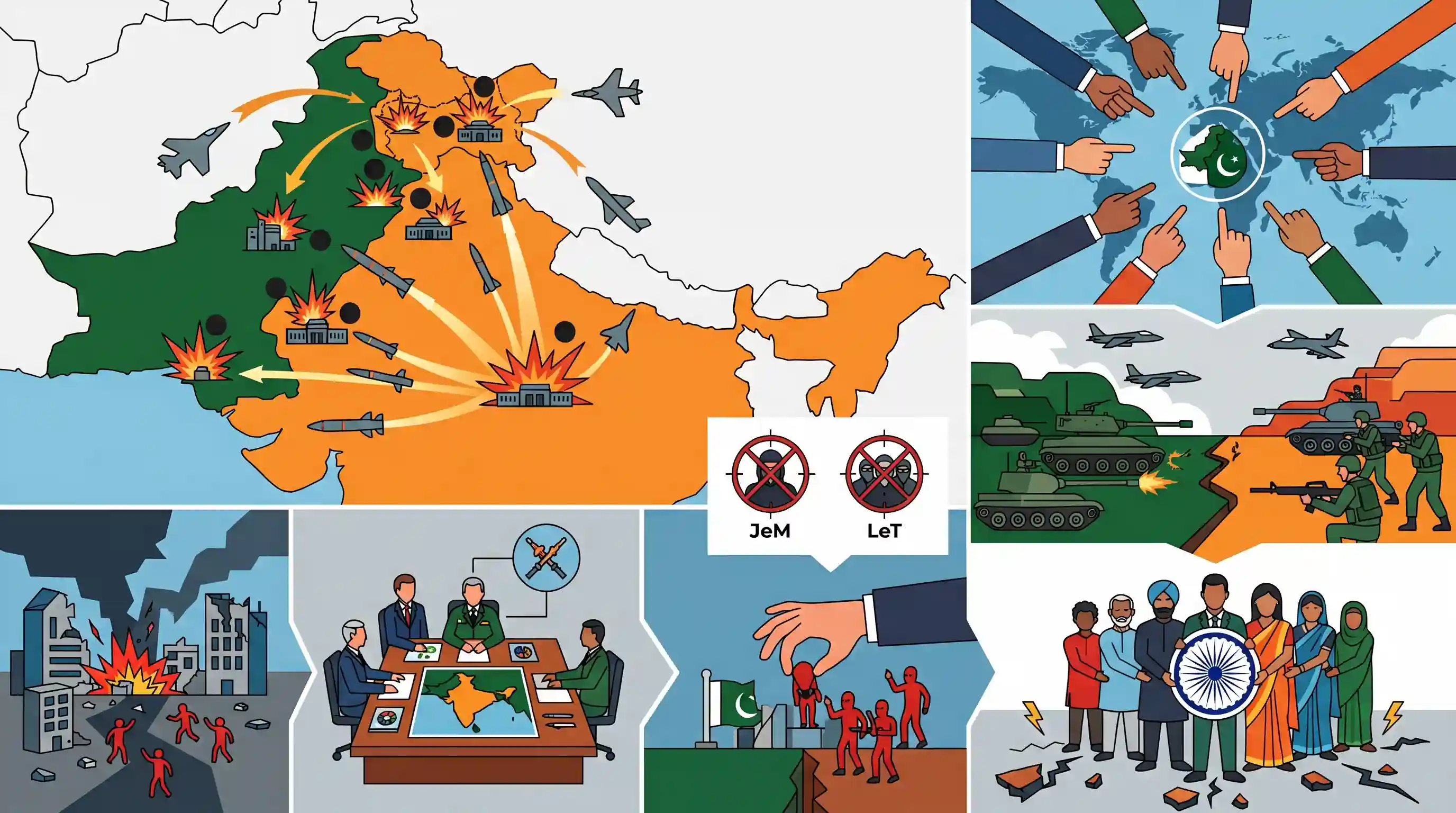
Operation Sindoor establishes a major precedent in India's modern military doctrine (moving from diplomatic to overt military response against non-state actors operating with state support). It is a vital case study for Internal Security and International Relations on cross-border counter-terrorism operations, deterrence, and proportional response.
Summary
The editorial analyses 'Operation Sindoor', India's precision military strikes across nine terror bases in Pakistan and PoK. Executed in response to the Pahalgam terror attack, the strikes targeted key JeM and LeT command centres as a pre-emptive measure. This overt military action underscores a strategic shift in India's policy toward countering Pakistan-backed cross-border terrorism. The piece advises the Indian government to maintain diplomatic pressure on Pakistan globally, prepare for potential military escalation, and ensure that domestic political consensus remains free from communal divisions.
Key Points
- India carried out 'Operation Sindoor', launching precision military strikes against nine terror targets in Pakistan and PoK on May 7, 2025, hitting major hubs of Jaish-e-Mohammed and Lashkar-e-Taiba.
- The overt military action was described as a pre-emptive, non-escalatory, and proportionate response to the April 2025 Pahalgam terror attack, which left 26 dead.
- The operation signifies a sharper, more resolute shift in India’s counter-terrorism strategy against Pakistan's state-sponsored terrorism, building on the precedent set by the 2019 Balakot strikes.
- The editorial advises India to anticipate and prepare for escalatory and diplomatic blowback from Pakistan, while strictly preventing domestic communal strife.
Important Terms
Operation Sindoor

India's May 2025 tri-service precision strikes against nine terror bases in Pakistan and PoK, launched in response to the Pahalgam terror attack.
UPSC context
GS III (Internal Security); tests understanding of India's evolving counter-terror doctrine and proactive deterrence strategy.
Pahalgam Terror Attack (2025)
A terror strike on April 22, 2025, in Kashmir's Baisaran Valley, killing 26 individuals (mostly tourists), serving as the trigger for Operation Sindoor.
UPSC context
GS III (Security); tests knowledge of terror tactics targeting J&K’s tourism and subsequent national security responses.
The Resistance Front (TRF)
A shadow group and offshoot of Lashkar-e-Taiba (LeT) that claimed responsibility for the 2025 Pahalgam attack to obscure direct Pakistani links.
UPSC context
GS III (Security); represents the evolution of "faceless" proxy organizations used in cross-border terrorism to evade global scrutiny.
Jaish-e-Mohammed (JeM)
A Pakistan-based, UN-designated terrorist organization whose headquarters in Bahawalpur were targeted during India’s 2025 Operation Sindoor strikes.
UPSC context
GS II/III (IR/Security); central to discussions on cross-border terrorism and India-Pakistan bilateral relations.
Lashkar-e-Taiba (LeT)
An extremist group based in Pakistan responsible for major attacks in India; its Markaz-e-Taiba base in Muridke was a primary target of Operation Sindoor.
UPSC context
GS III (Security); essential for analyzing the infrastructure of cross-border terror and the impact of precision military strikes.
Tri-Service Integration (Jointness)
The seamless coordination between the Army, Navy, and Air Force, demonstrated for the first time in offensive strikes during Operation Sindoor.
UPSC context
GS III (Defence); tests understanding of military reforms, the Chief of Defence Staff (CDS) role, and theaterization.
Prelims Trap
Operation Sindoor involved proportionate counter-strikes against conventional Pakistani military assets and command centres.
India explicitly categorises such operations as "non-military, pre-emptive strikes" targeting only non-state terror infrastructure, strictly avoiding state military assets to prevent conventional war escalation.
Static Concepts Connected
How does International Law govern pre-emptive strikes against non-state actors?
- UN Charter Article 51: Recognizes the inherent right of individual or collective self-defence if an armed attack occurs against a Member of the United Nations.
- Caroline Test: Establishes that the necessity for pre-emptive self-defence must be "instant, overwhelming, and leaving no choice of means, and no moment for deliberation."
- India's Doctrine: India frames operations like Balakot and Sindoor as "intelligence-led, non-military pre-emptive action" when the host state refuses to dismantle terror infrastructure.
What are India's options for conventional deterrence below the nuclear threshold?
- Cold Start Doctrine: A proactive doctrine meant to launch rapid, limited conventional armoured strikes within days of a terror attack to capture shallow territory.
- Precision Pre-emption: Using airpower or precision missiles (e.g., Operation Sindoor) to destroy terror hubs deep inside enemy territory without mobilizing massive ground forces, establishing credible deterrence.
Cross-Topic Patterns
FATF Grey Listing & Counter-Terror Finance
India will likely leverage intelligence gathered from Operation Sindoor's targets to push for Pakistan's re-entry into the FATF grey list, combining kinetic military action with multilateral financial warfare.
Cognitive warfare post-kinetic strikes
Adversaries increasingly follow up kinetic military losses with deep-fake driven cognitive warfare, aiming to exploit fault lines and polarize India's domestic communal harmony during high-tension border periods.

Expect a Mains GS3 question analyzing the shift in India's counter-terrorism doctrine from 'strategic restraint' to 'active pre-emption'.
Linked PYQs · 3
Linked PYQs · 3
- 2016MainsGS3
The terms 'Hot Pursuit' and 'Surgical Strikes' are often used in connection with armed action against terrorist attacks. Discuss the strategic impact of such actions.
- 2025MainsGS3
Terrorism is a global scourge. How has it manifested in India? Elaborate with contemporary examples. What are the counter measures adopted by the State? Explain.
- 2023MainsGS3
Winning of 'Hearts and Minds' in terrorism-affected areas is an essential step in restoring the trust of the population. Discuss the measures adopted by the Government in this respect as part of the conflict resolution in Jammu and Kashmir.
