Urban Lake Conservation and Wastewater Reuse Infrastructure
Source:The Hindu ↗
Why It Matters
Provides a concrete case study on urban lake conservation, multi-agency coordination in city governance, and practical implementation of wastewater reuse. It directly addresses GS1 and GS3 themes of urban flooding, water security, and alternative freshwater technologies.
Summary
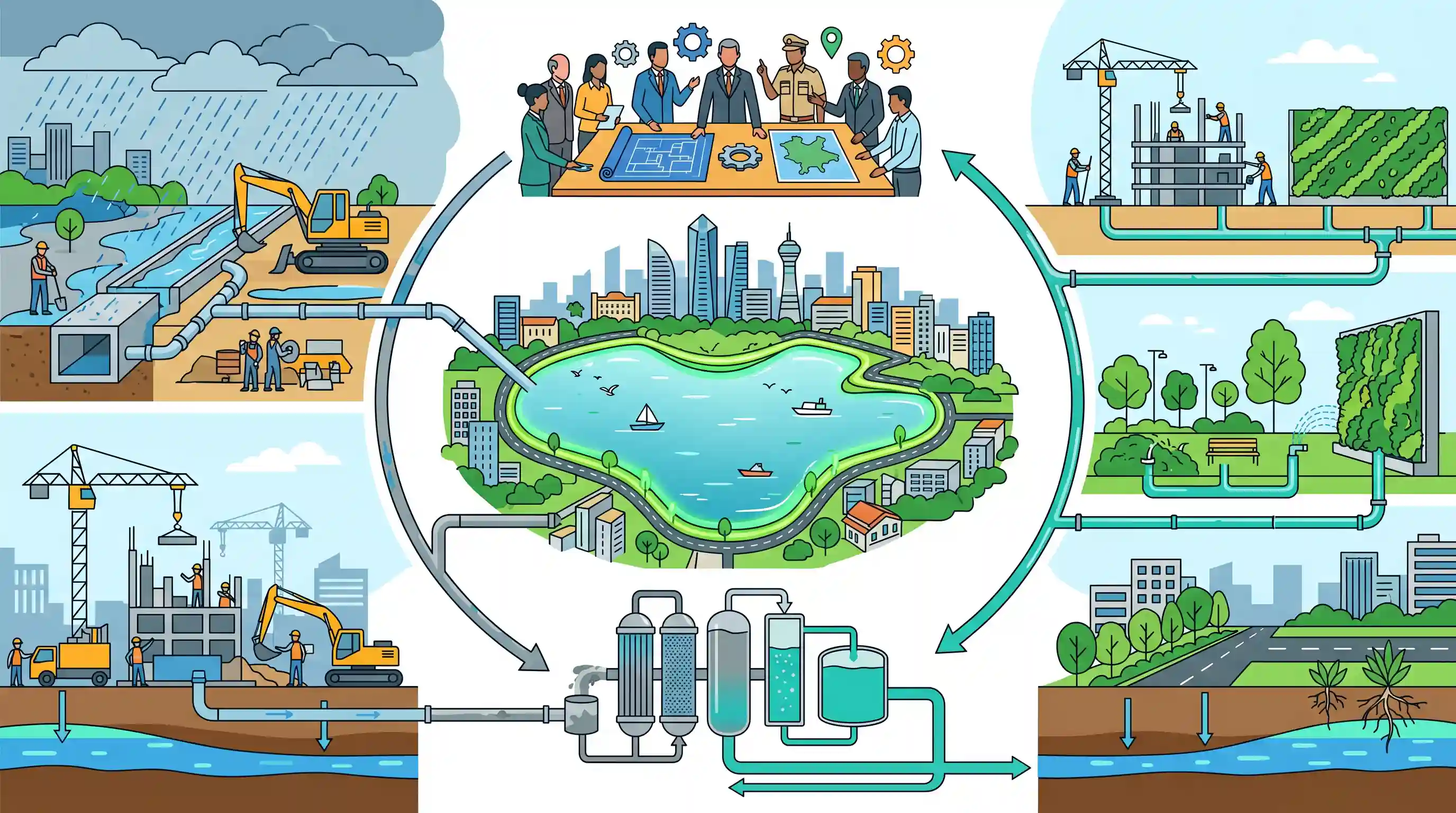
The Telangana government has initiated strict, multi-departmental measures to conserve Durgam Cheruvu, a prominent lake in Hyderabad. Key interventions include mandating the reuse of treated wastewater from nearby Sewage Treatment Plants (STPs) for local construction, gardening, and landscaping, thereby reducing freshwater demand and helping restore groundwater levels. Furthermore, specialized pipeline infrastructure and a box water drain are being constructed to manage sewage outflow and prevent storm-induced floodwater from contaminating the lake. This model serves as an excellent case study in urban water management, mitigating urban flooding, and institutionalising a circular water economy.
Key Points
- The Telangana government has mandated a multi-departmental approach to prevent sewage contamination in Durgam Cheruvu lake.
- Construction sites and landscaping projects in the vicinity are now required to use treated wastewater from local STPs (5 MLD and 7 MLD), replacing freshwater usage.
- A dedicated pipeline infrastructure is being built to transport STP-treated water directly to construction sites, promoting a circular water economy.
- To mitigate monsoon-related pollution, a box water drain is under construction to prevent floodwater from entering the lake.
Important Terms
Hyderabad Metropolitan Water Supply and Sewerage Board (HMWS&SB)

A statutory body responsible for providing potable water and managing sewerage infrastructure in Hyderabad. It implements Sewage Treatment Plants (STPs) and recycled water initiatives for urban sustainability.
UPSC context
GS Paper 2/3: Tests knowledge of statutory bodies and urban infrastructure management for sustainable development.
Greater Hyderabad Municipal Corporation (GHMC)
The urban local body (ULB) overseeing civic amenities and infrastructure in Hyderabad. It plays a critical role in managing stormwater drains, flood mitigation, and local sanitation projects.
UPSC context
GS Paper 2: Local governance and the 74th Amendment's role in delivering essential civic services.
Hyderabad Metropolitan Development Authority (HMDA)
An urban planning agency for the Hyderabad Metropolitan Region. It regulates land use and coordinates the Lake Protection Committee to demarcate lake boundaries and prevent illegal encroachments.
UPSC context
GS Paper 1/3: Important for urbanization challenges, regional planning, and environmental protection of urban commons.
Circular Water Economy
A resource management model emphasizing the reuse and recycling of wastewater to minimize freshwater demand, restore groundwater levels, and institutionalize sustainable water cycles in urban areas.
UPSC context
GS Paper 3: Environment/Economy. Tests understanding of resource efficiency, waste-to-wealth models, and sustainable development goals.
Urban Water Management
The integrated planning of a city's water supply, sanitation, and drainage systems. It aims to balance growing demand with environmental conservation and flood prevention.
UPSC context
GS Paper 3: Disaster Management and Infrastructure. Critical for addressing urban flooding and the national water crisis.
Full Tank Level (FTL)
The highest water level a reservoir can reach before overflowing. It serves as a legal boundary for lake conservation, defining restricted buffer zones to prevent urban encroachment.
UPSC context
GS Paper 3: Environmental Conservation. Key for understanding regulatory frameworks to protect water bodies from urban sprawl.
Prelims Trap
"Circular water economy initiatives mandate the treatment of sewage for direct municipal potable (drinking) supply."
Current Indian urban frameworks mandate treated STP water strictly for non-potable uses (construction, landscaping) to avoid health risks, not for direct drinking supply.
Static Concepts Connected
What differentiates Greywater from Blackwater in urban wastewater management?
- Greywater: Wastewater from sinks, showers, and washing machines. It contains fewer pathogens and is significantly easier to treat and reuse on-site.
- Blackwater: Wastewater originating from toilets, containing fecal matter and high pathogen loads. It requires intensive municipal Sewage Treatment Plant (STP) processing.
How do 'Sponge Cities' mitigate urban flooding?
- Permeability: Increases surface absorption through porous pavements, green roofs, and bio-swales, drastically reducing rapid and unmanageable surface runoff during monsoons.
- Blue-Green Infrastructure: Revives interconnected lakes, wetlands, and parks to act as natural sinks that absorb, filter, and store storm-induced floodwater.
Cross-Topic Patterns
Urban Lakes & Antimicrobial Resistance (AMR)
Untreated sewage entering urban lakes is a primary vector for Antimicrobial Resistance (AMR), as it creates environments where human pathogens freely mix with pharmaceutical residues.
Groundwater Stress & Real Estate
Substituting freshwater with treated wastewater in real estate directly curtails deep-aquifer depletion, offering a template to address the severe urban groundwater stress seen in metros like Bengaluru and Hyderabad.

Expect a 2026 Mains GS3 question linking the circular water economy (wastewater reuse) to urban flood mitigation (sponge city concepts).
Linked PYQs · 5
Linked PYQs · 5
- 2024MainsGS3
The world is facing an acute shortage of clean and safe freshwater. What are the alternative technologies which can solve this crisis? Briefly discuss any three such technologies citing their key merits and demerits.
- 2020MainsGS1
Account for the huge flooding of million cities in India including the smart ones like Hyderabad and Pune. Suggest lasting remedial measures.
- 2021MainsGS1
What are the environmental implications of the reclamation of water bodies into urban land use ? Explain with examples.
- 2018MainsGS1
The ideal solution of depleting ground water resources in India is water harvesting system." How can it be made effective in urban areas?
- 2024MainsGS3
Industrial pollution of river water is a significant environmental issue in India. Discuss the various mitigation measures to deal with this problem and also the government's initiatives in this regard.
