Delhi deploys automatic anti-smog misting system on streetlights
Source:Indian Express ↗
Why It Matters
This initiative serves as a highly relevant case study for GS3 Environmental Conservation and Technology, demonstrating how localized technological interventions can mitigate severe urban smog while simultaneously applying circular economy principles (zero water wastage via irrigation reuse) to address resource constraints.
Summary
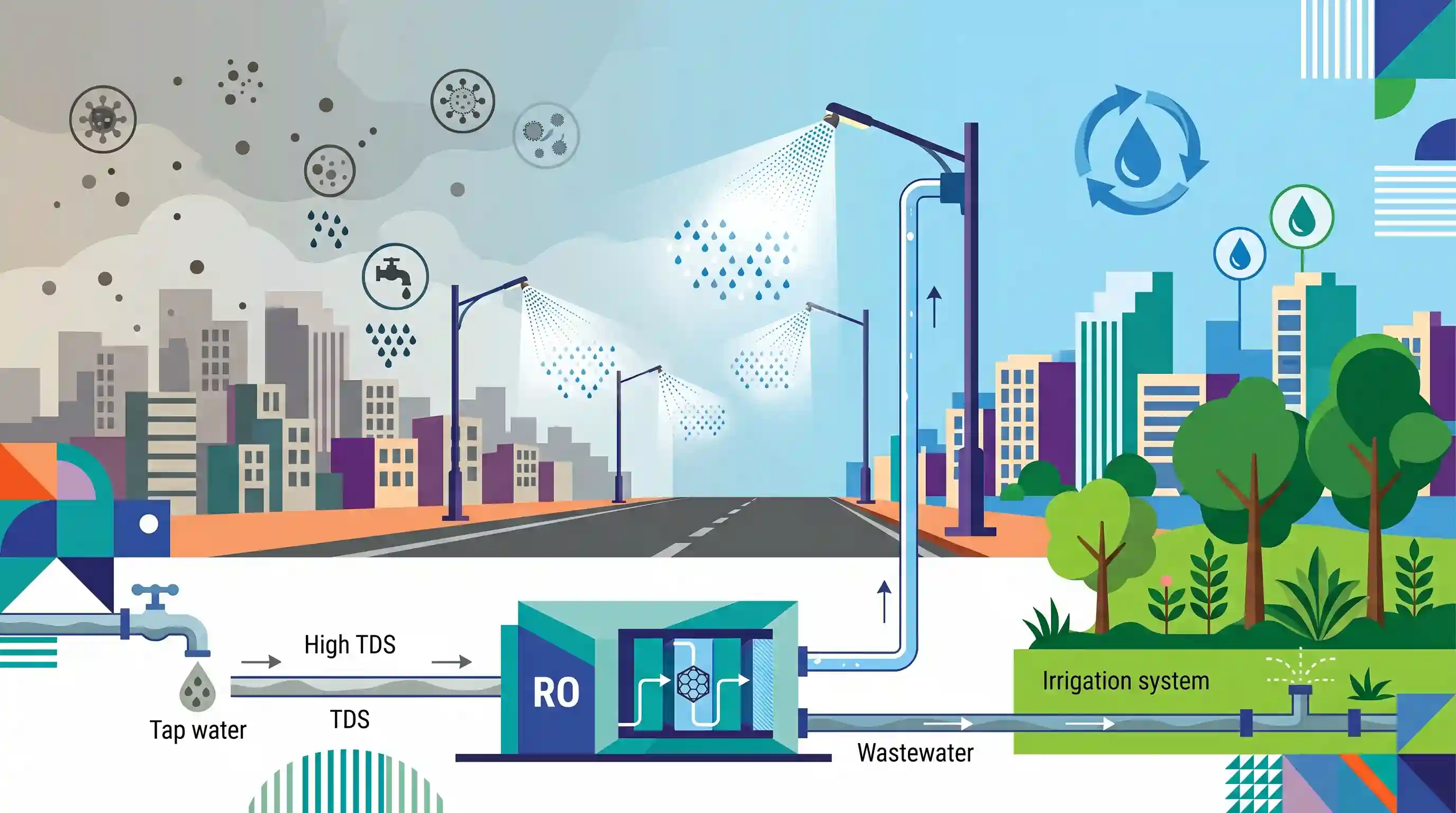
The Delhi Development Authority (DDA) has launched an 'Automatic Anti-Smog Misting System' installed on 166 streetlight poles in Dwarka to combat Delhi's severe winter air pollution. The technology sprays high-pressure, RO-treated mist to effectively settle suspended particulate matter and airborne dust. To avoid damage from high-TDS tap water, Reverse Osmosis is utilized to drastically reduce TDS levels. Highlighting a sustainable, zero-wastage approach, the system diverts the wastewater generated during the RO process to irrigate nearby green spaces, offering a novel technological intervention for urban environmental management.
Key Points
- The DDA inaugurated an Automatic Anti-Smog Misting System on 166 streetlight poles in Dwarka to tackle Delhi's winter air pollution.
- The system uses high-pressure mist nozzles spraying RO-treated water to suppress suspended particulate matter and settle road dust.
- Reverse Osmosis (RO) is used to reduce the Total Dissolved Solids (TDS) of the water from ~2,000 to ~50, preventing staining on vehicles and infrastructure.
- Demonstrating sustainable water management, the wastewater from the RO process is recovered and used to irrigate nearby parks, ensuring zero water wastage.
Important Terms
Delhi Development Authority (DDA)

A statutory body under the Ministry of Housing and Urban Affairs, established by the Delhi Development Act, 1957, to promote and secure the development of Delhi through planning and land management.
UPSC context
GS Paper II (Statutory Bodies) and GS Paper III (Urbanization/Infrastructure); tests knowledge of administrative roles in urban environmental governance.
Particulate Matter (PM)
Microscopic solid or liquid particles suspended in the air, categorized by size (e.g., PM10 or PM2.5), which can penetrate human lungs and bloodstream, causing severe health issues.
UPSC context
GS Paper III (Environment - Pollution); essential for understanding National Clean Air Programme (NCAP) and Air Quality Index (AQI) parameters.
Anti-Smog Misting System
A static technological intervention using high-pressure nozzles to release a fine mist that traps and settles airborne dust and pollutants like black carbon to improve local air quality.
UPSC context
GS Paper III (Environmental Technology/Pollution Mitigation); tests awareness of innovative technological solutions to urban smog and seasonal pollution crises.
Total Dissolved Solids (TDS)
A measure of the combined content of all inorganic and organic substances—including minerals, salts, and metals—dissolved in a liquid, often used to gauge water quality and hardness.
UPSC context
GS Paper III (Environment/Water Quality); relevant for analyzing industrial equipment maintenance and National Green Tribunal (NGT) rulings on water purifiers.
Reverse Osmosis (RO)
A water purification technology that uses a semi-permeable membrane and external pressure to remove contaminants, ions, and dissolved solids from water.
UPSC context
GS Paper III (Science & Tech/Environment); important for discussing sustainable water management, wastewater generation, and mineral-content regulations.
Prelims Trap
Anti-smog misting systems are deployed to neutralize gaseous pollutants like SO2 and NOx from the urban atmosphere.
Misting induces 'wet deposition' to physically settle suspended particulate matter (PM) and road dust. It does not chemically neutralize or eliminate primary gaseous pollutants.
Static Concepts Connected
What is 'Wet Deposition' in the context of air pollution?
- Mechanism: Atmospheric pollutants are scavenged by precipitation (rain, snow, or artificial mist) and forced down to the Earth's surface.
- Efficacy: Highly effective for settling coarse and fine particulate matter (PM10, PM2.5), but has limited impact on non-water-soluble greenhouse gases.
How does Reverse Osmosis (RO) function and manage TDS?
- Membrane filtration: RO forces water through a semi-permeable membrane under pressure, blocking dissolved inorganic solids (salts, minerals) and drastically lowering Total Dissolved Solids (TDS).
- Reject water (Brine): The process generates high-TDS reject wastewater. If improperly discharged, it degrades soil/water salinity, necessitating reuse strategies like landscape irrigation.
Cross-Topic Patterns
Circular economy in urban water management
Utilizing high-TDS RO reject water for park irrigation connects air pollution mitigation with circular water economy principles, a growing theme in GS3 urban planning.
Decentralized infrastructure for NCAP targets
Integrating mitigation tools onto existing public infrastructure (streetlights) solves the land-acquisition bottleneck for localized dust control under the National Clean Air Programme (NCAP).

Expect a multi-statement question in 2026 combining RO technology principles, TDS limits, and artificial wet deposition for smog control.
Linked PYQs · 4
Linked PYQs · 4
- 2022MainsGS3
Discuss in detail the photochemical smog emphasizing its formation, effects and mitigation. Explain the 1999 Gothenburg Protocol.
- 2024MainsGS3
The world is facing an acute shortage of clean and safe freshwater. What are the alternative technologies which can solve this crisis? Briefly discuss any three such technologies citing their key merits and demerits.
- 2025PrelimsGS1
Artificial way of causing rainfall to reduce air pollution makes use of
- 2020MainsGS3
Suggest measures to improve water storage and irrigation system to make its judicious use under depleting scenario.
