Taliban Five Year Rule and Regional Geopolitical Crisis
Source:Indian Express ↗
ఇది ఎందుకు ముఖ్యం
The stability and governance of Afghanistan deeply impact regional security dynamics in South and Central Asia. For UPSC aspirants, understanding the fallout of the Taliban's rule involves evaluating India's strategic geopolitical challenges, the threat of cross-border terrorism stemming from the Af-Pak region, the humanitarian consequences of international isolation, and the critical role of UN agencies in monitoring human rights and gender justice in conflict zones.
సారాంశం
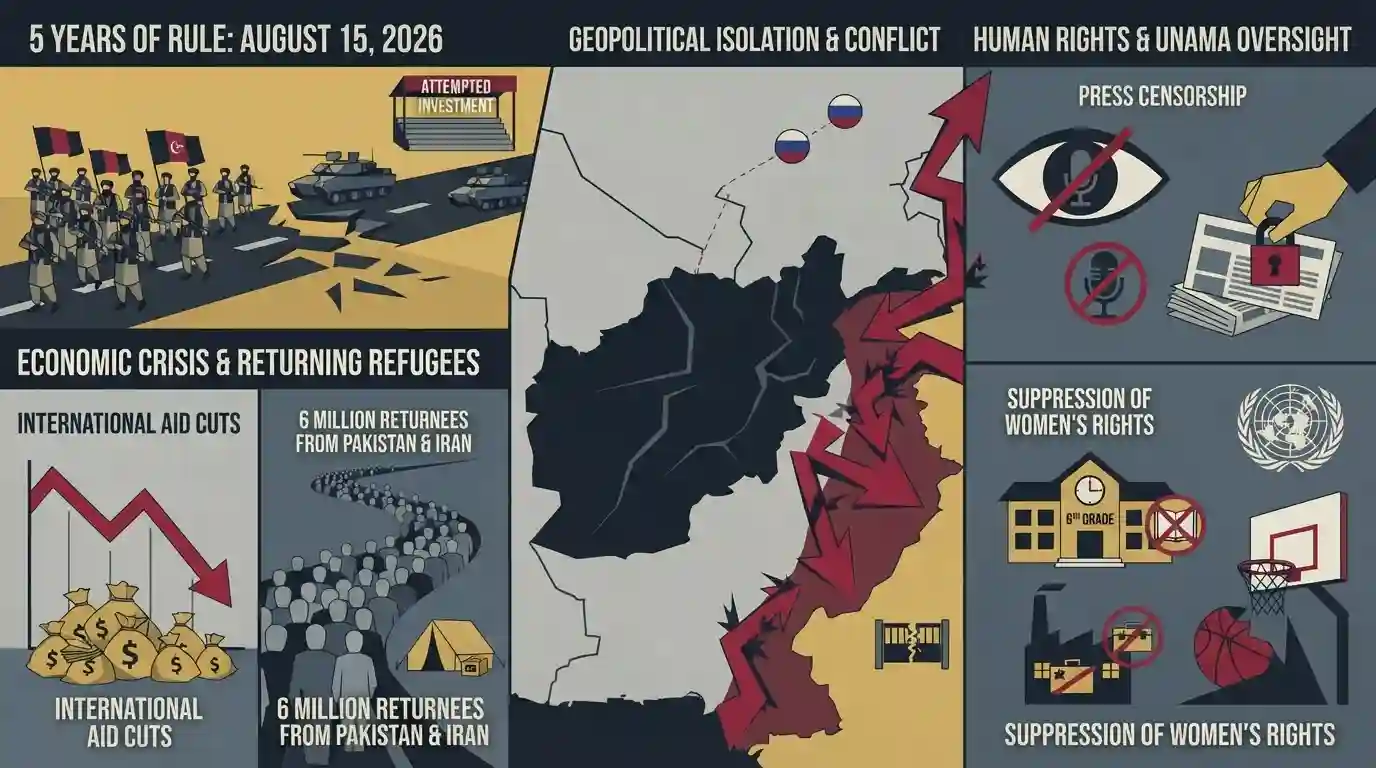
On August 15, 2026, the Taliban marked five years of ruling Afghanistan with street rallies and parades, attempting to project stability and attract foreign investment. However, the reality within the country remains grim. Afghanistan is grappling with a severe economic downturn and a humanitarian crisis, heavily impacted by drastic cuts in international aid and the sudden influx of six million refugees returning from Pakistan and Iran. Geopolitically, the regime is heavily isolated, maintaining formal recognition only from Russia, while its relations with Pakistan have rapidly deteriorated into open conflict. Concurrently, human rights watchdogs like UNAMA have highlighted the "suffocating restrictions" imposed on citizens, focusing heavily on press censorship and the draconian suppression of women's rights, including total bans on sports, most employment, and secondary education for girls.
ముఖ్య అంశాలు
- The Taliban celebrated five years of rule in Afghanistan following the US withdrawal in August 2021, staging rallies and military parades in cities like Kabul and Kandahar.
- The nation is experiencing a deepening economic crisis, with declining GDP per capita exacerbated by severe cuts in international aid and the return of six million refugees from Iran and Pakistan.
- Internationally, the Taliban regime remains largely unrecognized, with only Russia formally acknowledging the government, while relations with neighboring Pakistan have deteriorated into armed conflict.
- International organizations, including UNAMA and the CPJ, continue to condemn the regime for severe human rights violations, particularly the systemic marginalization of women, bans on girls' education beyond age 12, and brutal repression of the press.
ముఖ్యమైన పదాలు
Taliban

An Islamic fundamentalist movement that currently governs Afghanistan. Known for its strict interpretation of Sharia law, it seized control of the country in 2021 after the withdrawal of US and allied forces.
UPSC context
GS-II (International Relations) & GS-III (Security). Tests understanding of regional stability, terrorism, India's neighborhood policy, and engagement vs. recognition dilemmas.
United Nations Assistance Mission in Afghanistan (UNAMA)
A United Nations Special Political Mission established in 2002 to support peace, development, and human rights in Afghanistan. It acts to coordinate international humanitarian efforts and monitor the situation on the ground.
UPSC context
GS-II (International Relations). Tests knowledge of global organizations' roles in post-conflict reconstruction, human rights monitoring, and international diplomacy.
Committee to Protect Journalists (CPJ)
An independent, non-profit organization that promotes press freedom worldwide. It defends the right of journalists to report the news safely and without fear of reprisal, often documenting abuses and imprisonments.
UPSC context
GS-II (Polity & Governance). Relevant for topics on fundamental rights, democracy, freedom of expression, and international human rights watchdogs.
ప్రిలిమ్స్ ఉచ్చు
"No UN Member State officially recognizes the Taliban government in Afghanistan."
While widely isolated, Russia formally recognized the Taliban-led Islamic Emirate in July 2025. Absolute statements claiming 'zero international recognition' are now factually incorrect for Prelims.
అనుసంధానమైన స్థిర భావనలు
What is the mandate and nature of UNAMA?
- Mission Nature: It is a UN Special Political Mission (not a peacekeeping force) established in 2002 by the UN Security Council at the request of the Afghan government.
- Administration: It is directed and supported by the UN Department of Political and Peacebuilding Affairs (DPPA).
- Core Mandate: It focuses on human rights monitoring, humanitarian assistance coordination, and good offices, with its mandate recently extended to 2027.
What is the Moscow Format on Afghanistan?
- Origin: It is a regional dialogue mechanism established in 2017 to promote a political settlement and peace process in Afghanistan.
- Member States: It includes Russia, India, China, Pakistan, Iran, and Central Asian Republics.
- Recent Evolution: Reflecting shifting geopolitics, the grouping formally included a representative of the Taliban-led government as a full member in late 2025.
అంతర-అంశ నమూనాలు
Pragmatic Engagement Strategy
India's restoration of its Kabul Embassy and increased aid without formal recognition mirrors its "functional engagement" policy used with Myanmar's junta, prioritizing strategic regional interests over ideological estrangement.
Refugee Influx & Economic Strain
The sudden return of six million refugees from Pakistan and Iran exacerbates Afghanistan's economic crash, illustrating the vicious cycle between forced mass migration, resource depletion, and regional instability.

Expect a multi-statement question on India’s shifting Afghan policy (embassy restoration) paired with UNAMA's mandate or the Moscow Format.
అనుసంధాన PYQలు · 3
అనుసంధాన PYQలు · 3
- 2022PrelimsGS1
Consider the following countries: 1. Azerbaijan 2. Kyrgyzstan 3. Tajikistan 4. Turkmenistan 5. Uzbekistan Which of the above have borders with Afghanistan ?
- 2024MainsGS2
Critically analyse India's evolving diplomatic, economic and strategic relations with the Central Asian Republics (CARs) highlighting their increasing significance in regional and global geopolitics.
- 2016MainsGS2
Increasing cross-border terrorist attacks in India and growing interference in the internal affairs of several member-states by Pakistan are not conducive for the future of SAARC (South Asian Association for Regional Cooperation)." Explain with suitable examples.
