Direct Benefit Transfers Balance Welfare and Fiscal Prudence
Source:The Hindu ↗
Why It Matters
The intersection of welfare economics, the 'freebies' debate, and gender empowerment is a core UPSC theme. This article provides critical analytical fodder for GS-2 (welfare schemes vs. sustainable development) and GS-3 (state fiscal health, public expenditure management, and inclusive growth), equipping aspirants to write balanced answers on state welfare policies.
Summary
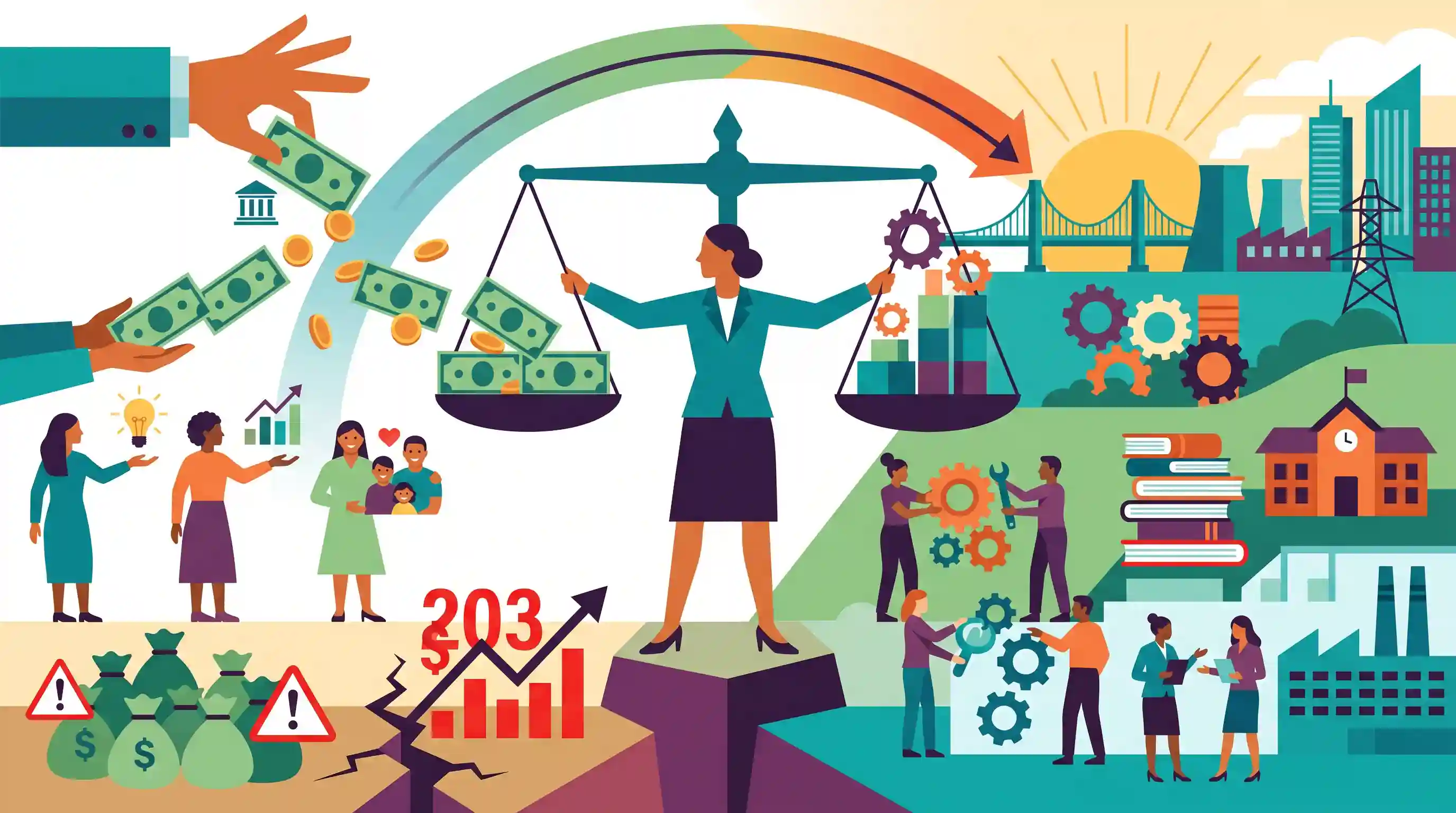
The article analyzes the recent surge in state-sponsored welfare programs and cash transfers aimed at women (often framed as 'Stree Shakti' or women empowerment initiatives). While acknowledging the positive impact of these Direct Benefit Transfers (DBTs) on women's immediate financial agency and household well-being, it cautions against the growing fiscal burden they impose on state governments. The piece argues for a critical balance between social empowerment and macroeconomic prudence, emphasizing that unchecked welfare spending—often debated as 'freebies'—can crowd out essential capital expenditure. Ultimately, true empowerment requires supplementing targeted financial aid with long-term structural reforms focused on skill development, education, and job creation.
Key Points
- State-led welfare schemes and Direct Benefit Transfers (DBTs) specifically targeting women provide immediate financial agency, improve household nutrition, and enhance basic economic independence.
- The proliferation of these schemes raises significant macroeconomic concerns, as populist welfare spending places immense fiscal strain on state exchequers.
- High revenue expenditures on subsidies risk crowding out critical capital expenditure, infrastructure development, and long-term asset creation.
- Sustainable women's empowerment requires a balance between targeted financial assistance and structural reforms like skill development, job creation, and ensuring safe workplaces, rather than merely relying on cash handouts.
Important Terms
Direct Benefit Transfer (DBT)

A mechanism transferring government subsidies and welfare benefits directly into beneficiaries' bank accounts, leveraging Aadhaar and Jan Dhan to minimize leakages and intermediaries.
UPSC context
GS Paper 2 & 3; tests understanding of governance efficiency, financial inclusion, and technology-led welfare delivery.
Fiscal Prudence
The disciplined management of public finances by controlling deficits, maintaining sustainable debt levels, and prioritizing productive expenditure over populist giveaways to ensure long-term stability.
UPSC context
GS Paper 3 (Budgeting); assesses knowledge of fiscal consolidation, the FRBM Act, and state-level financial health.
Capital Expenditure (CapEx)
Government spending dedicated to creating long-term physical or social assets (like infrastructure) or reducing liabilities, which generates a multiplier effect on economic growth.
UPSC context
GS Paper 3 (Economy); tests the ability to distinguish between asset-building investments and recurring revenue expenditures.
Inclusive Growth
Economic growth that is broad-based and distributed fairly across all sections of society, ensuring equitable access to opportunities, assets, and essential services.
UPSC context
GS Paper 3; a foundational syllabus topic evaluating how development benefits marginalized groups, including women.
Mission Shakti
An integrated umbrella scheme for women's safety, security, and empowerment, comprising 'Sambal' (safety/security) and 'Samarthya' (empowerment/skill-building) sub-schemes.
UPSC context
GS Paper 2 (Social Justice); tests knowledge of institutional frameworks for gender empowerment and welfare implementation.
Freebies (Revdi Culture)
A critical term for populist electoral promises of free utilities or cash, often contrasted with 'merit subsidies' that build long-term human or physical capital.
UPSC context
GS Paper 2 & 3; tests the analytical debate between short-term political populism and long-term fiscal sustainability.
Prelims Trap
"Cash transfers under women empowerment schemes are classified as capital expenditure."
UPSC often confuses economic outcomes with accounting classifications. While cash handouts may build 'human capital', they are strictly revenue expenditure, not capital.
Static Concepts Connected
What are the NK Singh Committee's debt-to-GDP targets?
- Combined limit: Recommends a combined debt-to-GDP ceiling of 60% for both the Centre and the States.
- Specific breakdown: The 60% target is strictly divided into 40% for the Centre and 20% for the States.
- Current status: India's current combined debt hovers around 81% of GDP, well above the recommended prudential limit.
How does 'crowding out' occur in state budgets?
- Revenue expansion: High spending on subsidies and unconditional cash transfers swells the revenue expenditure side of the budget.
- Capital squeeze: To maintain overall fiscal deficit limits (typically 3% of GSDP), states are forced to cut back on capital expenditure.
- Growth impact: Lower Capex reduces the state's future infrastructure and revenue-generating capacity, creating long-term fiscal traps.
Cross-Topic Patterns
SHGs vs. Unconditional Cash
Contrasting consumption-based state DBTs with productive welfare like DAY-NRLM or the Lakhpati Didi scheme is a recurring GS2/GS3 evaluative theme.
Freebies vs. DPSPs and ECI
The fiscal debate touches the Representation of the People Act, 1951, and SC judgments distinguishing valid DPSP-backed welfare from undue electoral influence.

Mains 2026: Expect a 15-marker evaluating state-level unconditional cash transfers for women against the FRBM combined debt ceiling.
Linked PYQs · 5
Linked PYQs · 5
- 2024MainsGS1
Distinguish between gender equality, gender equity and women's empowerment. Why is it important to take gender concerns into account in programme design and implementation?
- 2022MainsGS2
Besides the welfare schemes, India needs deft management of inflation and unemployment to serve the poor and the underprivileged sections of the society. Discuss.
- 2025MainsGS3
Explain how the Fiscal Health Index (FHI) can be used as a tool for assessing the fiscal performance of states in India. In what way would it encourage the states to adopt prudent and sustainable fiscal policies?
- 2024MainsGS3
Examine the pattern and trend of public expenditure on social services in the post-reforms period in India. To what extent this has been in consonance with achieving the objective of inclusive growth?
- 2019MainsGS3
The public expenditure management is a challenge to the Government of India in the context of budget making during the post-liberalization period. Clarify it.
