आवारा पशु प्रबंधन सार्वजनिक सुरक्षा और नैतिकता के बीच संतुलन बनाता है
स्रोत:इंडियन एक्सप्रेस ↗
क्यों मायने रखता है
Stray animal management is an ongoing urban governance issue that requires a careful balance between civic safety (preventing rabies and dog bites) and statutory animal welfare laws. It touches upon fundamental duties, municipal responsibilities, and judicial oversight.
सारांश
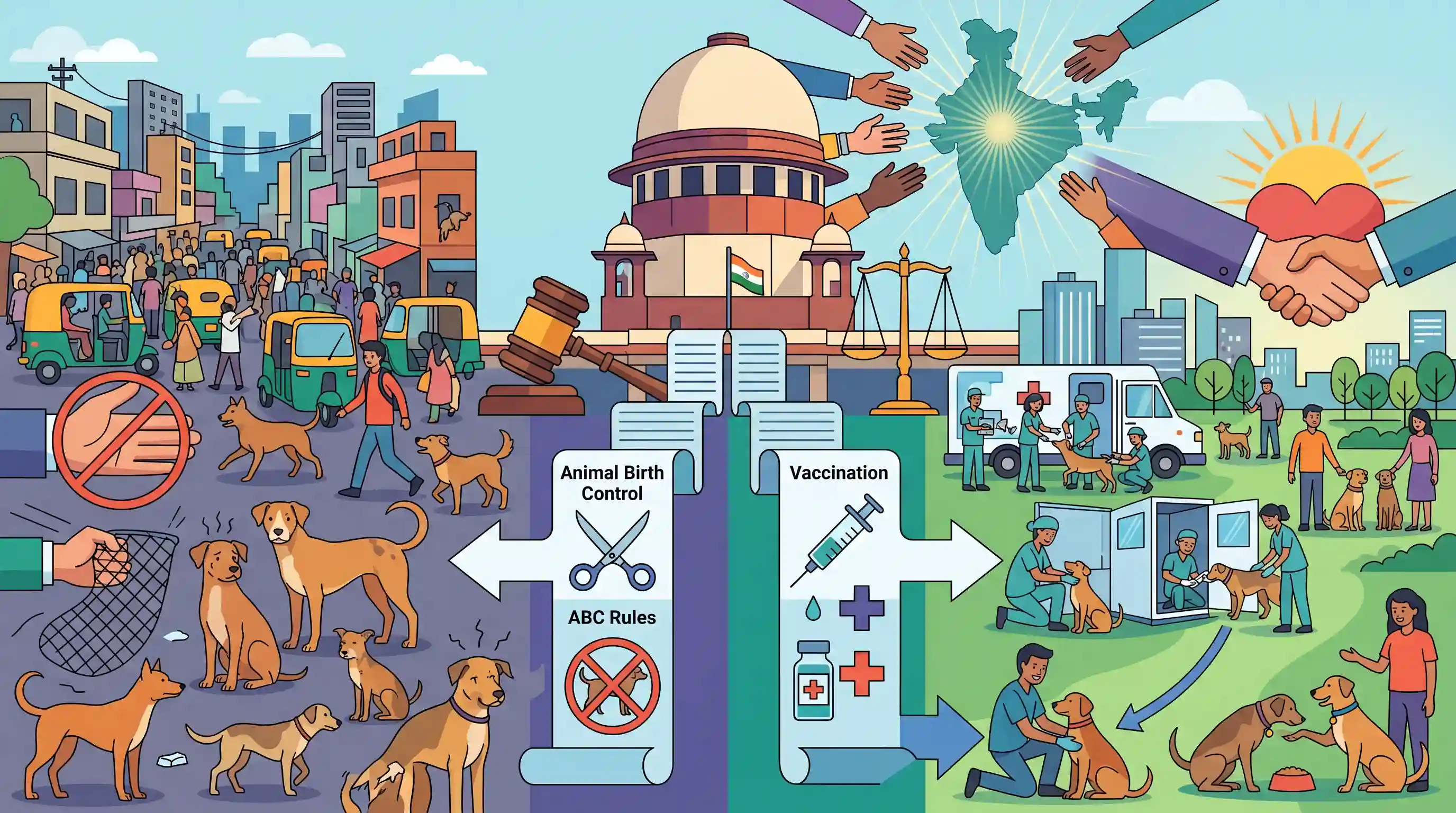
The article delves into the debate surrounding stray dog management in India, focusing on the intersection of animal welfare, public health, and urban governance. It highlights the Supreme Court's involvement in interpreting the Prevention of Cruelty to Animals Act, 1960, and enforcing the Animal Birth Control (ABC) Rules. The piece argues that instead of culling, humanely managing stray populations through sterilization and vaccination upholds constitutional values of compassion towards living creatures. Ultimately, it suggests that India can set a global example by prioritizing ethical animal welfare while addressing civic safety concerns.
मुख्य बिंदु
- The article highlights the growing human-animal conflict in urban areas, particularly concerning stray dogs and public safety vs. animal welfare.
- यह मानव सुरक्षा और पशु क्रूरता के खिलाफ कानूनों के बीच संतुलन बनाने में भारत के सर्वोच्च न्यायालय की भूमिका को रेखांकित करता है।
- पशु क्रूरता निवारण (PCA) अधिनियम और पशु जन्म नियंत्रण (ABC) नियम हत्या (culling) के बजाय नसबंदी जैसे मानवीय प्रबंधन का समर्थन करने वाला वैधानिक ढांचा तैयार करते हैं।
- Emphasizes the ethical and constitutional mandate (Article 51A(g)) to show compassion towards all living creatures, presenting India as a potential global model for compassionate animal welfare.
महत्वपूर्ण शब्द
Prevention of Cruelty to Animals Act, 1960

A central law aimed at preventing "unnecessary pain or suffering" to animals, providing for punishments against cruelty and the establishment of the Animal Welfare Board of India.
UPSC context
GS II (सामाजिक न्याय) और GS III (पर्यावरण)। यह पशु कल्याण के लिए वैधानिक ढांचे और कानूनी संरक्षण का परीक्षण करता है।
Animal Birth Control (ABC) Rules, 2023
Statutory rules under the PCA Act mandating the Catch-Neuter-Vaccinate-Release (CNVR) protocol for stray dogs, designating them as "community animals" and prohibiting their arbitrary relocation.
UPSC context
GS II (Governance) and GS III (Environment). Relevant for addressing human-animal conflict and urban governance challenges.
Animal Welfare Board of India (AWBI)
A statutory advisory body under the Ministry of Fisheries, Animal Husbandry and Dairying that advises the government on animal welfare laws and provides financial assistance to shelters.
UPSC context
GS II (सांविधिक निकाय)। भारत में पशु अधिकारों के प्रवर्तन के लिए संस्थागत तंत्र को समझने के लिए महत्वपूर्ण।
Article 51A(g)
A Fundamental Duty under the Indian Constitution that mandates every citizen to protect the natural environment and have "compassion for living creatures."
UPSC context
GS II (Polity/Fundamental Duties). Frequently cited by the Supreme Court as a constitutional basis for animal rights jurisprudence.
Municipal Corporations
Local urban governing bodies constitutionally mandated under Article 243W to manage stray animal populations and implement public health programs like rabies control.
UPSC context
GS II (Urban Governance). Tests knowledge of local bodies' roles in civic safety and public health administration.
Human-Animal Conflict
A moral and administrative challenge where human safety interests (e.g., dog-bite prevention) collide with animal rights and humane treatment standards.
UPSC context
GS III (Environment) and GS IV (Ethics). Evaluates the ability to balance competing rights and ethical values.
प्रारंभिक ट्रैप
"Municipal corporations can legally authorize the mass culling of stray dogs to control severe rabies outbreaks."
पशु जन्म नियंत्रण (ABC) नियम, 2023 के तहत, आवारा कुत्ते 'सामुदायिक पशु' हैं। सामूहिक हत्या या स्थानांतरण कानूनी रूप से प्रतिबंधित है; केवल कैच-न्यूटर-वैक्सीनेट-रिलीज़ (CNVR) प्रोटोकॉल की ही अनुमति है।
संबंधित अवधारणाएँ
What is the Animal Welfare Board of India (AWBI)?
- वैधानिक उत्पत्ति: Established in 1962 under the Prevention of Cruelty to Animals (PCA) Act, 1960. It is a statutory body, distinct from wildlife conservation bodies.
- Advisory Role: पशु कल्याण कानून बनाने और पशु कल्याण योजनाओं को बढ़ावा देने के लिए केंद्र सरकार के मुख्य सलाहकार निकाय के रूप में कार्य करता है।
- मुख्यालय: Originally established in Chennai, its headquarters was later relocated to Ballabhgarh in Haryana.
Which Constitutional provisions safeguard animal welfare in India?
- मौलिक कर्तव्य: Article 51A(g) explicitly imposes a duty on every citizen to protect the natural environment and have compassion for living creatures.
- DPSP: Article 48 directs the State to organize agriculture and animal husbandry on modern lines and take steps to preserve and improve breeds.
- Concurrent List: 'पशुओं के प्रति क्रूरता का निवारण' को सातवीं अनुसूची की समवर्ती सूची की प्रविष्टि 17 के तहत रखा गया है, जो केंद्र और राज्यों दोनों को कानून बनाने के लिए सशक्त बनाता है।
अंतर-विषय पैटर्न
Article 21 and Animal Rights overlaps
The SC's A. Nagaraja (2014) judgment extended the right to dignity to animals, creating a complex judicial tension between public safety (human Article 21 rights) and animal welfare.
Local Governance & One Health
Effective stray management requires municipal capacity under the 74th Amendment, directly linking urban governance funding to zoonotic disease control and the One Health approach.

Expect a Prelims statement testing AWBI's statutory origin (PCA Act vs WPA 1972) paired with the CNVR mandate of the 2023 ABC Rules.
संबद्ध PYQ · 3
संबद्ध PYQ · 3
- 2009PrelimsGS1
Where is the headquarters of Animal Welfare Board of India located?
- 2024MainsGS2
Analyse the role of local bodies in providing good governance at local level and bring out the pros and cons merging the rural local bodies with the urban local bodies.
- 2024MainsGS4
“Ethics encompasses several key dimensions that are crucial in guiding individuals and organizations towards morally responsible behaviour.” Explain the key dimensions of ethics that influence human actions. Discuss how these dimensions shape ethical decision-making in the professional context.
