Bengaluru Civic Body Plans Target Based Animal Birth Control Reforms
Source:The Hindu ↗
Why It Matters
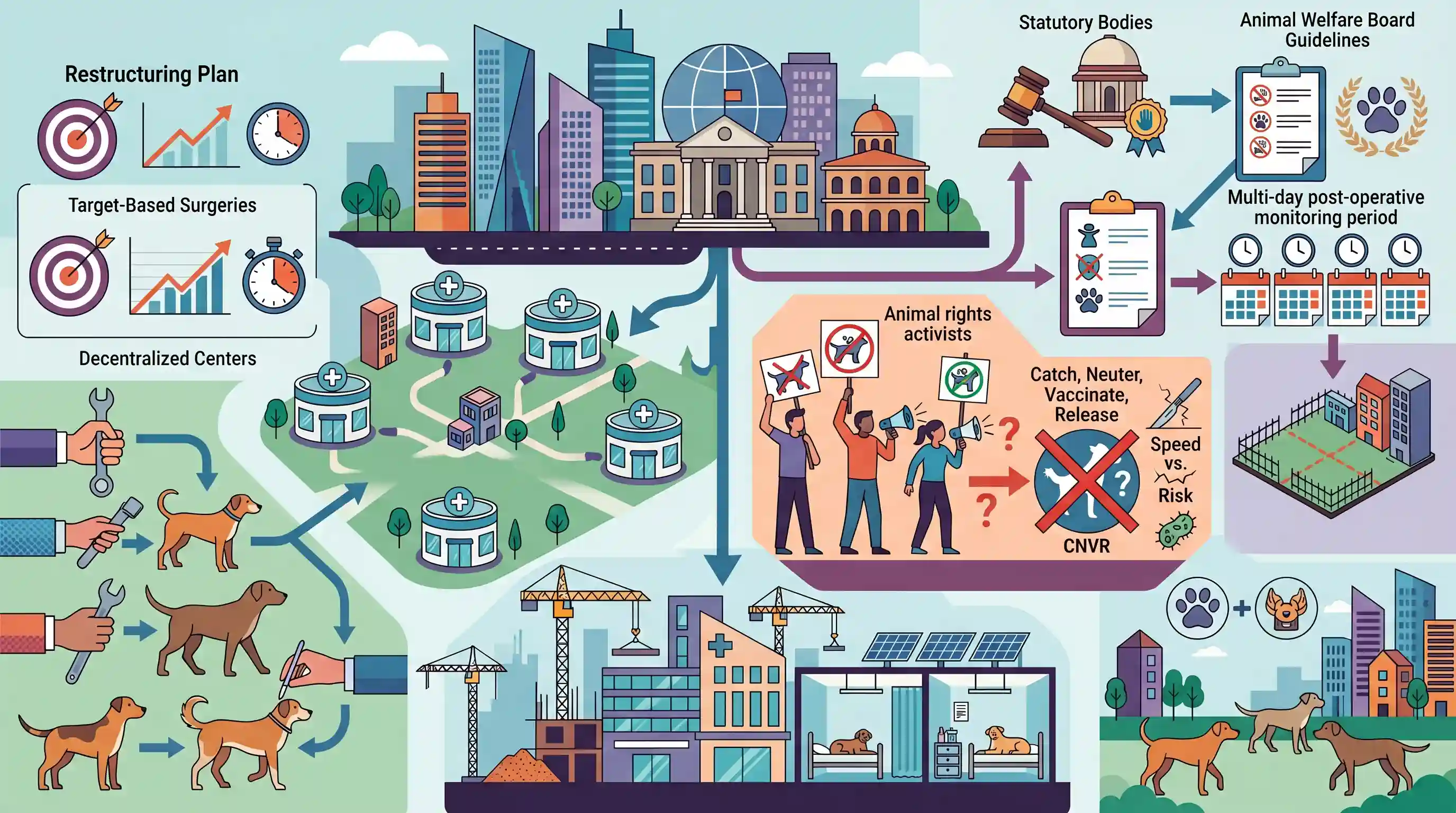
Highlights the governance challenges Urban Local Bodies face in managing civic issues like the stray dog menace. It underscores the tension between public safety, animal rights frameworks governed by statutory bodies like the AWBI, and the influence of civil society in shaping municipal policies.
Summary
Bengaluru's civic authorities are restructuring the Animal Birth Control (ABC) programme by introducing target-based surgeries and decentralised centres to manage the stray dog population effectively. Challenges such as land scarcity and strict Animal Welfare Board of India (AWBI) guidelines—requiring a three-day post-operative monitoring period—have constrained existing capacity. In response to Supreme Court directives, bodies like the BBMP are exploring new infrastructure while shelving faster but riskier methods like the Catch, Neuter, Vaccinate, and Release (CNVR) technique following opposition from animal rights activists concerning surgical safety and disease transmission.
Key Points
- Bengaluru's civic bodies plan to introduce stricter, target-based surgeries to increase accountability in the Animal Birth Control (ABC) programme.
- Existing ABC centres face severe capacity constraints due to Animal Welfare Board of India (AWBI) rules that mandate keeping dogs under observation for three days post-surgery.
- To overcome land shortages and comply with Supreme Court directives regarding dog shelters, authorities are searching for smaller land parcels to establish decentralised ABC centres.
- A proposal to adopt the Catch, Neuter, Vaccinate, and Release (CNVR) technique (same-day release) was scrapped following strong opposition from animal rights activists who cited risks of botched surgeries and disease spread.
Important Terms
Animal Birth Control (ABC) Rules, 2023

Notified under the Prevention of Cruelty to Animals Act, 1960, these rules mandate humane stray dog population management through sterilization and immunization, classifying them as "community animals."
UPSC context
GS II (Governance/Public Health); tests knowledge of animal welfare laws and local body obligations under municipal governance.
Animal Welfare Board of India (AWBI)
A statutory advisory body under the Ministry of Fisheries, Animal Husbandry and Dairying that implements the Prevention of Cruelty to Animals Act and recognizes ABC-executing organizations.
UPSC context
GS II (Statutory Bodies); focuses on institutional frameworks for animal protection and executive oversight of welfare standards.
Catch, Neuter, Vaccinate, and Release (CNVR)
A population control technique involving catching strays, neutering/sterilizing them, vaccinating against rabies, and returning them to their territory to prevent pack aggression and stabilize populations.
UPSC context
GS III (Public Health/Environment); relevant for zoonotic disease management (Rabies) and scientific methods of humane urban animal management.
Greater Bengaluru Authority (GBA)
A newly established apex body under the Greater Bengaluru Governance Act, 2024, tasked with coordinating planning and parastatal agencies across multiple city corporations in Bengaluru.
UPSC context
GS II (Urban Governance); illustrates three-tier governance models and metropolitan planning reforms replacing traditional single municipal structures.
Bruhat Bengaluru Mahanagara Palike (BBMP)
The erstwhile primary municipal corporation for Bengaluru, responsible for civic infrastructure and amenities, currently being restructured into five independent corporations overseen by the GBA.
UPSC context
GS II (Local Bodies); tests understanding of municipal administration, urban challenges, and restructuring of local self-government in tier-1 cities.
Supreme Court (Human-Animal Conflict Jurisprudence)
In animal welfare, the Court balances Article 21 (Right to Life) for humans with the inherent dignity of animals, recently issuing directives for permanent sheltering.
UPSC context
GS II (Judiciary); examines judicial activism and the legal evolution of animal rights vs. public safety in India.
Prelims Trap
The Animal Welfare Board of India (AWBI) is a statutory body established under the Wildlife Protection Act, 1972.
The AWBI is established under the Prevention of Cruelty to Animals (PCA) Act, 1960. Additionally, it now falls under the Ministry of Fisheries, Animal Husbandry and Dairying, not MoEFCC.
Static Concepts Connected
What are the core functions and jurisdiction of the Animal Welfare Board of India (AWBI)?
- Statutory origin: Established under Section 4 of the Prevention of Cruelty to Animals Act, 1960.
- Nodal Ministry: Shifted from the Environment Ministry to the Ministry of Fisheries, Animal Husbandry and Dairying in 2018.
- Mandate: Advises the government on animal welfare laws and provides financial assistance to recognized Animal Welfare Organisations (AWOs).
How does the 12th Schedule empower Urban Local Bodies (ULBs) in animal welfare?
- Constitutional backing: Inserted by the 74th Amendment, Article 243W enumerates 18 functional items for municipalities.
- Direct mandate: Specifically includes 'cattle pounds; prevention of cruelty to animals' as an item under the purview of ULBs.
- Public health linkage: Also covers 'Public health and sanitation', legally obligating civic bodies to manage stray dog populations and rabies prevention.
Cross-Topic Patterns
One Health + Zoonotic disease elimination
Stray dog management directly links to India's National Action Plan for Dog Mediated Rabies Elimination (NAPRE) by 2030, serving as a practical application of the 'One Health' concept in urban ecosystems.
Judicial interventions + Local self-governance
Supreme Court directives balancing human safety (Article 21) with animal rights frequently shape Urban Local Body policies, highlighting the judiciary's role in local governance and public health management.

Expect a multi-statement prelims question combining AWBI's statutory origin (PCA Act 1960) with the 'One Health' approach to rabies.
Linked PYQs · 3
Linked PYQs · 3
- 2023MainsGS2
“The states in India seem reluctant to empower urban local bodies both functionally as well as financially.” Comment.
- 2024MainsGS2
Analyse the role of local bodies in providing good governance at local level and bring out the pros and cons merging the rural local bodies with the urban local bodies.
- 2021MainsGS2
Can Civil Society and Non-Governmental Organizations present an alternative model of public service delivery to benefit the common citizen? Discuss the challenges of this alternative model.
