Supreme Court Summons Chief Secretaries Over Stray Dog Guidelines
Source:The Hindu ↗
Why It Matters
This article serves as a practical example of judicial oversight over executive inaction. It highlights how the Supreme Court utilizes its authority to enforce statutory frameworks (ABC Rules 2023) and navigate complex public policy issues that pit animal welfare against public safety.
Summary
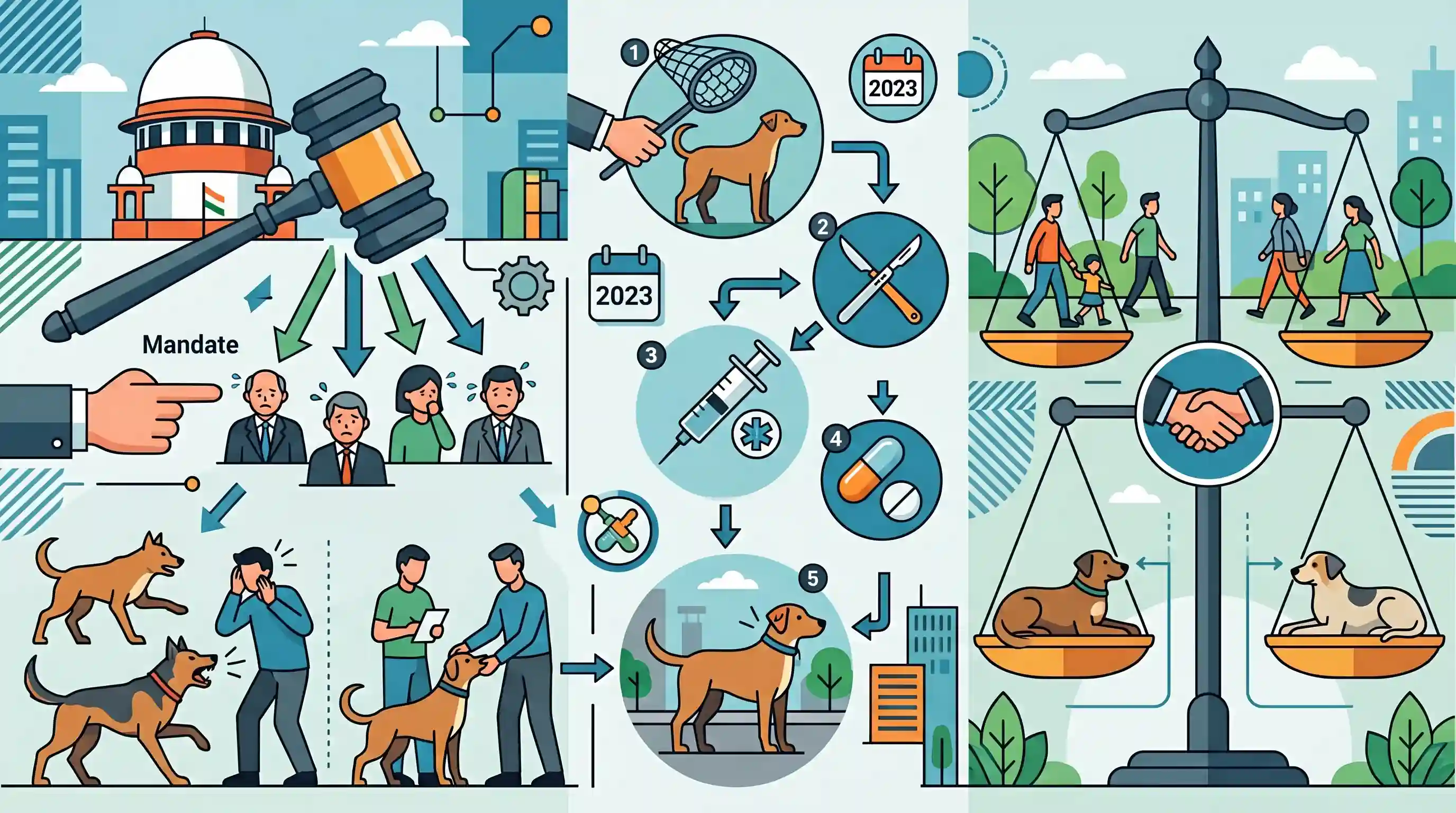
The Supreme Court has taken strict action against several States and Union Territories for failing to comply with its mandate on the sterilisation, deworming, and immunisation of stray dogs. Summoning the Chief Secretaries, the Court emphasized the enforcement of the Animal Birth Control (ABC) Rules, 2023, under the Prevention of Cruelty to Animals Act. The judiciary aims to establish a balance between protecting citizens from stray dog attacks and ensuring humane treatment of animals through the catch-neuter-vaccinate-release model.
Key Points
- The Supreme Court has summoned Chief Secretaries of all States and UTs (except West Bengal and Telangana) for non-compliance with its August 2023 directive on managing stray dogs.
- States were mandated to file affidavits detailing the implementation of the Animal Birth Control (ABC) Rules, 2023, framed under the Prevention of Cruelty to Animals Act, 1960.
- The Court stressed the 'catch-neuter-vaccinate-release' model to control the stray dog population humanely.
- The case highlights the judicial effort to balance animal welfare (preventing cruelty) with public safety (preventing stray dog attacks on citizens).
Important Terms
Animal Birth Control (ABC) Rules, 2023

Statutory guidelines under the PCA Act 1960 that mandate the 'catch-neuter-vaccinate-release' model for managing stray dogs, prohibiting their mass relocation while designating them as 'community animals' to be cared for locally.
UPSC context
GS Paper II (Governance) & III (Environment); focuses on local body responsibilities, public health (rabies), and animal welfare standards.
Prevention of Cruelty to Animals Act, 1960
India’s primary legislation enacted to prevent 'unnecessary pain or suffering' to animals. It established the Animal Welfare Board of India and provides the legal framework for animal rights and protections.
UPSC context
GS Paper II & III; key statutory framework for environmental legislation and ethical governance.
Chief Secretary
The highest-ranking civil servant and administrative head of an Indian state or Union Territory. They serve as the principal advisor to the Chief Minister and lead the state's bureaucratic machinery.
UPSC context
GS Paper II (Polity & Governance); critical for understanding state executive structure, center-state relations, and administrative accountability.
Animal Welfare Board of India (AWBI)
A statutory advisory body established under Section 4 of the PCA Act, 1960. It advises the central and state governments on animal welfare laws and promotes humane treatment through grants.
UPSC context
GS Paper III (Environment); institutional mechanism for wildlife and domestic animal protection.
Community Animals
A legal classification introduced under the ABC Rules 2023 for unowned dogs, shifting the focus from 'strays' as nuisances to beings residing within a local territory that residents are encouraged to care for.
UPSC context
GS Paper III (Bio-diversity/Ethics); represents a shift in urban governance and animal-human coexistence policies.
Judicial Activism
The proactive role of the judiciary in ensuring the executive fulfills its constitutional and legal duties, often evidenced by the Supreme Court issuing direct mandates or summoning high officials for non-compliance.
UPSC context
GS Paper II (Judiciary); tests concepts of checks and balances, separation of powers, and judicial overreach.
Prelims Trap
Municipalities can relocate stray dogs outside city limits or cull them to control population under the ABC Rules 2023.
The ABC Rules 2023 strictly prohibit both the relocation and culling of stray dogs, mandating only a 'catch-neuter-vaccinate-release' model within their original territory.
Static Concepts Connected
What is the constitutional and statutory framework for animal welfare in India?
- Statutory body: The Animal Welfare Board of India (AWBI) was established under the Prevention of Cruelty to Animals Act, 1960 (not the Wildlife Protection Act).
- Fundamental Duty: Article 51A(g) explicitly mandates citizens to protect the natural environment and to have compassion for all living creatures.
- Seventh Schedule: 'Prevention of cruelty to animals' is placed under Entry 17 of the Concurrent List, allowing both the Centre and States to legislate.
What are the key features of the Animal Birth Control (ABC) Rules, 2023?
- Community Animals: The rules legally reclassify stray dogs as "community animals," shifting the administrative perspective toward co-existence and humane population management.
- Mandated Model: Strictly enforces the Catch-Neuter-Vaccinate-Release (CNVR) mechanism, explicitly banning the culling or arbitrary territorial relocation of stray dogs.
- Implementation: Requires local municipal bodies to execute ABC programs in collaboration with organizations officially recognized by the Animal Welfare Board of India.
Cross-Topic Patterns
Judicial Mandamus & Municipal Governance
Summoning Chief Secretaries for municipal tasks like stray dog management exemplifies 'continuing mandamus,' sparking GS2 debates on judicial overreach versus executive apathy.
One Health & Rabies Control
Effective execution of the ABC Rules links directly to India's National Action Plan for Dog Mediated Rabies Elimination, anchoring animal welfare within the broader 'One Health' epidemiological approach.

Expect a 2026 Prelims multi-statement question mixing AWBI's statutory backing, Concurrent List placement, and ABC Rules 2023 provisions.
Linked PYQs · 2
Linked PYQs · 2
- 2024MainsGS2
Explain the reasons for the growth of public interest litigation in India. As a result of it, has the Indian Supreme Court emerged as the world's most powerful judiciary ?
- 2020MainsGS2
Judicial Legislation is antithetical to the doctrine of separation of powers as envisaged in the Indian Constitution. In this context justify the filing of large number of public interest petitions praying for issuing guidelines to executive authorities.
