Institutional Animal Cells for Stray Dog Management and Vaccination
Source:The Hindu ↗
Why It Matters
The issue of stray animal management lies at the intersection of urban governance, public health, and animal welfare. It highlights the functional and financial limitations of urban local bodies (ULBs) and examines the practical implementation of the Prevention of Cruelty to Animals Act, 1960, both highly relevant for GS2 Governance and GS3 Environment (urban ecology).
Summary
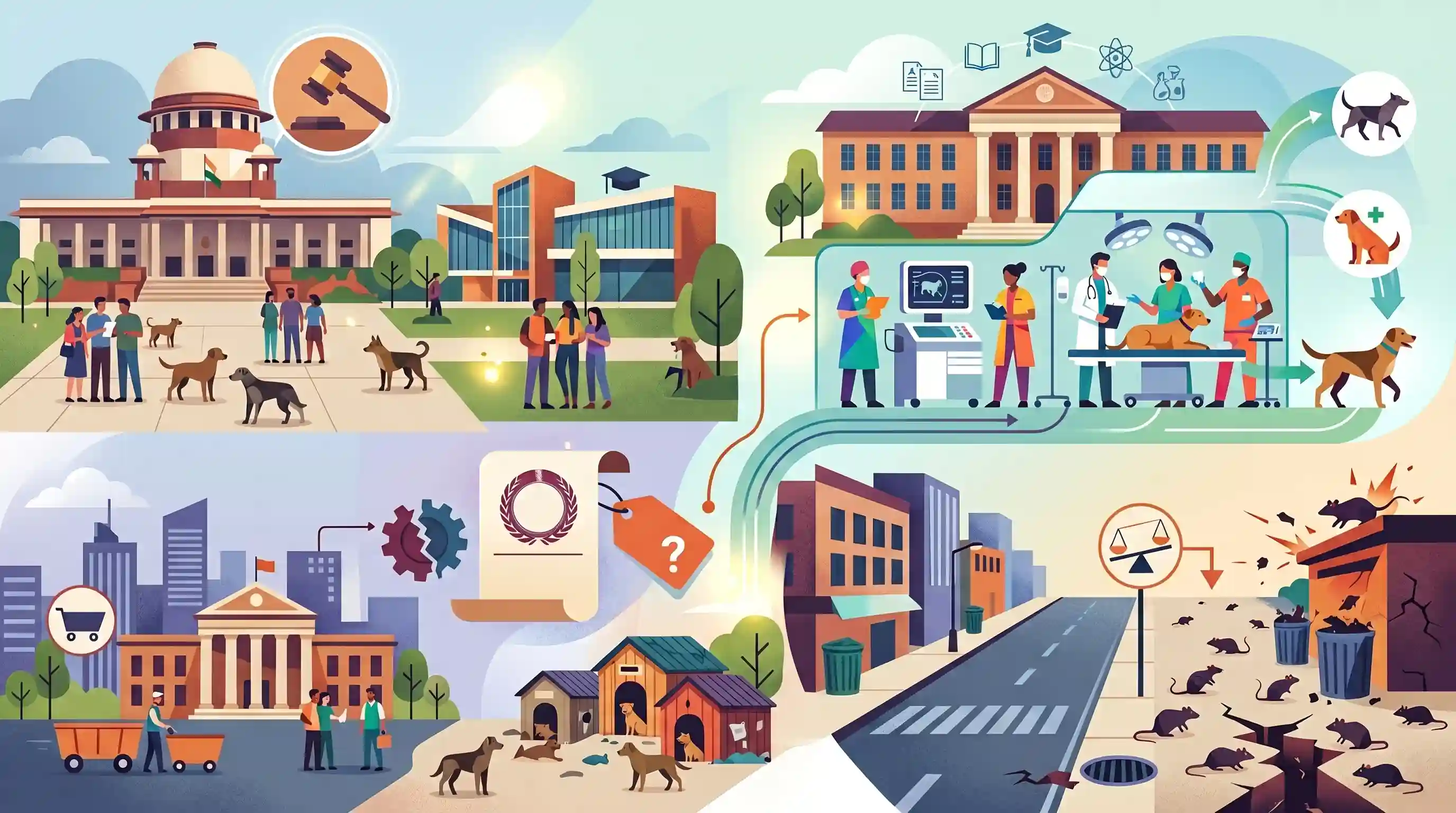
The Supreme Court is hearing petitions regarding the management of stray dogs in public and educational spaces. The Faculty of Law, University of Delhi, has proposed that public institutions establish their own 'animal cells' to handle the humane sterilisation and vaccination of stray dogs, arguing that municipal authorities are currently ill-equipped to manage the issue. Highlighting severe infrastructure gaps—such as the existence of only five government-owned dog shelters nationwide—the case underscores the failure to properly implement the Animal Birth Control Rules, 2023 under the Prevention of Cruelty to Animals Act, 1960. Additionally, animal rights activists cautioned that the abrupt removal of strays could disrupt urban ecosystems, leading to unintended consequences like a spike in rodent populations.
Key Points
- The Faculty of Law, DU, petitioned the Supreme Court to allow public and educational institutions to form their own 'animal cells' to manage stray dogs rather than relying on municipal authorities.
- A November 2025 Supreme Court order directed States to remove stray dogs from public spaces, sterilise, vaccinate, and move them to designated shelters under the Animal Birth Control (ABC) Rules, 2023.
- The implementation of this order is hampered by severe infrastructure deficits; there are reportedly only five government-owned dog shelters in the country.
- Animal rights advocates warn that abrupt removal of stray dogs could disturb the urban ecosystem by triggering a rise in the rodent population.
- The case highlights the limitations of municipal bodies in urban governance and points to decentralised, institutional-level interventions as a potential solution.
Important Terms
Prevention of Cruelty to Animals Act, 1960

A 1960 Indian law enacted to prevent the infliction of unnecessary pain or suffering on animals. It established the Animal Welfare Board of India and mandates humane treatment.
UPSC context
GS Paper II (Statutory Bodies). Tests knowledge of animal welfare legislation and the legal framework for animal rights in India.
Animal Birth Control (ABC) Rules, 2023
Rules notified under the PCA Act mandating local bodies to control stray dog populations through humane sterilization and vaccination rather than culling or relocation.
UPSC context
GS Paper II (Government Policies). Relevant for urban governance, public health, and human-animal conflict management.
Animal Welfare Board of India (AWBI)
A statutory advisory body established in 1962 under the PCA Act. It advises the government on animal welfare laws and promotes protection.
UPSC context
GS Paper II (Statutory Bodies). Important for understanding the institutional framework under the Ministry of Fisheries and Animal Husbandry.
Article 51A(g)
A Fundamental Duty in the Indian Constitution mandating citizens to protect the natural environment and have compassion for all living creatures.
UPSC context
GS Paper II (Constitution). Cited by courts as the legal basis for animal rights and environmental ethics in India.
Urban Local Bodies (ULBs)
Constitutional bodies (Article 243W) responsible for urban public health. They are the primary agencies for implementing sterilization and vaccination programs for strays.
UPSC context
GS Paper II (Local Self-Government). Tests understanding of the 74th Amendment and the functional challenges of city administration.
Vacuum Effect
An ecological principle where removing animals from an area leads to rapid repopulation by new ones from nearby regions due to available resources.
UPSC context
GS Paper III (Environment). Relevant for the scientific rationale behind population control policies versus relocation.
Prelims Trap
"The Animal Welfare Board of India (AWBI) is a statutory body established under the Wildlife (Protection) Act, 1972."
UPSC frequently swaps environmental statutes. AWBI is established under the Prevention of Cruelty to Animals Act, 1960, not the WPA or EPA.
Static Concepts Connected
What is the statutory framework of the Animal Welfare Board of India (AWBI)?
- Statutory origin: Established under Section 4 of the Prevention of Cruelty to Animals (PCA) Act, 1960.
- Nodal Ministry: It functions under the Ministry of Fisheries, Animal Husbandry and Dairying (not MoEFCC).
- Core mandate: It acts as a statutory advisory body to advise the government on animal welfare laws and promote animal welfare.
What are the key provisions of the Animal Birth Control (ABC) Rules, 2023?
- CNVR Methodology: Mandates the Catch-Neuter-Vaccinate-Release (CNVR) approach; stray dogs must be returned to their original areas post-sterilization, not permanently relocated.
- Local implementation: Assigns the responsibility of conducting sterilization and immunization programs to local bodies (municipalities and panchayats).
- No culling: Strictly prohibits the culling or arbitrary mass removal of stray dogs as a population control measure.
Cross-Topic Patterns
Urban ecology and zoonotic disease vectors
Mass removal of urban strays creates an ecological vacuum, often leading to a spike in rodent populations and increasing the risk of zoonotic diseases like leptospirosis.
74th CAA and unfunded municipal mandates
Delegating the Animal Birth Control Rules 2023 to municipalities highlights the classic 74th Amendment issue: functional devolution without adequate financial empowerment or infrastructure.

Expect a Prelims question mixing AWBI's statutory backing (PCA Act 1960) with the ecological role of urban scavengers and zoonotic risks.
Linked PYQs · 3
Linked PYQs · 3
- 2024MainsGS2
Analyse the role of local bodies in providing good governance at local level and bring out the pros and cons merging the rural local bodies with the urban local bodies.
- 2023MainsGS2
“The states in India seem reluctant to empower urban local bodies both functionally as well as financially.” Comment.
- 2014PrelimsGS1
Consider the following statements : 1. Animal Welfare Board of India is established under the Environment (Protection) Act, 1986. 2. National Tiger Conservation Authority is a statutory body. 3. National Ganga River Basin Authority is chaired by the Prime Minister. Which of the statements given above is/are correct?
