US Iran military conflict results in strategic stalemate
Source:The Hindu ↗
Why It Matters
The conflict underscores the geopolitical fragility of the Middle East and the critical importance of the Strait of Hormuz for global energy security, directly impacting India's strategic interests and foreign policy decisions regarding oil imports and regional stability.
Summary
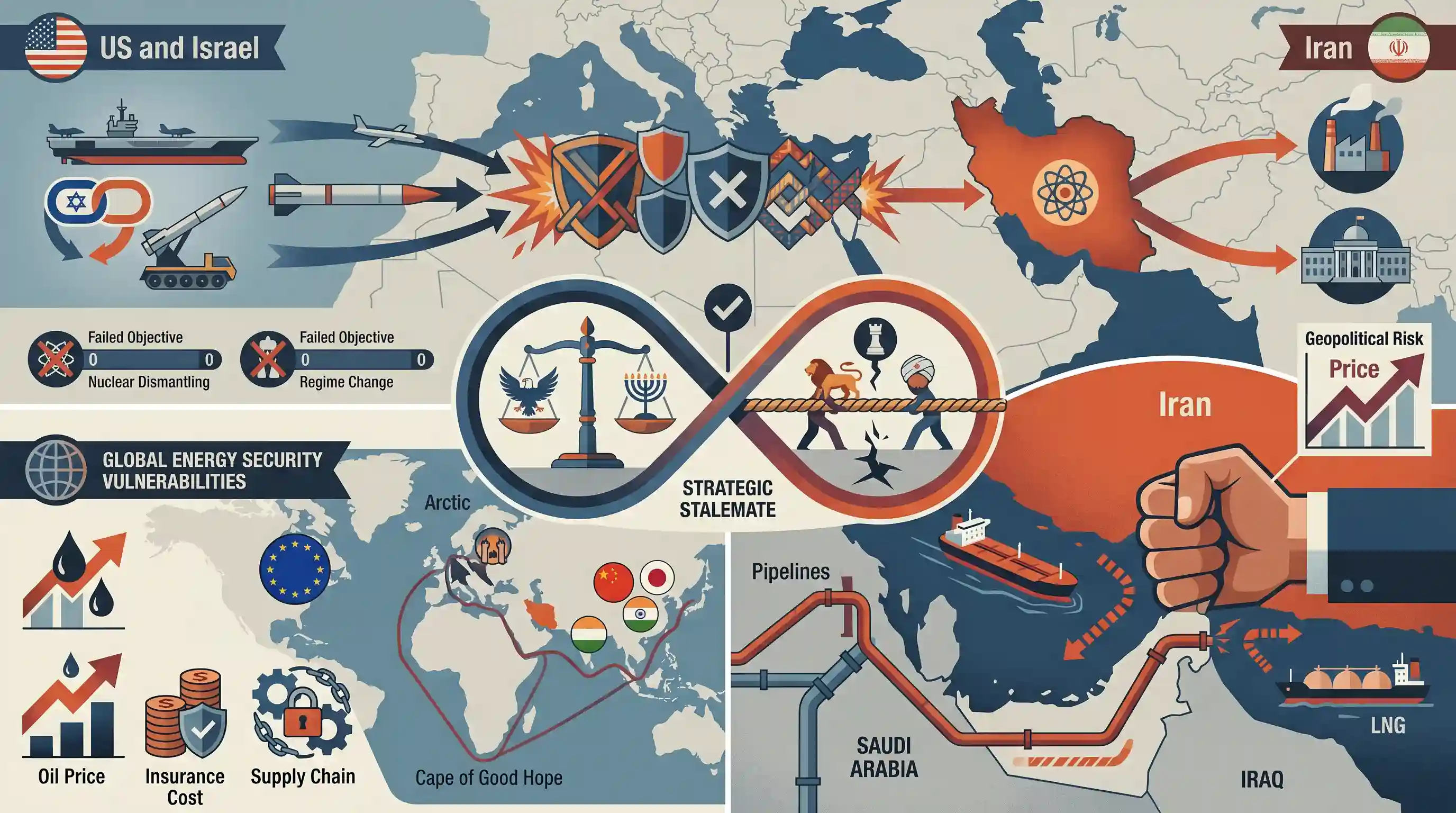
An analysis of the February 2026 military conflict between the US, Israel, and Iran, highlighting that the campaign failed to achieve its objectives of regime change and dismantling Iran's nuclear program. Instead, the confrontation resulted in a strategic stalemate, with Iran successfully leveraging its control over the Strait of Hormuz to assert regional dominance and highlight vulnerabilities in global energy security routes.
Key Points
- The US and Israel launched a military campaign in February 2026 aimed at dismantling Iran's nuclear program, degrading its missile capabilities, and prompting regime change.
- The conflict ended in a strategic stalemate as Iran successfully utilized asymmetric warfare, including targeting US bases in Jordan, Kuwait, and Bahrain, and downing a US Apache helicopter.
- Iran demonstrated its control over the Strait of Hormuz, an essential global energy chokepoint, thereby increasing its geopolitical leverage against Western forces.
- Faced with mounting pressure and a failure to achieve initial war objectives, US President Donald Trump shifted focus towards ending the conflict and lifting the blockade on the Strait of Hormuz.
Important Terms
Strait of Hormuz

A 33km-wide waterway connecting the Persian Gulf to the Gulf of Oman; it is the world's most critical oil transit route, handling approximately 20-25% of global crude and LNG trade.
UPSC context
GS Paper 1 (Geography) and GS 2 (IR); tests knowledge of global strategic locations and energy security vulnerabilities.
Iran Nuclear Programme
Iran's dual-use nuclear technology project; by 2025-2026, it is considered a 'threshold' program with enrichment levels (60%) capable of rapid weaponization, posing a significant global non-proliferation challenge.
UPSC context
GS Paper 2 (International Relations); tests understanding of non-proliferation regimes (NPT) and regional security dynamics.
Axis of Resistance
An informal, Iran-led military and political coalition including Hezbollah, Hamas, and the Houthis, aimed at countering US and Israeli influence in the Middle East through asymmetric warfare.
UPSC context
GS Paper 2 (International Relations); evaluates regional power blocks, non-state actors, and impact on India's West Asia interests.
Strategic Chokepoint
Narrow geographic passages (straits/canals) like Hormuz or Malacca through which large volumes of international trade or military assets pass, providing strategic leverage to the controlling nations.
UPSC context
GS Paper 1 (Geography) and GS 3 (Security); focuses on maritime security, global trade resilience, and naval strategy.
Energy Security
The uninterrupted availability of energy sources at an affordable price; for India, this is heavily dependent on stable maritime passage through Middle Eastern chokepoints like Hormuz.
UPSC context
GS Paper 3 (Energy/Economy); tests understanding of external dependencies and the economic impact of geopolitical disruptions.
Joint Comprehensive Plan of Action (JCPOA)
A 2015 landmark agreement between Iran and P5+1 powers to curb Tehran’s nuclear activities in exchange for sanctions relief; it faces terminal challenges due to 2025 sunset clauses.
UPSC context
GS Paper 2 (International Relations); tests historical diplomacy, multilateralism, and the consequences of unilateral treaty exits.
Prelims Trap
The Strait of Hormuz is bordered by Iran to the north and the United Arab Emirates to the south.
While the UAE is nearby, the crucial southern coast of the Strait of Hormuz belongs to the Musandam Peninsula, which is an exclave of Oman.
Static Concepts Connected
What are the key geographical features of the Strait of Hormuz?
- Water bodies: It connects the Persian Gulf to the Gulf of Oman and subsequently the Arabian Sea.
- Bordering nations: It is bounded by Iran to the north and Oman's Musandam Peninsula to the south.
- Strategic significance: It handles approximately 20% of the world's daily global oil consumption, making it a critical maritime chokepoint.
What constitutes 'Asymmetric Warfare' in defense doctrines?
- Definition: Conflicts between actors with highly unequal military power, forcing the weaker side to exploit vulnerabilities using unconventional means rather than direct conventional engagement.
- Key tactics: Reliance on low-cost drone swarms, naval mines, proxy militias, and fast-attack boats to deter conventionally superior forces and disrupt global supply chains.
Cross-Topic Patterns
Gulf chokepoints and imported inflation
A Hormuz blockade spikes crude prices, widening India's Current Account Deficit (CAD) and triggering imported inflation, intrinsically linking Middle Eastern geopolitics to the RBI's monetary policy.
Chabahar Port and strategic bypass routes
Persistent instability in the Strait of Hormuz amplifies the need for alternative maritime and transit corridors like the Chabahar port and the INSTC to secure India's supply chains.

Map questions combining the Strait of Hormuz, adjacent US bases (Bahrain, Kuwait), and West Asian water bodies are highly likely in 2026.
Linked PYQs · 4
Linked PYQs · 4
- 2018MainsGS2
In what ways would the ongoing US-Iran Nuclear Pact Controversy affect the national interest of India? How should India respond to this situation?
- 2025MainsGS2
"Energy security constitutes the dominant kingpin of India's foreign policy, and is linked with India's overarching influence in Middle Eastern countries.” How would you integrate energy security with India's foreign policy trajectories in the coming years?
- 2022PrelimsGS1
The term "Levant" often heard in the news roughly corresponds to which of the following regions?
- 2024PrelimsGS1
Consider the following statements : Statement-I : Sumed pipeline is a strategic route for Persian Gulf oil and natural gas shipments to Europe. Statement-II : Sumed pipeline connects the Red Sea with the Mediterranean Sea. Which one of the following is correct in respect of the above statements?
