Strait of Hormuz Conflict Impact on Global Oil and LNG Supply
Source:Indian Express ↗
Why It Matters
The Strait of Hormuz is a frequent focal point for both Prelims map-based questions and Mains questions analyzing India's energy diplomacy, West Asian relations, and the economic fallout of global conflicts on domestic inflation.
Summary
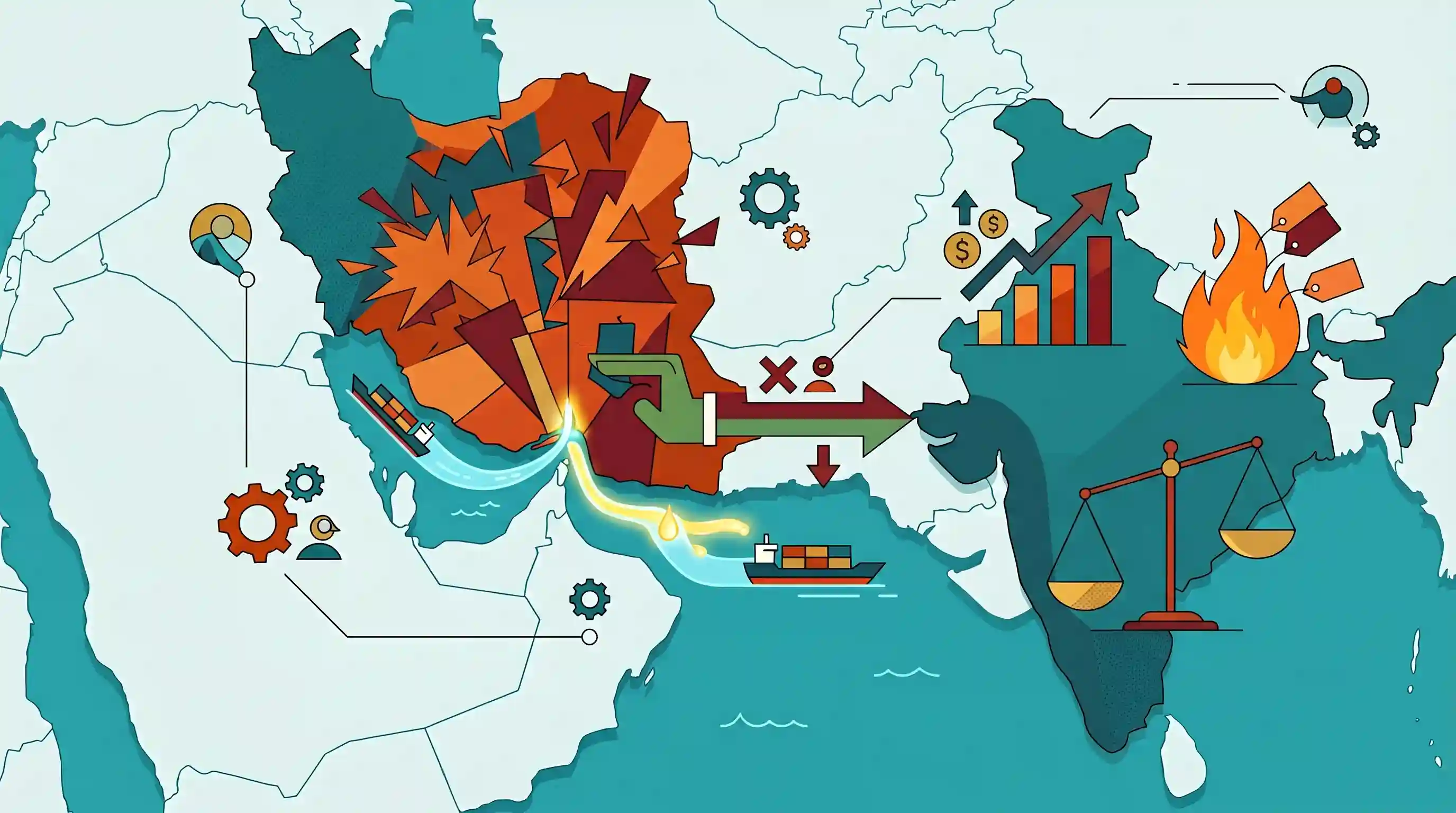
The Strait of Hormuz, connecting the Persian Gulf to the Arabian Sea, acts as the primary artery for global energy trade, managing a significant share of the world's crude oil and LNG shipments. Escalating hostilities in West Asia, particularly any direct involvement of Iran, threaten to disrupt shipments through this vital chokepoint. Such a geopolitical crisis poses an immense risk to global energy markets. For India, which depends overwhelmingly on energy imports from the Middle East, a disruption would drastically increase the import bill, stoke domestic inflation, and negatively impact the current account deficit. This underscores the deep interconnectedness of India's macroeconomic stability and energy security with West Asian geopolitics.
Key Points
- The Strait of Hormuz is the world's most critical maritime chokepoint for global energy supplies, situated between Iran and Oman, connecting the Persian Gulf to the Gulf of Oman and the Arabian Sea.
- Escalating conflicts in West Asia, particularly involving Iran, pose a severe threat to the uninterrupted flow of oil and Liquefied Natural Gas (LNG) through this narrow strait, which handles roughly 20% of global oil consumption.
- India is exceptionally vulnerable to disruptions in this region due to its heavy reliance on Middle Eastern crude oil and LNG imports from countries like Iraq, Saudi Arabia, the UAE, and Qatar.
- A blockade or disruption in the strait would trigger a sharp spike in global energy prices, inflating India's import bill, widening its current account deficit, and exacerbating domestic inflationary pressures.
Important Terms
Strait of Hormuz

A narrow waterway between Iran and Oman connecting the Persian Gulf to the Arabian Sea; it handles nearly 20% of global oil and 35% of global LNG trade.
UPSC context
GS Paper 1 (Geography) and GS Paper 2 (International Relations); tests strategic maritime locations and regional energy diplomacy.
OPEC (Organization of the Petroleum Exporting Countries)
A permanent intergovernmental organization of 12 oil-exporting nations (e.g., Saudi Arabia, Iran) that coordinates petroleum policies to stabilize global markets and ensure fair producer returns.
UPSC context
GS Paper 2 (International Groupings) and GS Paper 3 (Economy); tests knowledge of global energy cartels and their impact on India's inflation.
Maritime Chokepoint
A narrow, strategically vital maritime passage (like a strait or canal) where high volumes of trade are concentrated, making it a funnel for global energy and commerce.
UPSC context
GS Paper 1 (Geography); essential for map-based questions and analyzing the vulnerability of global supply chains.
Current Account Deficit (CAD)
A measure of a country's trade where the value of imported goods and services exceeds the value of exports; heavily influenced in India by global oil price spikes.
UPSC context
GS Paper 3 (Indian Economy); tests understanding of Balance of Payments (BoP) and macroeconomic stability.
Energy Security
The uninterrupted availability of energy sources at an affordable price, crucial for a nation's strategic autonomy and sustained industrial and economic growth.
UPSC context
GS Paper 3 (Infrastructure/Energy); tests strategies for resource diversification and reducing import dependency.
United States Energy Information Administration (EIA)
An independent U.S. government agency that provides official energy statistics, data, and projections, frequently cited in global energy security reports and policy analysis.
UPSC context
GS Paper 3 (Energy/Economy); relevant for using credible international data sources to support arguments on energy trends.
Prelims Trap
"The Strait of Hormuz is geographically bordered by Iran to the north and the United Arab Emirates to the south."
This is a classic map trap. The southern shore of the Strait of Hormuz is actually controlled by Oman's Musandam Peninsula (an exclave), not the UAE.
Static Concepts Connected
What are the major maritime chokepoints in the West Asian energy corridor?
- Strait of Hormuz: Connects the Persian Gulf to the Gulf of Oman and Arabian Sea. Most critical global oil artery.
- Bab-el-Mandeb: Connects the Red Sea to the Gulf of Aden. Vital for Suez Canal-bound traffic.
- Suez Canal: Connects the Red Sea to the Mediterranean Sea, bypassing the Cape of Good Hope.
How does a crude oil price shock impact India's macroeconomic indicators?
- Inflated Import Bill: India imports over 80% of its crude. Inelastic demand causes total import value to surge when global prices rise.
- Widening CAD: Higher import bills without a proportional increase in exports directly widen the Current Account Deficit (CAD).
- Imported Inflation: Elevated fuel costs cascade into domestic transport and manufacturing sectors, pushing up headline CPI.
Cross-Topic Patterns
Maritime Chokepoints + Strategic Petroleum Reserves
Supply shocks from West Asian chokepoints directly test the adequacy of India's Strategic Petroleum Reserves (SPRs) at Mangaluru, Padur, and Visakhapatnam, highlighting energy security vulnerabilities.
Oil shocks + Rupee Depreciation Dynamics
A widening CAD due to oil shocks increases dollar demand, which depreciates the Rupee and systematically compounds imported inflation for non-oil commodities.

Expect a 2026 prelims question linking West Asian maritime chokepoints directly to India's CAD and Strategic Petroleum Reserves.
Linked PYQs · 5
Linked PYQs · 5
- 2024PrelimsGS1
Consider the following statements : Statement-I : Sumed pipeline is a strategic route for Persian Gulf oil and natural gas shipments to Europe. Statement-II : Sumed pipeline connects the Red Sea with the Mediterranean Sea. Which one of the following is correct in respect of the above statements?
- 2022PrelimsGS1
The term "Levant" often heard in the news roughly corresponds to which of the following regions?
- 2025MainsGS2
"Energy security constitutes the dominant kingpin of India's foreign policy, and is linked with India's overarching influence in Middle Eastern countries.” How would you integrate energy security with India's foreign policy trajectories in the coming years?
- 2017MainsGS2
The question of India's Energy Security constitutes the most important part of India's economic progress. Analyze India's energy policy cooperation with West Asian countries.
- 2024MainsGS3
What are the causes of persistent high food inflation in India? Comment on the effectiveness of the monetary policy of the RBI to control this type of inflation.
