Strait of Hormuz UNSC Resolution and Permanent Member Veto
Source:Indian Express ↗
Why It Matters
The geopolitical rivalry at the UNSC (US vs. China/Russia) stalls international conflict resolution mechanisms. Furthermore, the stability of the Strait of Hormuz is critical for India's energy security and the uninterrupted flow of global supply chains.
Summary
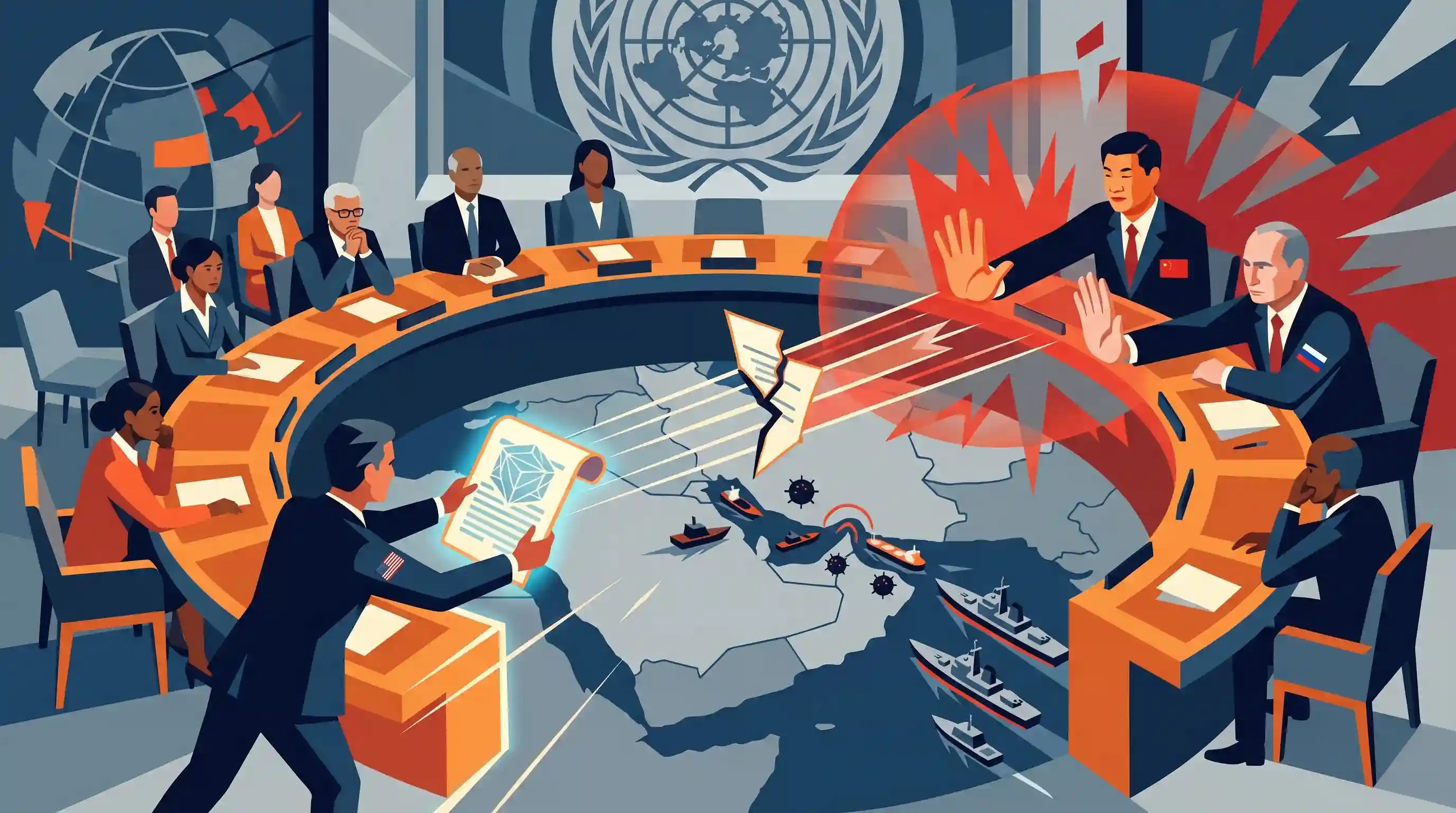
The US has introduced a "high-stakes" UN Security Council resolution invoking Chapter VII of the UN Charter, demanding that Iran cease proxy attacks and mining operations in the strategic Strait of Hormuz. The draft aims to legitimize international maritime coalitions to secure the vital global energy transit route. However, permanent UNSC members China and Russia have signaled their intention to veto the measure, arguing it risks escalating regional tensions and serves US geopolitical interests. The diplomatic deadlock underscores the polarization within the UNSC and the broader East-West geopolitical rivalry.
Key Points
- The US has proposed a Chapter VII UN Security Council resolution demanding Iran halt attacks and mining operations in the Strait of Hormuz.
- The resolution seeks to provide an international legal mandate for maritime coalitions to secure the vital transit route.
- Permanent UNSC members China and Russia are expected to veto the measure, arguing it disproportionately targets Iran and risks escalating regional tensions.
- The diplomatic deadlock highlights the paralysis within the UNSC due to the growing polarization between the US and the Russo-Chinese bloc.
- The Strait of Hormuz remains a critical chokepoint for global energy markets, making its security a key geostrategic concern.
Important Terms
UN Charter (Chapter VII)

Chapter of the UN Charter empowering the Security Council to maintain peace through enforcement actions, including sanctions (Article 41) or military force (Article 42).
UPSC context
Crucial for GS Paper 2 (International Relations) regarding the UN's mandate and collective security mechanisms during global conflicts.
United Nations Security Council (UNSC)
The UN's principal organ responsible for international peace and security, consisting of 15 members: 5 permanent (P5) with veto power and 10 rotating non-permanent members.
UPSC context
A frequent UPSC topic (GS 2) focusing on global governance, its structural limitations, and the necessity of institutional reforms.
Strait of Hormuz
A strategic maritime chokepoint between Iran and Oman connecting the Persian Gulf to the Gulf of Oman; handles ~20% of the world's oil consumption.
UPSC context
Key for GS Paper 1 (Geography) and GS Paper 3 (Energy Security/Economy) due to its role in global oil transit.
Veto Power
The power of the P5 members to block any substantive UNSC resolution, irrespective of majority support, frequently leading to diplomatic deadlock.
UPSC context
Tests understanding of "Geopolitical Gridlock" in GS Paper 2, often cited in discussions about India's bid for a permanent seat.
Maritime Security
The protection of maritime interests, including freedom of navigation and shipping lane safety, often governed by the UN Convention on the Law of the Sea (UNCLOS).
UPSC context
Important for GS Paper 2 and 3; covers India's 'SAGAR' initiative and the security of Sea Lines of Communication (SLOCs).
Maritime Chokepoint
A narrow geographical passage, such as a strait or canal, where traffic can be easily obstructed, significantly impacting global trade and military movements.
UPSC context
Essential for Geography and International Relations; examples include Hormuz, Malacca, and Bab-el-Mandeb.
Prelims Trap
"The Strait of Hormuz is bordered by Iran, Saudi Arabia, and the UAE."
Saudi Arabia does NOT border the Strait of Hormuz. It is exclusively flanked by Iran to the north and Oman (Musandam exclave) and the UAE south.
Static Concepts Connected
What are the key maritime chokepoints in the Middle East?
- Strait of Hormuz: Connects the Persian Gulf to the Gulf of Oman and Arabian Sea. Flanked by Iran, UAE, and Oman.
- Bab el-Mandeb: Connects the Red Sea to the Gulf of Aden and Arabian Sea. Bordered by Yemen, Djibouti, and Eritrea.
- Suez Canal: Artificial sea-level waterway in Egypt connecting the Mediterranean Sea directly to the Red Sea.
What distinguishes Chapter VII of the UN Charter from other chapters?
- Binding Authority: Grants the UNSC exclusive power to determine threats to peace, breaches of peace, or acts of aggression, and issue legally binding resolutions.
- Enforcement Measures: Authorizes enforcement without the consent of the targeted state, ranging from economic sanctions (Article 41) to direct military intervention (Article 42).
- Veto Vulnerability: Because these actions are substantive, they are subject to the veto power of the P5 members under Article 27.
Cross-Topic Patterns
Chokepoints & Imported Inflation
Disruptions in Hormuz spike global crude prices, worsening India's Current Account Deficit and driving imported inflation, which directly complicates the RBI's monetary policy and inflation targeting.
UNSC Paralysis & Multilateral Reforms
Frequent P5 deadlocks over regional conflicts underscore the structural failure of the UN, strengthening the Global South's (and India's) demand for comprehensive UNSC reform.

Expect a map-based Prelims question pairing Middle East chokepoints (Hormuz, Bab el-Mandeb) with bordering nations and water bodies.
Linked PYQs · 4
Linked PYQs · 4
- 2025MainsGS2
"The reform process in the United Nations remains unresolved, because of the delicate imbalance of East and West and entanglement of the USA vs. Russo-Chinese alliance.” Examine and critically evaluate the East-West policy confrontations in this regard.
- 2025MainsGS2
"Energy security constitutes the dominant kingpin of India's foreign policy, and is linked with India's overarching influence in Middle Eastern countries.” How would you integrate energy security with India's foreign policy trajectories in the coming years?
- 2017MainsGS2
The question of India's Energy Security constitutes the most important part of India's economic progress. Analyze India's energy policy cooperation with West Asian countries.
- 2024MainsGS2
Discuss the geopolitical and geostrategic importance of Maldives for India with a focus on global trade and energy flows. Further also discuss how this relationship affects India's maritime security and regional stability amidst international competition ?
