Strait of Hormuz Shipping Disruption Threatens India Energy Security
Source:Indian Express ↗
Why It Matters
The Strait of Hormuz serves as the premier energy transit chokepoint globally. Geopolitical friction in the Persian Gulf directly compromises India's national energy security, macro-economic stability (through inflation and CAD expansion), and challenges India's foreign policy maneuvers in balancing relations with the US, Iran, and Arab Gulf partners.
Summary
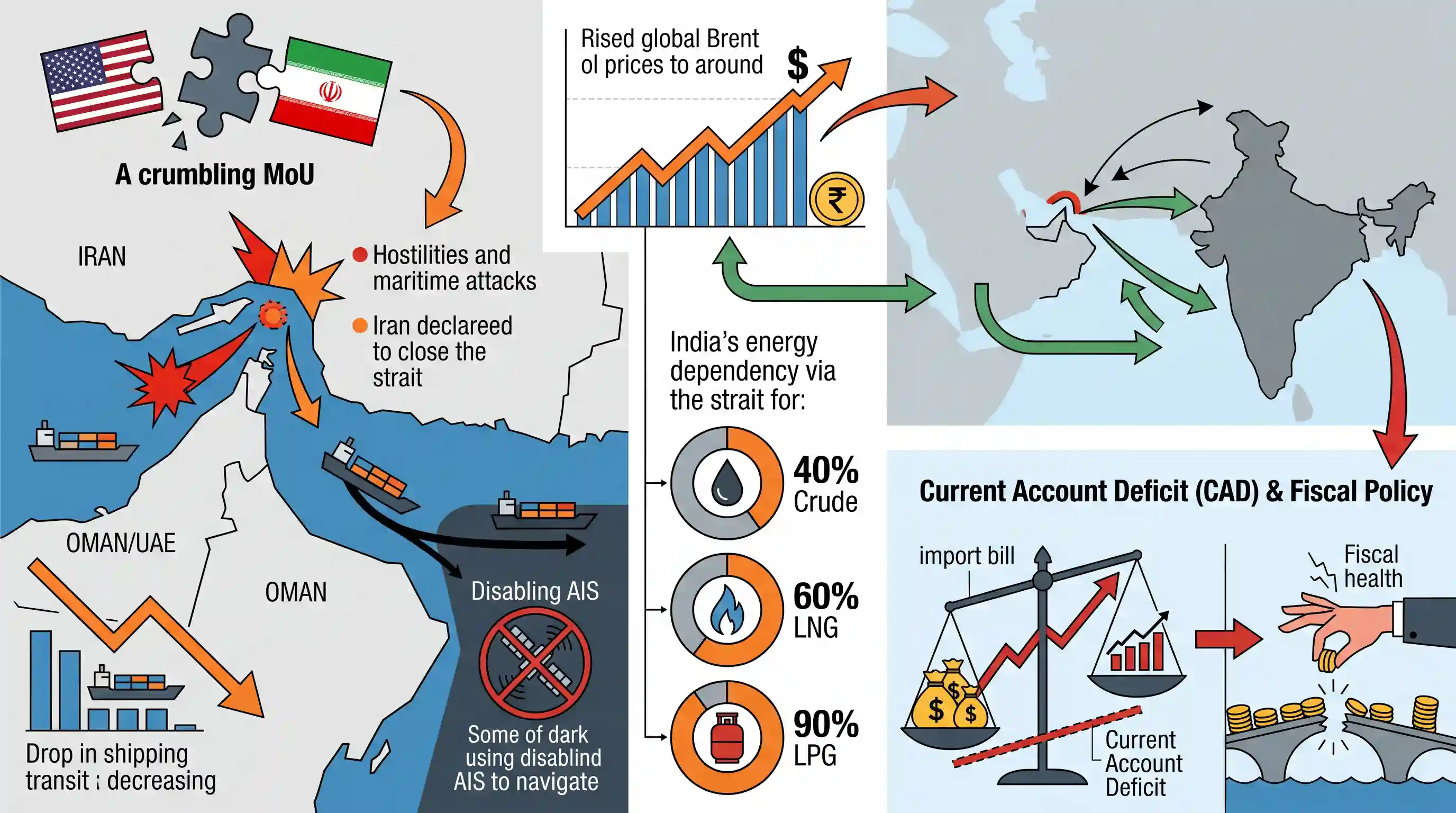
The Strait of Hormuz is experiencing a sharp drop in shipping transit as the June 2026 US-Iran Memorandum of Understanding (MoU) crumbles. Renewed hostilities, maritime attacks, and Iran's declaration to close the strait to commercial vessels have severely disrupted global energy supply chains, driving Brent oil prices to around $80 per barrel. Shippers are increasingly relying on 'dark routes' (disabling AIS transponders) to navigate the crisis. This choke-point vulnerability poses severe economic threats to India, which depends on the strait for 40% of its crude oil, 60% of its LNG, and 90% of its LPG imports. The resulting crude price hikes strain India's fiscal health, inflating its import bill and widening the Current Account Deficit (CAD).
Key Points
- Strait of Hormuz transits have plummeted to their lowest levels in nearly a month (~14 transits on July 12, 2026) following a rapid deterioration of the US-Iran MoU signed on June 17, 2026.
- The collapse of the uneasy ceasefire stems from conflicting interpretations: Iran asserts sovereign authority over the narrow waterway, imposing designated routing and planned service fees, while the US and allies push for the alternative Omani corridor and deploy protective escort initiatives like 'Project Freedom' (which has effectively collapsed).
- The escalation has triggered defensive maritime tactics, such as 'dark shipping'—where commercial vessels turn off their Automatic Identification System (AIS) transponders to avoid detection—and has caused regional spillovers, including Qatar suspending all maritime activity for the first time in the conflict.
- The Strait of Hormuz is a vital energy artery, previously accounting for a fifth of global oil and LNG flows before the conflict broke out in February 2026. The disruption has caused Brent crude to jump to around $80 per barrel.
- India faces major energy security threats due to its high import dependency (over 88% for oil, 60% for LPG, 50% for natural gas). Around 40% of India's crude, 60% of LNG, and 90% of LPG imports transit specifically through this strait.
- An increase of $1 per barrel in oil prices expands India's annual import bill by up to $2 billion. According to Nomura, every 10% oil price hike widens India's Current Account Deficit (CAD) by 0.4% of GDP, highlighting India's high economic vulnerability to West Asian supply shocks.
Important Terms
US-Iran Memorandum of Understanding (MoU)

A June 2026 bilateral framework agreement brokered by third-party nations to halt hostilities between the US and Iran, lift the naval blockade, and temporarily reopen the Strait of Hormuz for commercial shipping.
UPSC context
GS Paper II: Bilateral agreements, West Asia geopolitics, and international relations affecting India's strategic interest.
Project Freedom
A US Central Command-led defensive maritime operation launched in May 2026 to secure the Strait of Hormuz and protect stranded commercial vessels from hostile attacks while maintaining a blockade on Iranian ports.
UPSC context
GS Paper II: Global security initiatives, regional conflicts, and maritime safety impacting international trade lanes.
International Maritime Organization (IMO)
A specialized United Nations agency responsible for promoting shipping safety, preventing marine pollution, and regulating maritime traffic, actively working to uphold unimpeded transit and seafarer safety in international straits.
UPSC context
GS Paper II: Important International institutions, agencies and fora — their structure, mandate, and role in global governance.
Kpler
A private global data intelligence company specializing in real-time tracking of commodities, dry bulk cargo, and LNG tanker movements across strategic international trade corridors and shipping lanes.
UPSC context
GS Paper III: Infrastructure, energy security, and supply chain logistics monitoring during geopolitical crises.
Windward
An artificial intelligence-driven maritime data platform that tracks and analyzes maritime risks, illegal shipping practices, and suspicious transponder activities (going "dark") in high-security maritime corridors.
UPSC context
GS Paper III: Security challenges and their management in border and coastal areas; role of AI in maritime surveillance.
S&P Global
A leading international provider of financial market intelligence, economic research, and commodity analytics, crucial for assessing energy supply trends, market ratings, and global credit implications of geopolitical shocks.
UPSC context
GS Paper III: Global economic indicators, inflation, energy security, and impact of international crises on national fiscal health.
Nomura
A prominent global investment bank and financial services group that provides market forecasts, economic risk assessments, and energy sector analysis detailing how geopolitical supply shocks affect import-dependent countries.
UPSC context
GS Paper III: Indian Economy, macroeconomic stability, and implications of global oil price volatility on import bills.
Prelims Trap
The southern coastline of the Strait of Hormuz is under the sovereign jurisdiction of the United Arab Emirates.
The southern shore is the Musandam Peninsula, which is an exclave of Oman, not the UAE, despite being physically separated from mainland Oman by UAE territory.
Static Concepts Connected
What are the geographic boundaries and legal regimes governing transit through the Strait of Hormuz?
- Geographic Bounding: Bounded by Iran to the north and Oman's Musandam Peninsula exclave to the south, connecting the Persian Gulf with the Gulf of Oman.
- Transit Passage: Governed by the UNCLOS 'transit passage' regime, allowing continuous and expeditious navigation for international vessels through straits used for international navigation.
- SOLAS Mandate: The IMO's SOLAS Convention mandates Automatic Identification Systems (AIS) for international vessels over 300 gross tonnage to ensure maritime safety.
How do global oil price shocks transmit to India's Balance of Payments and domestic inflation?
- CAD Expansion: As India imports 88% of its crude, rising oil prices widen the merchandise trade deficit, directly expanding the Current Account Deficit.
- Imported Inflation: Higher fuel costs raise logistics and production expenses, transmitting as imported headline inflation and putting depreciation pressure on the Indian Rupee.
- Fiscal Pressure: Spikes in oil prices balloon government subsidy bills for LPG and fertilizers, challenging fiscal deficit consolidation targets.
Cross-Topic Patterns
Chokepoints and Indo-Pacific security
Escalating Hormuz vulnerability accelerates India's active participation in the Quad's Indo-Pacific Partnership for Maritime Domain Awareness (IPMDA) to track sanctions-evading 'dark vessels'.
Strategic reserves and energy security
Supply shocks via Hormuz highlight the capacity limitations of India's Strategic Petroleum Reserves (SPR) and accelerate policies targeting structural energy transition and biofuel mandates.

West Asian chokepoints, their bordering exclaves, and the macroeconomic impacts of oil shocks on India's CAD will likely be paired in 2026.
Linked PYQs · 3
Linked PYQs · 3
- 2026PrelimsGS1
Ships from which of the following countries have to cross the Strait of Hormuz to reach out to the Indian Ocean ? 1. Bahrain 2. Syria 3. Qatar 4. Egypt Select the answer using the code given below :
- 2025MainsGS2
"Energy security constitutes the dominant kingpin of India's foreign policy, and is linked with India's overarching influence in Middle Eastern countries.” How would you integrate energy security with India's foreign policy trajectories in the coming years?
- 2017MainsGS2
The question of India's Energy Security constitutes the most important part of India's economic progress. Analyze India's energy policy cooperation with West Asian countries.
