Maritime security threats and naval mine clearance in energy routes
Source:Indian Express ↗
Why It Matters
The Strait of Hormuz is a critical chokepoint for India's energy imports. Understanding asymmetric naval warfare tactics like mining is crucial for GS3 Maritime Security and GS2 International Relations.
Summary
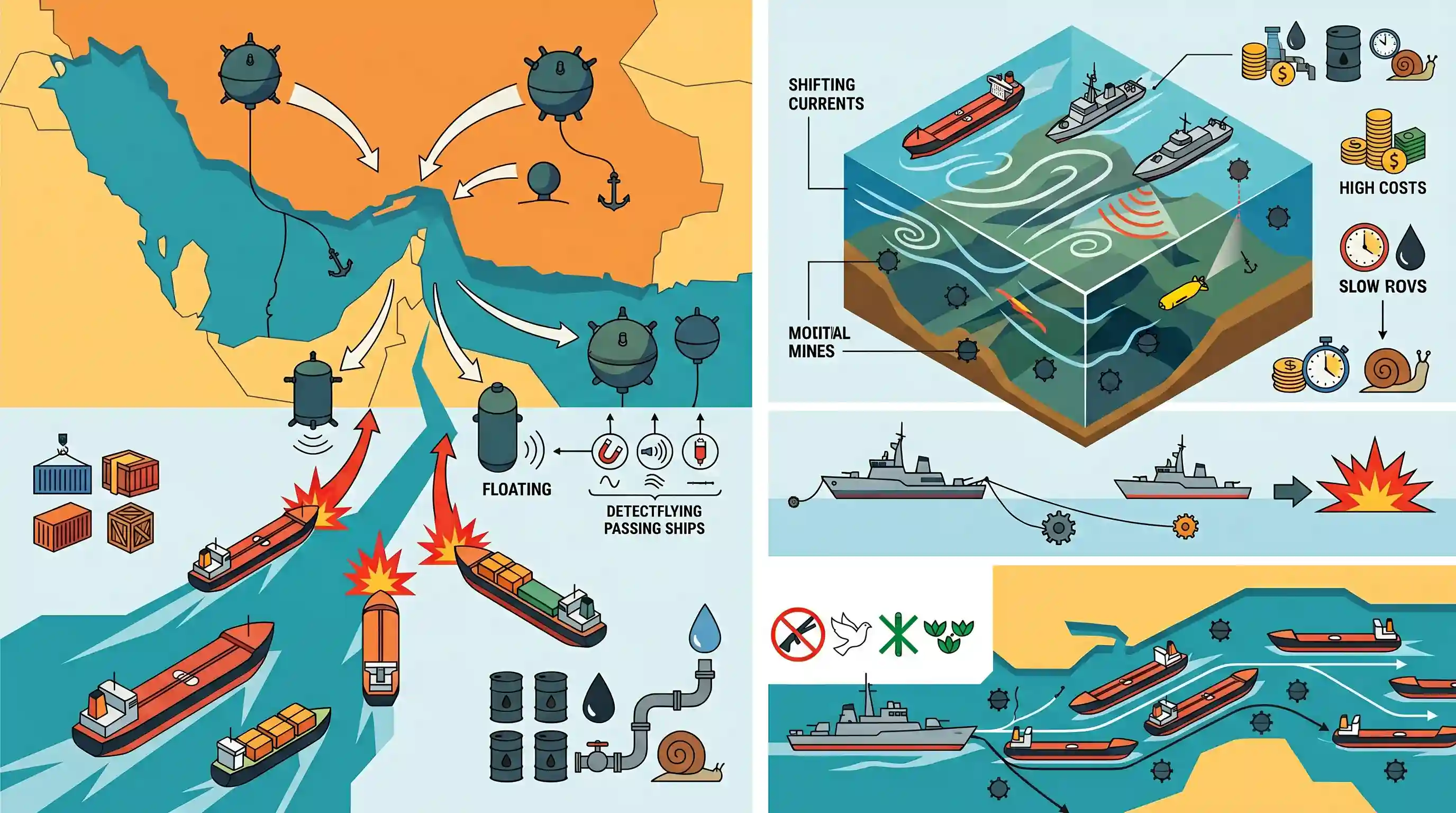
The article examines the strategic deployment of untraced naval mines by Iran in the Strait of Hormuz, highlighting the severe implications for global maritime trade and energy security. It details the various types of naval mines—such as contact, influence, and moored variants—and explains the immense technical challenges of locating them in a dynamic, three-dimensional oceanic environment characterized by shifting currents. The slow and expensive processes of minesweeping and mine hunting mean that even after a ceasefire, restoring safe passage through this critical energy chokepoint will require prolonged, convoy-based operations.
Key Points
- Iran deployed untraced naval mines in the Strait of Hormuz during a conflict with the US and Israel, disrupting a chokepoint that handles a fifth of global energy supplies.
- Unlike landmines, naval mines operate in a dynamic 3D environment and shift with tidal currents, making them significantly harder to map, locate, and neutralize.
- Naval mines include contact mines (triggered by touch), influence mines (triggered by acoustic, magnetic, or pressure changes), and limpet mines.
- Mine clearance relies on minesweeping (dragging wire to cut moorings or simulate ship signatures) or mine hunting (using sonar and autonomous underwater vehicles), both of which are slow and expensive processes.
- The presence of unmapped mines necessitates time-consuming convoy operations and specialized clearance, imposing lasting logistical and economic costs on international shipping even after a ceasefire.
Important Terms
Strait of Hormuz

Narrow waterway between Iran and Oman connecting the Persian Gulf to the Gulf of Oman. It handles roughly 20% of the world's daily oil supply.
UPSC context
GS-I (Geography) and GS-II (International Relations); key to understanding West Asian geopolitics and India's energy import vulnerabilities.
Maritime Chokepoint
A strategic narrow passage in global sea lanes where trade volume is concentrated, making it a critical vulnerability for international commerce and energy supplies.
UPSC context
GS-I/GS-II; essential for analyzing global trade architecture and maritime security bottlenecks.
UN Mine Action Service (UNMAS)
A specialized UN body established in 1997 that coordinates international efforts to eliminate threats from landmines, naval mines, and explosive remnants of war.
UPSC context
GS-II; relevant for international organizations and global humanitarian/security governance.
Mine Hunting
The precise process of searching for, identifying, and destroying individual naval mines using sonar, divers, or remotely operated vehicles (ROVs).
UPSC context
GS-III (Defense/Internal Security); tests knowledge of advanced maritime countermeasure technology and naval operations.
Minesweeping
A broad naval operation used to clear mined areas by towing 'sweeps' that mechanically cut or magnetically detonate explosives across wide sections of water.
UPSC context
GS-III (Defense); technical term for maritime safety and demining capabilities in conflict zones.
US Fifth Fleet
The naval division of the US Central Command based in Bahrain, responsible for maritime security in the Persian Gulf and Red Sea.
UPSC context
GS-II; pertains to regional security frameworks and strategic presence in India’s extended neighborhood.
Energy Security
The uninterrupted availability of energy sources at an affordable price, often dependent on the stability of maritime transit routes.
UPSC context
GS-III; a critical component of national economic planning and resource management.
Prelims Trap
"The deployment of naval mines is strictly prohibited under the Ottawa Treaty."
The Ottawa Treaty (Mine Ban Treaty) only bans anti-personnel landmines. Naval mines are entirely distinct and loosely regulated by the much older 1907 Hague Conventions.
Static Concepts Connected
What are the key maritime chokepoints surrounding the Arabian Peninsula?
- Strait of Hormuz: Connects the Persian Gulf to the Gulf of Oman and Arabian Sea. Essential for global oil trade.
- Bab el-Mandeb: Connects the Red Sea to the Gulf of Aden and Arabian Sea. Critical for Suez Canal-bound maritime traffic.
How do modern 'influence' naval mines differ from traditional contact mines?
- Contact Mines: Rely on physical touch with a vessel's hull to trigger detonation, usually moored near the surface.
- Influence Mines: Triggered remotely by a passing ship's acoustic, magnetic, or pressure signatures without requiring physical contact.
- Limpet Mines: Manually attached to a ship's hull using magnets by special forces or divers.
Cross-Topic Patterns
Energy Security & Strategic Reserves
Disruptions in the Strait of Hormuz directly test India's energy resilience, emphasizing the need for Strategic Petroleum Reserves (ISPRL) and diversification of crude sources away from the Middle East.
UNCLOS & Transit Passage Regimes
Mining international straits impacts the UNCLOS right of 'transit passage', raising complex international law questions about the legal threshold for self-defense, blockades, and freedom of navigation.

Expect a map-based question linking West Asian chokepoints (Hormuz, Bab el-Mandeb) with India's energy supply vulnerabilities in 2026.
Linked PYQs · 4
Linked PYQs · 4
- 2025MainsGS2
"Energy security constitutes the dominant kingpin of India's foreign policy, and is linked with India's overarching influence in Middle Eastern countries.” How would you integrate energy security with India's foreign policy trajectories in the coming years?
- 2025MainsGS3
Why is maritime security vital to protect India's sea trade? Discuss maritime and coastal security challenges and the way forward.
- 2024PrelimsGS1
Consider the following statements : Statement-I : Sumed pipeline is a strategic route for Persian Gulf oil and natural gas shipments to Europe. Statement-II : Sumed pipeline connects the Red Sea with the Mediterranean Sea. Which one of the following is correct in respect of the above statements?
- 2022MainsGS3
What are the maritime security challenges in India ? Discuss the organisational, technical and procedural initiatives taken to improve the maritime security.
