Uttar Pradesh Infrastructure Push Aims to Curb Distress Migration
Source:Indian Express ↗
Why It Matters
This article serves as an excellent case study for GS3 (infrastructure and state-level economic reforms) and GS1 (addressing distress internal migration through regional development). It demonstrates how law and order, regulatory easing, and transport infrastructure can work together to reverse negative migration trends.
Summary
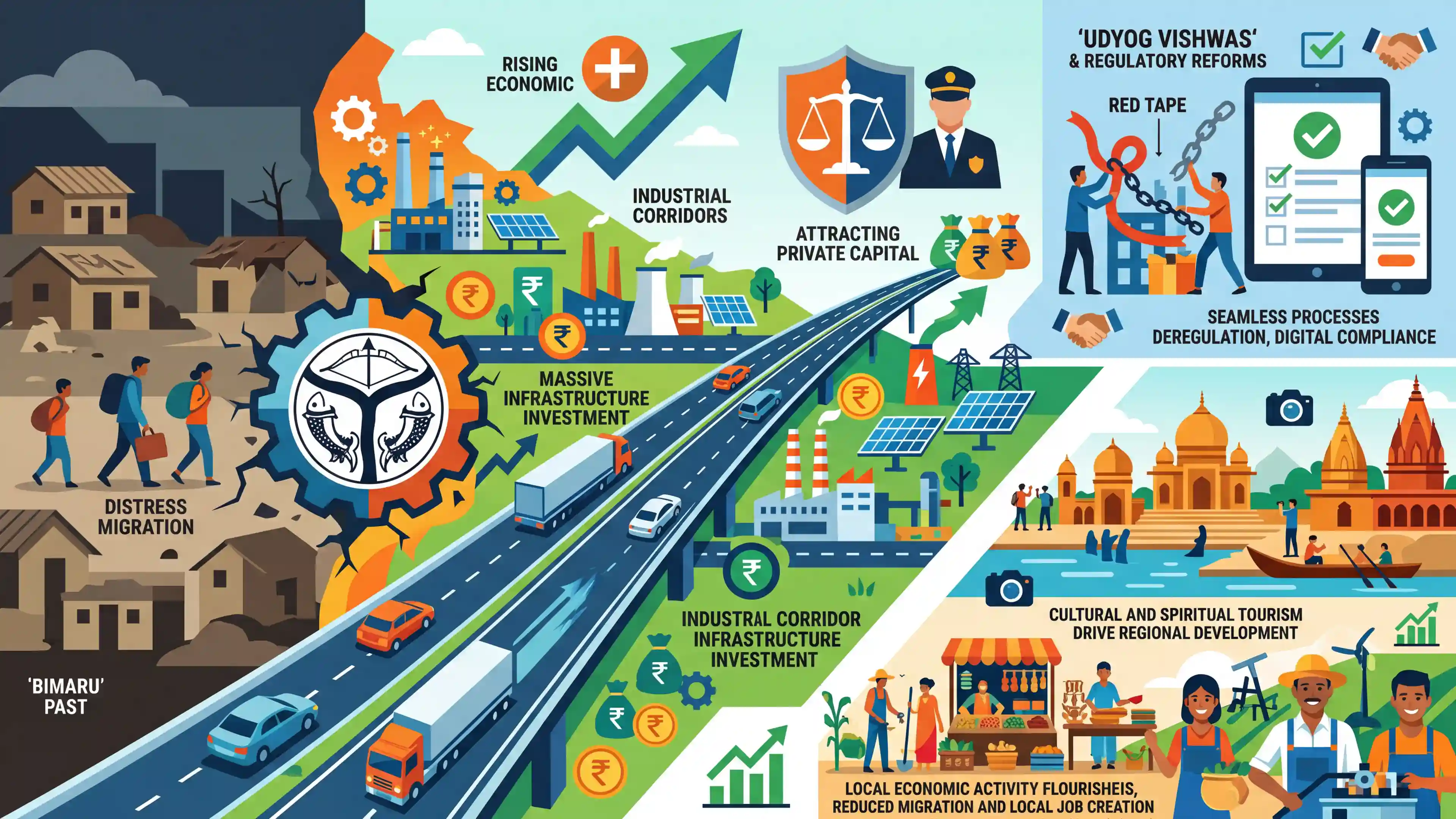
Authored by the Chief Minister of Uttar Pradesh, the article details the state's structural transformation from a historically lagging 'Bimaru' state into an emerging economic powerhouse. The core strategy revolves around curbing distress migration by generating local employment opportunities through massive infrastructure investments, specifically major expressways and industrial corridors. Crucial to this transformation has been the establishment of strong law and order to attract private capital. The state is actively promoting 'Udyog Vishwas' (business confidence) via deep regulatory reforms, including deregulation, the decriminalisation of business laws, and digital compliance platforms. Simultaneously, the state leverages its cultural and spiritual heritage to drive tourism and regional development.
Key Points
- Reversing Migration Trends: Uttar Pradesh aims to stop historical distress out-migration by adopting a strategy to "bring jobs to people, not people to jobs."
- Law & Order as an Economic Prerequisite: Establishing a fear-free environment ('bhay mukt pradesh') was the foundational step to attract private investment and build state capability.
- Infrastructure-led Growth: Massive capital expenditure on the Purvanchal, Bundelkhand, and Ganga Expressways, alongside industrial corridors, has decentralized economic activity across the state.
- Ease of Doing Business Reforms ('Udyog Vishwas'): The state has focused on deregulation, digitization, and decriminalisation of minor business offenses (through the State Open Compliance Grid and Jan Vishwas principles).
- Cultural Economy: Revitalizing spiritual centers like Kashi, Ayodhya, and Mathura is being leveraged as an engine for tourism-led economic growth.
Important Terms
BIMARU States

Acronym for Bihar, Madhya Pradesh, Rajasthan, and Uttar Pradesh, coined by Ashish Bose in the 1980s to identify states with poor economic and human development indicators.
UPSC context
GS Paper I (Social Issues/Population) and GS Paper III (Economic Development) — focuses on regional disparities and development.
Jan Vishwas Act (principles)
A legislative reform aimed at 'trust-based governance' by decriminalising minor, non-malicious business violations and replacing imprisonment with civil penalties to enhance the Ease of Doing Business.
UPSC context
GS Paper II (Governance/Law) and GS Paper III (Economy) — tests understanding of regulatory reforms and business environment.
Ganga Expressway
A 594 km six-lane greenfield expressway connecting Meerut to Prayagraj; once completed, it will be Uttar Pradesh's longest, serving as a critical industrial and logistics corridor.
UPSC context
GS Paper III (Infrastructure) — pertains to mega-infrastructure projects and their role in regional economic integration.
Purvanchal Expressway
A 341 km access-controlled expressway linking Lucknow to Ghazipur, designed to stimulate the economic development of eastern Uttar Pradesh (Purvanchal) via enhanced connectivity and industrial clusters.
UPSC context
GS Paper III (Infrastructure/Regional Development) — relevant for questions on connecting backward regions to economic hubs.
State Open Compliance Grid
An upcoming unified, paperless digital platform in UP designed for automated business-government interaction, leveraging Unique Enterprise Numbers and API-based data exchange to reduce corruption and delays.
UPSC context
GS Paper II (e-Governance) — tests knowledge of digital tools used to improve transparency and ease of compliance.
Bundelkhand Expressway
A 296 km expressway connecting Chitrakoot to Etawah, aimed at mainstreaming the backward Bundelkhand region and supporting the Uttar Pradesh Defence Industrial Corridor.
UPSC context
GS Paper III (Infrastructure/Security) — touches upon regional development and its link to strategic defense corridors.
Prelims Trap
"The Jan Vishwas Act is a state-specific law of Uttar Pradesh aimed at decriminalising major corporate fraud."
The Jan Vishwas Act is a Central Act (2023) decriminalizing minor procedural offences across 42 central laws, not a state-level law or one dealing with major financial fraud.
Static Concepts Connected
What differentiates 'Push' and 'Pull' factors in internal migration?
- Push Factors: Distress-driven reasons compelling people to leave rural/backward areas, such as poverty, disguised agricultural unemployment, and poor local infrastructure.
- Pull Factors: Economic attractors in destination regions, including better industrial job prospects, higher wages, and access to urban amenities.
- Policy Imperative: Addressing push factors requires decentralizing economic activity ("bringing jobs to people") rather than just upgrading urban infrastructure at destination nodes.
What is the core governance philosophy behind the Jan Vishwas Act?
- Decriminalisation: Replaces imprisonment clauses with civil monetary penalties for minor, procedural defaults in business laws.
- Trust-Based Governance: Shifts state regulation from a presumptive-suspicion model to one of mutual trust to attract private capital.
- Ease of Doing Business: Reduces the compliance burden on MSMEs and corporations, simultaneously unclogging judicial backlogs from minor corporate litigation.
Cross-Topic Patterns
Demographic Dividend vs. Spatial Inequality
UP's transformation connects GS-1 population dynamics with GS-3 regional development, illustrating how decentralized infrastructure corridors can arrest demographic out-flow from historically 'BIMARU' states.
Tourism-led Urbanization and Spiritual Circuits
Leveraging religious heritage (Kashi, Ayodhya) for economic growth aligns with the PRASHAD scheme, showcasing a model where tier-2/3 spiritual centers become primary urban growth nodes.

Mains 2026 could ask to evaluate 'decentralized infrastructure' vs 'urban agglomeration' in curbing distress internal migration.
Linked PYQs · 4
Linked PYQs · 4
- 2024MainsGS1
Why do large cities tend to attract more migrants than smaller towns? Discuss in the light of conditions in developing countries.
- 2021MainsGS3
“Investment in infrastructure is essential for more rapid and inclusive economic growth.” Discuss in the light of India's experience.
- 2019MainsGS1
Can the strategy of regional resource-based manufacturing help in promoting employment in India?
- 2015MainsGS1
Discuss the changes in the trends of labour migration within and outside India in the last four decades.
