Jharkhand Twenty Five Years of Statehood and Tribal Aspirations
Source:Indian Express ↗
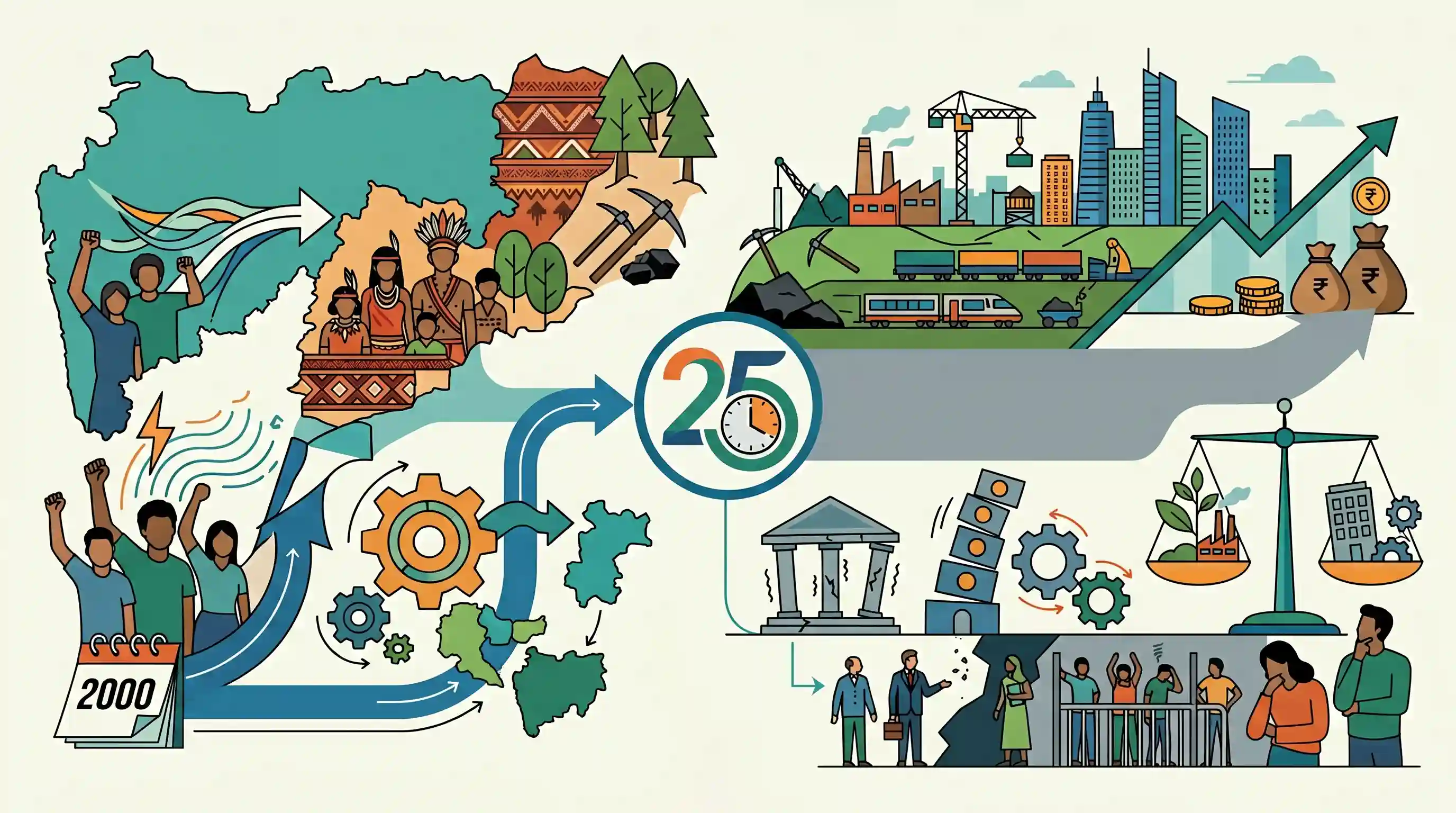
Why It Matters
The 25th anniversary of states formed in 2000 (Jharkhand, Chhattisgarh, Uttarakhand) provides a critical case study for UPSC aspirants to analyze the success and failures of state reorganization based on regional and ethnic demands, directly linking to GS1 (Society/Regionalism) and GS2 (Polity/Federalism).
Summary
The article reflects on the 25-year journey of Jharkhand since its formation as a separate state from Bihar on November 15, 2000. Originally driven by deep-rooted regionalism and the aspiration to empower its significant tribal population, the creation of Jharkhand was part of a broader move to establish smaller states for better governance and equitable development. After a quarter of a century, the state's progress presents a complex picture of economic growth weighed down by political instability, administrative challenges, and the continuous struggle to uplift marginalized tribal communities. The anniversary serves as a critical juncture to evaluate the actual developmental impact of state reorganization in India.
Key Points
- Jharkhand was carved out of southern Bihar in 2000 to fulfill long-standing regional demands driven by tribal aspirations and socio-economic disparities.
- Marking 25 years of its formation, the state's journey reflects mixed outcomes regarding its original goals of better governance, economic development, and tribal empowerment.
- While the creation of smaller states aims at improving administrative efficiency, Jharkhand has faced persistent challenges such as political instability, resource curse issues, and socio-economic gaps.
- The milestone prompts an evaluation of whether creating separate geographical entities successfully resolves historical grievances and marginalization of tribal communities.
Important Terms
Bihar Reorganisation Act, 2000

Passed in 2000, this Act bifurcated Bihar to create Jharkhand as India's 28th state. It addressed long-standing demands for a separate tribal-dominated state for better governance.
UPSC context
GS Paper 1 (State Reorganization) and GS Paper 2 (Indian Polity/Federalism). Essential for understanding post-independence boundary changes.
PESA Act, 1996
This 1996 Act extends Panchayati Raj provisions to Fifth Schedule areas, empowering Gram Sabhas to manage local resources and traditional practices, ensuring tribal self-governance.
UPSC context
GS Paper 2 (Polity/Local Governance). Tests knowledge of democratic decentralization and tribal empowerment mechanisms.
Fifth Schedule of the Constitution
Deals with the administration of Scheduled Areas and Tribes in ten states, including Jharkhand. It empowers the Governor to protect tribal lands and traditional customs.
UPSC context
GS Paper 2 (Constitutional Provisions). Frequently tested in Prelims and Mains regarding tribal rights and administrative specializations.
Jharkhand Movement
A multi-decade socio-political struggle led by tribal leaders for a separate state. It emphasized regional identity and protection of tribal 'Jal, Jangal, Zameen' (Water, Forest, Land).
UPSC context
GS Paper 1 (Modern Indian History/Post-Independence). Illustrates regionalism and social movements driven by ethnic and economic deprivation.
Tribal Sub-Plan (TSP)
Introduced in 1974, it ensures a proportionate flow of development funds and benefits to Scheduled Tribes from various government sectors to bridge socio-economic gaps.
UPSC context
GS Paper 2 (Welfare Schemes). Tests understanding of targeted developmental strategies for marginalized communities.
Prelims Trap
Jharkhand was created as, and currently remains, a tribal-majority state to protect indigenous rights.
Jharkhand does not have a tribal majority. STs make up only about 26.2% of its population (2011 Census) due to historical out-migration and non-tribal influx.
Static Concepts Connected
What are the Constitutional provisions for the creation of new states?
- Article 3: Empowers Parliament to form new states, alter areas, boundaries, or names of existing states by a simple majority, making India an "indestructible union of destructible states."
- Prior Recommendation: A bill for this purpose can only be introduced in either House of Parliament on the prior recommendation of the President.
- State Legislature Views: The President must refer the bill to the concerned state legislature for its views within a specified period, though these views are not binding on Parliament.
What is the Resource Curse and Dutch Disease?
- Resource Curse: A paradox where regions with abundant natural resources, like minerals or fuels, experience stagnant economic growth, poor human development, and political instability compared to resource-poor regions.
- Dutch Disease: An economic phenomenon where a boom in the resource sector draws capital and labor, causing a decline in other sectors like agriculture or manufacturing (often via currency appreciation).
Cross-Topic Patterns
Mineral Taxation & Fiscal Federalism
The 2024 SC ruling granting states the power to tax mineral rights directly impacts Center-State fiscal relations, enabling resource-rich states like Jharkhand to boost own-tax revenues and counter historical inequalities.
Smaller States & Political Instability
Jharkhand's 14 government formations in 25 years starkly contrasts with the State Reorganization Commission and 2nd ARC's general premise that smaller states inherently yield better administrative efficiency and political stability.
Resource Extraction & Tribal Displacement
The steady decline in Jharkhand's ST proportion highlights the sociological impact of extractive industries—driving indigenous out-migration due to displacement while pulling in non-tribal migrant labor for mining operations.

A 2026 Prelims question will likely fuse Article 3 state reorganization mechanics with the landmark SC ruling on states' mineral tax rights.
Linked PYQs · 4
Linked PYQs · 4
- 2018MainsGS1
Discuss whether formation of new states in recent times is beneficial or not for the economy of India.
- 2013MainsGS1
Growing feeling of regionalism is an important factor in generation of demand for a separate State. Discuss.
- 2022MainsGS1
The political and administrative reorganization of states and territories has been a continuous ongoing process since the mid-nineteenth century. Discuss with examples.
- 2023MainsGS1
How did the colonial rule affect the tribals in India and what was the tribal response to the colonial oppression?
