US Leverage and the Humanitarian Crisis in Gaza
Source:The Hindu ↗
Why It Matters
The U.S.-Israel relationship and the Gaza humanitarian crisis underscore the ethical and geopolitical challenges in contemporary international relations. The role of major powers in conflict resolution and the jurisdiction of institutions like the ICC are critical for understanding global governance and Middle Eastern dynamics, which impact India's foreign policy.
Summary
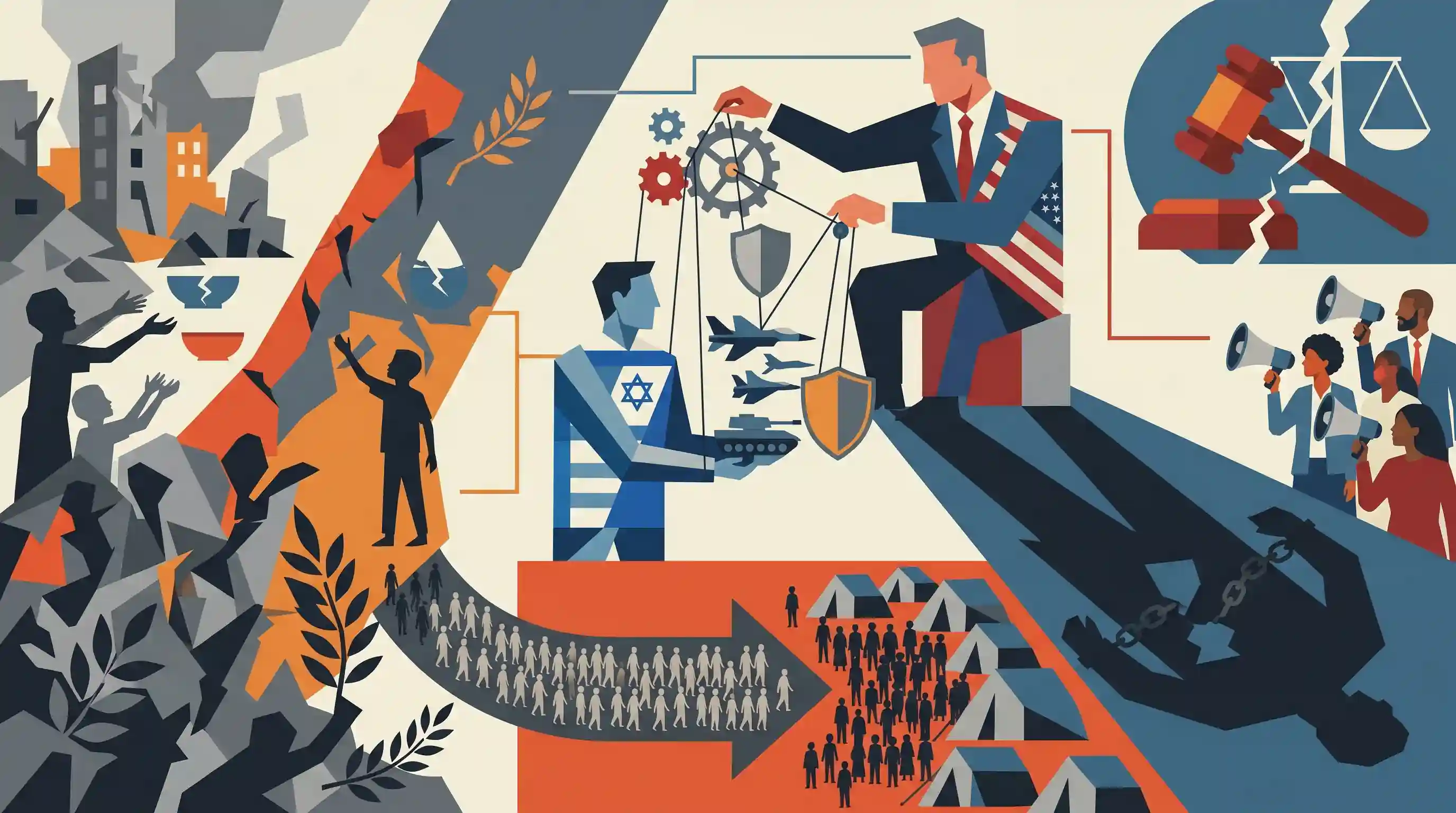
The editorial condemns the ongoing war in Gaza and calls on U.S. President Donald Trump to leverage his influence over Israeli Prime Minister Benjamin Netanyahu to enforce a ceasefire. Despite Netanyahu praising Trump during a White House visit, Israel remains uncommitted to halting the conflict and plans to forcibly relocate 2.3 million Palestinians to Rafah. The article highlights widespread starvation and over 70,000 civilian deaths in Gaza. Emphasizing Israel's heavy dependence on American military and diplomatic backing—especially as Netanyahu faces an ICC arrest warrant—the editorial warns that the U.S. will be historically condemned as complicit in war crimes if it fails to stop the slaughter.
Key Points
- Israeli Prime Minister Netanyahu praised U.S. President Trump but refrained from committing to a ceasefire in Gaza.
- The Israeli Defence Forces are planning the forced relocation of 2.3 million Palestinians from Gaza to the ruins of Rafah.
- Over 70,000 people have reportedly been killed in the 20-month conflict, amid severe starvation and civilian suffering.
- The editorial emphasizes that Trump has proven leverage over Israel (e.g., averting a major strike on Iran) and urges the U.S. to use it.
- Netanyahu heavily relies on U.S. military and diplomatic support, particularly as he faces an impending International Criminal Court (ICC) arrest warrant for war crimes.
- The U.S. faces historical condemnation for complicity if it continues unconditional support without forcing a resolution to the conflict.
Important Terms
International Criminal Court (ICC)

Permanent international tribunal in The Hague that prosecutes individuals for genocide, war crimes, and crimes against humanity. It operates as a court of last resort when national systems fail.
UPSC context
GS-II: International Institutions. Important for understanding global justice, jurisdiction, and India's status as a non-signatory to the Rome Statute.
Hamas
Palestinian Sunni-Islamic militant and political organization that has governed the Gaza Strip since 2007. It is designated a terrorist organization by the U.S., EU, and Israel.
UPSC context
GS-II: International Relations. Relevant for analyzing Middle East geopolitics, non-state actors, and the impact of their policies on global stability.
Israeli Defence Forces (IDF)
The national military of Israel, established in 1948. It is responsible for the country's security and is currently conducting major operations against Hamas in Gaza.
UPSC context
GS-II: International Relations. Essential for understanding regional security dynamics, military cooperation, and the conduct of armed conflict in the Middle East.
Rafah
A strategic city in southern Gaza bordering Egypt, housing the critical Rafah Crossing. It is currently a focal point for millions of displaced Palestinians and humanitarian aid.
UPSC context
GS-I/Current Affairs: World Geography. Significant as a 'place in news' and for its role in humanitarian corridors during the Gaza conflict.
International Humanitarian Law (IHL)
Also known as the 'law of war,' this set of rules seeks to limit the effects of armed conflict, protect non-combatants, and restrict methods of warfare.
UPSC context
GS-II/GS-IV: International Law/Ethics. Crucial for assessing the legality and morality of military actions and the protection of civilian populations.
Rome Statute
The 1998 international treaty that established the ICC. It defines the core crimes of genocide, war crimes, and crimes against humanity, and provides the court's legal framework.
UPSC context
GS-II: International Institutions. Tests knowledge of the legal foundation of international criminal justice and why major powers (India, US, Russia) haven't ratified it.
Two-State Solution
A proposed diplomatic resolution envisioning two independent states—Israel and Palestine—living side by side in peace. It remains the mainstream international framework for conflict resolution.
UPSC context
GS-II: International Relations. A cornerstone of India's long-standing foreign policy in the Middle East and a key topic in global diplomacy.
War Crimes
Serious violations of international humanitarian law, such as the intentional killing of civilians, torture, or unlawful deportation, for which individuals can be held criminally responsible.
UPSC context
GS-IV: Ethics in International Relations. Tests the ability to apply ethical frameworks and legal standards to modern conflicts and state conduct.
Prelims Trap
The ICC has universal jurisdiction and its Rome Statute is legally binding on all UN member states, including Israel.
The ICC is not a UN organ. It derives authority from the Rome Statute, which Israel, the U.S., and India have not signed, limiting its enforcement.
Static Concepts Connected
How does the ICC differ from the ICJ in international law?
- Institutional Foundation: ICJ is the principal judicial organ of the UN; ICC is an independent body established by the 1998 Rome Statute.
- Subject Matter Jurisdiction: ICJ hears civil disputes between states; ICC prosecutes individuals for criminal offenses like war crimes, genocide, and crimes against humanity.
- Membership & Ratification: UN members are automatically parties to ICJ; ICC requires specific state ratification. The US, India, China, and Israel are non-members of the ICC.
What are the core tenets of the Just War Theory?
- Jus ad bellum: The right to go to war, which must include a just cause, proper authority, and be considered a last resort.
- Jus in bello: The right conduct in war, emphasizing proportionality and strict distinction between active combatants and non-combatant civilians.
- Jus post bellum: Justice after a war, focusing on fair treaties, post-conflict reconstruction, and holding war criminals accountable.
Cross-Topic Patterns
Gaza conflict's shadow on IMEC
Prolonged instability in West Asia and shifting US-Israel dynamics severely threaten the operationalization of the India-Middle East-Europe Economic Corridor (IMEC) and the broader normalization processes under the Abraham Accords.
Complicity and Ethical IR
GS4 often tests the dilemma of national interest vs human rights. US military support for Israel despite ICC warrants serves as a prime case study for the ethics of international funding and complicity.

Expect a 2026 Prelims question testing the subtle jurisdiction rules of the ICC (Rome Statute) vs the ICJ (UN Charter) on non-members.
Linked PYQs · 3
Linked PYQs · 3
- 2018MainsGS2
“India’s relations with Israel have, of late, acquired a depth and diversity, which cannot be rolled back.” Discuss.
- 2019MainsGS2
‘Too little cash, too much politics, leaves UNESCO fighting for life.’ Discuss the statement in the light of US' withdrawal and its accusation of the cultural body as being 'anti-Israel bias'.
- 2022MainsGS4
Russia and Ukraine war has been going on for the last seven months. Different countries have taken independent stands and actions keeping in view their own national interests. We are all aware that war has its own impact on the different aspects of society, including human tragedy. What are those ethical issues that are crucial to be considered while launching the war and its continuation so far? Illustrate with justification the ethical issues involved in the given state of affair.
